- Article
- Source: Campus Sanofi
- Dec 1, 2025
Early screening for autoimmune T1D: A paradigm shift in disease management

Key takeaway
Transforming autoimmune T1D care: Why a paradigm shift is crucial?
Type 1 diabetes (T1D) is an autoimmune condition that destroys pancreatic beta cells, leading to insulin deficiency and long-term insulin dependence. Despite treatment advances, T1D remains challenging, with significant financial, emotional, and medical burdens.3
Globally, millions suffer from autoimmune T1D3. While individuals with a first-degree relative have a 15-fold higher risk, about 85% of newly diagnosed children have no family history.4 Poor glycemic control in youth increases the risk of morbidity and early mortality.3,5
As a greater understanding of pathophysiology of T1D have evolved, research efforts have been devoted to delaying the onset of clinical disease.4

Stay ahead of the management of autoimmune T1D: How early detection can be a game changer?
Autoantibodies in the blood can be detected before the onset of clinical symptoms of the disease.6 Hence, identification of islet beta-cell autoantibodies in asymptomatic children can serve as a true diagnostic feature of autoimmune T1D, reflective of a medical condition. By implementing early staging, autoimmune T1D can be recognized initially as an immune disorder. This approach creates an opportunity for therapeutic intervention before the disease advances to a clinical diagnosis.7
Screening for islet beta-cell autoantibodies in high-risk individuals allows for
- Diagnosis of early stage autoimmune T1D
- Timely intervention through monitoring and treatment
- Prevention of complications such as DKA.8-9
Furthermore, early screening and detection can significantly expedite drug development, enhance academic research, boost public health initiatives aimed at reversing islet beta-cell autoimmunity and halting the progression to symptomatic autoimmune T1D.7
Click here to know more about importance of testing for autoantibodies as a method to identify individuals at risk of developing autoimmune T1D.
Benefits of early autoimmune T1D screening4, 9-10
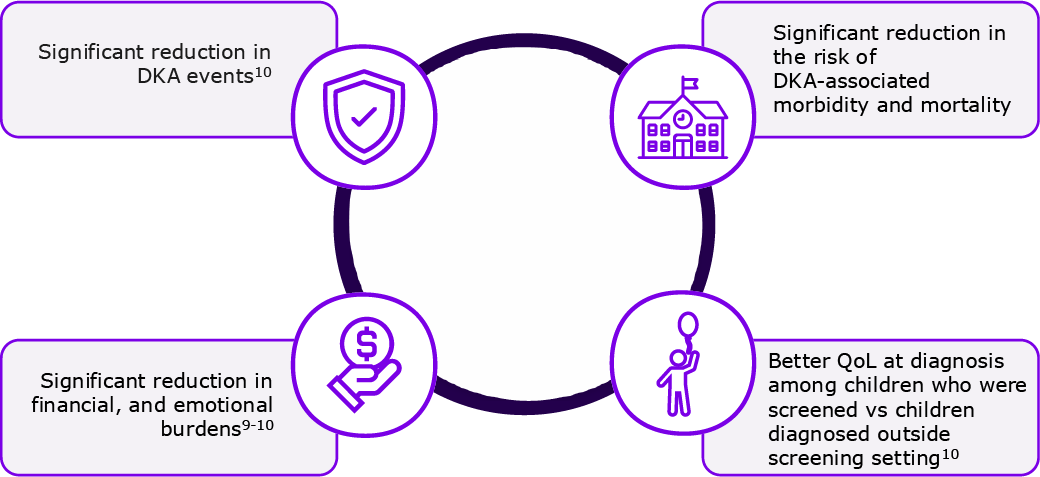

What is the supporting evidence on screening of autoimmune T1D?
Previous large-scale screening programs conducted in different countries have already shown the benefits of universal screening, including prevention of hospitalizations for DKA and improvements in long-term glycemic control in patient with autoimmune T1D.11-12
The Autoimmunity Screening for Kids (ASK) study, a large-scale pediatric screening initiative in Colorado (USA) for celiac disease (CeD) and autoimmune T1D, demonstrated that pre-symptomatic autoimmune T1D screening could be cost-effective in regions with a high prevalence of DKA.11
Fr1da study (Bavaria, Germany), has shown that at the time of clinical diagnosis of autoimmune T1D, children with a prior early-stage diagnosis (vs those without) had lower median HbA1c, lower median fasting glucose, and higher median fasting C-peptide. The incidence of ketonuria and DKA was also lower at clinical diagnosis in children with a prior early-stage diagnosis.13
These pilot studies have demonstrated the potential of conducting pediatric screening for autoimmune T1D in the general population. In Italy, these developments have translated into a nationwide health program with the objective of reaching the entire pediatric population.12
What do the guidelines recommend?
International guidelines on autoimmune T1D suggests diabetes-related autoantibody screening among individuals with a family history and offered to appropriate candidates within research setting.14 However, consideration for screening the risk of autoimmune T1D in the general population is now growing.4
Recommendations on screening of individuals with risk of autoimmune T1D by various societies1,4,15
| Society | Guidance |
| American Diabetes Association (ADA)15 |
|
| The International Society for Pediatric and Adolescent Diabetes (ISPAD)4 |
|
| International consensus developed by Breakthrough T1D (formerly JDRF) and endorsed by ADA and European Association for the Study of Diabetes (EASD)1 |
|
| *Screening for presymptomatic T1D may be done by detection of autoantibodies to insulin, glutamic acid decarboxylase (GAD), islet antigen 2 (IA-2), or zinc transporter 8 (ZnT8). †Younger age at diagnosis, unintentional weight loss, ketoacidosis, or short time to insulin treatment. | |
What are the tools and resources available for screening?
Globally, various screening programs for autoimmune T1D, designed to identify autoantibodies, are available. These programs vary in their approach.4,16
Screening programs/studies to detect early-stage autoimmune T1D9,17
| Screening Program | Population | Location |
| Screening of general population | ||
| DIPP | Age 0.25–15 years with high-risk HLA genotypes | Finland |
| BABY-SCREEN |
Newborns to 3 years with high-risk HLA for T1D and/or celiac disease | Finland |
| TEDDY | Age from birth to 15 years | USA, Germany, Sweden, Finland |
| GPPAD | Infants <1 month of age | Germany, UK, Poland, Belgium, and Sweden |
| PLEDGE | Age <6 years | North and South Dakota and Minnesota, USA |
| CASCADE | Age ≥1 year | Northwest USA |
| PRiMeD | Age 2-16 years | Virginia, USA |
| Fr1da | Age 1.75–10.99 years | Germany |
| Fr1dolin | Age 2–6 years | Germany |
| T1Detect (JDRF) | Age ≥1 year | Most USA states |
| ASK | Age 1–17 years | Colorado, USA |
| Screening of relatives for eligibility to participate in clinical studies | ||
| TrialNet Pathway to Prevention (TN01) |
Relatives aged 3–45 years | USA, Canada, Europe, Australia |
| INNODIA |
Relatives and general population | Europe |
| Bart’s Oxford (BOX) Family Study | Relatives | UK |
| Type1Screen |
Relatives aged 2–30 years | Australia and New Zealand |
| Screening programs (in development) | ||
| T1Early | Preschool Age: 3.5-4 years | UK |
| ADIR | Age 9–18 months and 5 years | Israel |
| JDRF General Population Screening Pilot |
Newborns, infants, and 2–6 years | Australia |
Click here to know more about tools and resources that can help in the management of autoimmune T1D.
For more information on the screening and detection of autoimmune T1D, visit the DETECT T1D website.
How can HCPs become an advocate for autoimmune T1D screening?
HCPs play a crucial role in advocating for autoimmune T1D screening.14 Here's how they can become effective advocates:
1. Education and awareness: HCPs can explain the risk and benefits of screening to patients and their family members.14
2. Identifying at risk individuals: HCPs can identify high-risk individuals in collaboration with specialists, and either provide a stage-specific intervention or offer clinical trial opportunities.14
3. Advocating for equity in care: It is important for HCPs to continue the advocacy for equal opportunities of screening and monitoring among patients with racial/ethnic or socioeconomic disparities.14
4. Patient communication: HCPs play a crucial role in diabetes education. They can provide accurate information, promote self-management strategies, and work to combat stigma and misinformation.2
5. Fostering collaboration between primary care and specialist HCPs: Primary care HCPs can play a crucial role in screening and monitoring population with early-stage diabetes. Partnership between primary and secondary HCP can help facilitate training and skill development to improve understanding of early stage autoimmune T1D.18
6. Guidelines development: HCP can also support in development of
evidence-based screening guidelines to drive paradigm shift in autoimmune T1D care, as early diagnosis has the potential to prevent serious morbidity and mortality.14,18
Autoimmune T1D screening programs are gaining recognition due to the benefits of screening to prevent DKA at late stage of autoimmune T1D diagnosis as well as the availability of therapy to delay the disease progression.18

References
- American Diabetes Association Showcases Innovations and Guidance for Early Risk Monitoring of Type 1 Diabetes. Press Release June 24, 2024. Orlando, FL. Available at: https://diabetes.org/newsroom/press-releases/american-diabetes-association-showcases-innovations-and-guidance-early-risk. Accessed: December 2025
- Evans J et al. The essential role of the diabetes educator. Available at: https://diabetesvoice.org/en/caring-for-diabetes/diabetes-educators-and-diabetes-education/. Accessed: December 2025
- Owusu BA, Ofori-Boateng P, Bankahet E, et al. A qualitative study of type 1 diabetes complications, mental health, and structural pathways of complications occurrence among young people (14–24 years) and caregivers in southern Ghana. SSM-Mental Health. 2024;6:100368. doi:10.1016/j.ssmmh.2024.100368
- Besser REJ, Bell KJ, Couper JJ, et al. ISPAD Clinical Practice Consensus Guidelines 2022: Stages of type 1 diabetes in children and adolescents. Pediatr Diabetes. 2022;23(8):1175−1187. doi: 10.1111/pedi.13410
- Duca LM, Wang B, Rewers M, et al. Diabetic Ketoacidosis at Diagnosis of Type 1 Diabetes Predicts Poor Long-term Glycemic Control. Diabetes Care. 2017;40(9):1249−1255. doi: 10.2337/dc17-0558
- Al-Mulla, Nizam R, Alqabandi R, Alkandari H, Abubaker J. Early autoantibody screening for type 1 diabetes: a Kuwaiti perspective on the advantages of multiplexing chemiluminescent assays. Front Immunol. 2023;14:1273476. doi: 10.3389/fimmu.2023.1273476
- Bonifacio E, Mathieu C, Nepom GT, et al. Rebranding asymptomatic type 1 diabetes: the case for autoimmune beta cell disorder as a pathological and diagnostic entity. Diabetologia. 2017;60(1):35−38. doi: 10.1007/s00125-016-4144-8
- Cherubini V, Grimsmann JM, Åkesson K, et al. Temporal trends in diabetic ketoacidosis at diagnosis of paediatric type 1 diabetes between 2006 and 2016: results from 13 countries in three continents. Diabetologia. 2020;63(8):1530−1541. doi: 10.1007/s00125-020-05152-1
- Sims EK, Besser REJ, Dayan C, et al. NIDDK Type 1 Diabetes TrialNet Study Group. Screening for Type 1 Diabetes in the General Population: A Status Report and Perspective. Diabetes. 2022;71(4):610−623. doi: 10.2337/dbi20-0054
- Quinn LM, Rashid R, Narendran P, et al. Screening children for presymptomatic type 1 diabetes. British Journal of General Practice 2023;73(726):36−39. doi: 10.3399/bjgp23X731709
- McQueen RB, Rasmussen CG, Waugh K, et al. Cost and Cost-effectiveness of Large-scale Screening for Type 1 Diabetes in Colorado. Diabetes Care. 2020; 43(7):1496–1503. doi:10.2337/dc19-2003
- Catassi C, Vincentini O, Pricci F, et al. Pediatric screening for type 1 diabetes and celiac disease: the future is today in Italy. Minerva Pediatr (Torino). 2024;76(4):461−463. doi: 10.23736/S2724-5276.24.07573-6
- Hummel S, Carl J, Friedl N, et al. Fr1da Study Group. Children diagnosed with presymptomatic type 1 diabetes through public health screening have milder diabetes at clinical manifestation. Diabetologia. 2023;66(9):1633−1642. doi: 10.1007/s00125-023-05953-0
- Moore DJ, Leibel NI, Polonsky W, et al. Recommendations for Screening and Monitoring the Stages of Type 1 Diabetes in the Immune Therapy Era. Int J Gen Med. 2024;17:3003−3014. doi: 10.2147/IJGM.S438009
- American Diabetes Association Professional Practice Committee. 2. Diagnosis and Classification of Diabetes: Standards of Care in Diabetes-2024. Diabetes Care. 2024 Jan 1;47(Suppl 1):S20-S42. doi: 10.2337/dc24-S002
- STOP T1D. Module 4. Available at: https://www.stopt1dprogram.org/hcp-directory/module-4. Accessed: December 2025
- Finding diabetes early can prevent serious illness and complications (no date) The Environmental Determinants of Diabetes in the Young (TEDDY). Available at: https://teddy.epi.usf.edu/. Accessed: December 2025
- Phillip M, Achenbach P, Addala A, et al. Consensus guidance for monitoring individuals with islet autoantibody-positive pre-stage 3 type 1 diabetes. Diabetes Care. 2024;47(8):1276−1298. doi: 10.2337/dci24-0042
- Hilliard ME, Oser SM, Close KL, et al. From Individuals to International Policy: Achievements and Ongoing Needs in Diabetes Advocacy. Curr Diab Rep. 2015;15(9):59. doi:10.1007/s11892-015-0636-z. doi:10.1016/j.ssmmh.2024.100368
MAT-GLB-2503430-2.0 - 12/2025