- Article
- Source: Campus Sanofi
- Jun 22, 2026
Rising incidence of autoimmune T1D: Need for screening

Key Takeaways
Understanding autoimmune T1D: Global prevalence and health burden
Globally, the prevalence of autoimmune T1D continues to rise.4
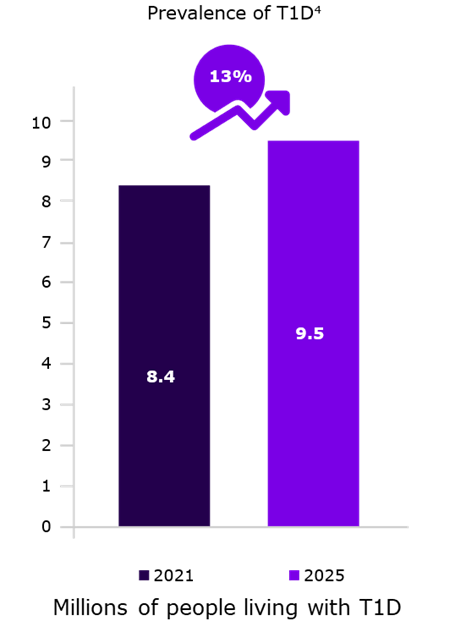
In 2025, an estimated 9.5 million people are living with autoimmune T1D, which is 13% more from 8.4 million in 2021. This number is expected to increase to 14.7 million by 2040, highlighting the growing global burden.4
Why is autoimmune T1D incidence rising globally?
The global burden of autoimmune T1D is rising due to the combined impact of increasing incidence, population growth, ageing, and falling mortality.4
- While T1D genetic susceptibility is polygenic, human leukocyte antigen Class II-associated polymorphisms account for approximately 50% of the inherited risk, yet most individuals with autoimmune T1D have no family history of the condition.1
- The increasing incidence of autoimmune T1D cases in genetically stable populations support a growing role of environmental factors in triggering β-cell-directed autoimmunity or accelerating the progression of autoimmune T1D; however, despite extensive investigation into viral infections, intestinal microbiota changes, and nutritional factors, the triggering agent and/or events remain unknown.1
Autoimmune T1D: Insights into pathophysiology and clinical features
Autoimmune T1D is a complex, chronic autoimmune condition driven by both genetic differences and environmental triggers.3 Progression of the condition involves both humoral and cell-mediated autoimmunity and is associated with loss of functional β‑cell mass.1 Clinically, autoimmune T1D typically presents with classic symptoms of polyuria, polydipsia, and polyphagia, often accompanied by ketosis and, particularly in pediatric cases, DKA:1

At initial diagnosis, 25%–50% of children manifest with DKA, compared to 6%–21% of adults. Autoimmune T1D can manifest at any age.1 In adults, approximately 38% of T1D cases are initially misdiagnosed as type 2 diabetes and treated with non-insulin antidiabetic therapies, highlighting the importance of accurate diagnosis.5
Autoimmune T1D staging and progression
The progression of T1D occurs silently through two defined stages before symptomatic onset:6
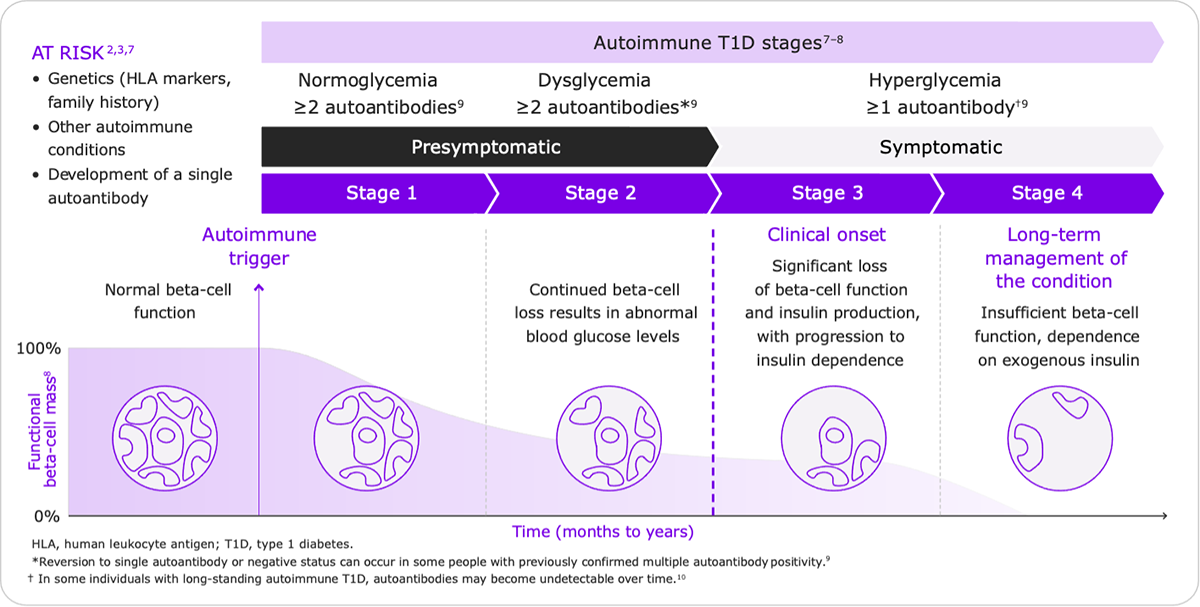
For children with presymptomatic T1D, 44% in stage 1 and 70% in stage 2 will progress to symptomatic T1D (stage 3) within 10 years.11 Early identification of presymptomatic T1D enables monitoring and reduces DKA risk at stage 3 diagnosis.2
Clinical benefits of early detection of autoimmune T1D through screening12-14
Presymptomatic autoimmune T1D screening enables timely monitoring and intervention before clinically significant β-cell loss, reducing the risk of DKA.2 When combined with education and metabolic monitoring, early identification of presymptomatic autoimmune T1D in children has been associated with improved clinical presentation at stage 3 onset, with lower prevalence of DKA and reduced rates of hospitalization and intensive care unit admissions.12 Primary care providers, such as pediatricians, family practitioners, and internal medicine physicians, play a central role in screening the general population for autoimmune T1D, as most individuals at risk for developing autoimmune T1D are unlikely to be under the care of an endocrinologist. It is therefore essential that primary care teams are engaged in screening efforts, with a focus on increasing awareness of early-stage T1D and available autoantibody screening options.2
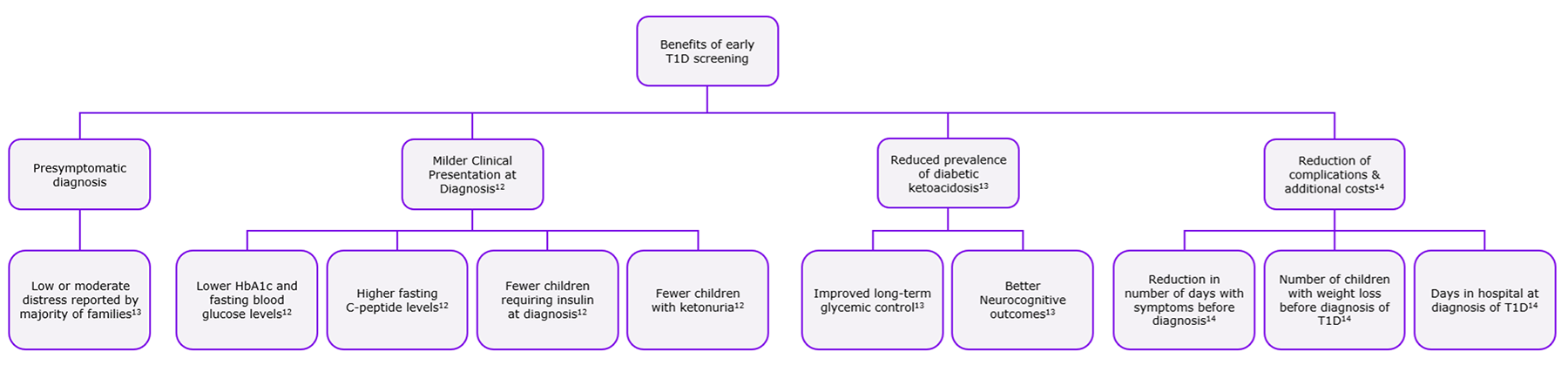
Early detection of autoimmune T1D through screening: A proactive approach to reducing medical emergencies
Early detection of autoimmune T1D through screening significantly reduces medical emergency incidence at diagnosis. The ASK study demonstrated DKA rates could be lowered to approximately 5% in screened children compared to 60% in Colorado. Early detection affords families time for education and counselling before symptom onset, enhancing clinical presentation.2
Early detection of autoimmune T1D through screening involves a blood test for T1D autoantibodies against glutamic acid decarboxylase (GAD), insulin (IAA), islet antigen-2 (IA-2), and zinc transporter 8 (ZnT8). These autoantibodies serve as markers of the evolving autoimmune process.1,2
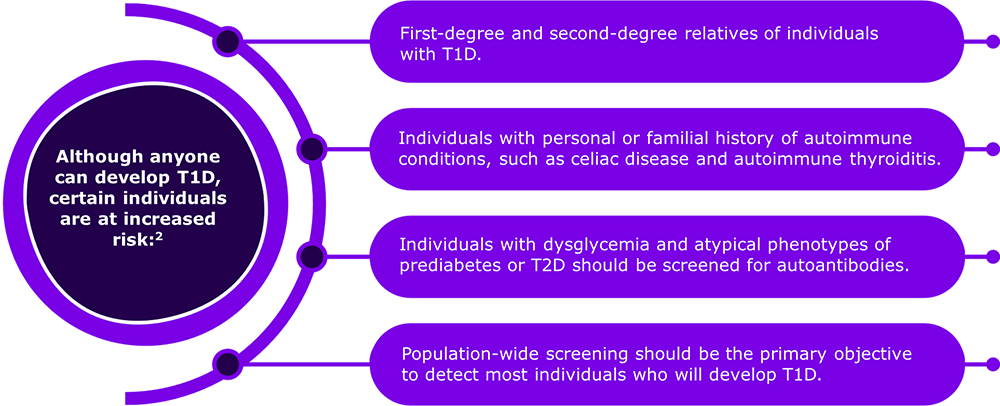
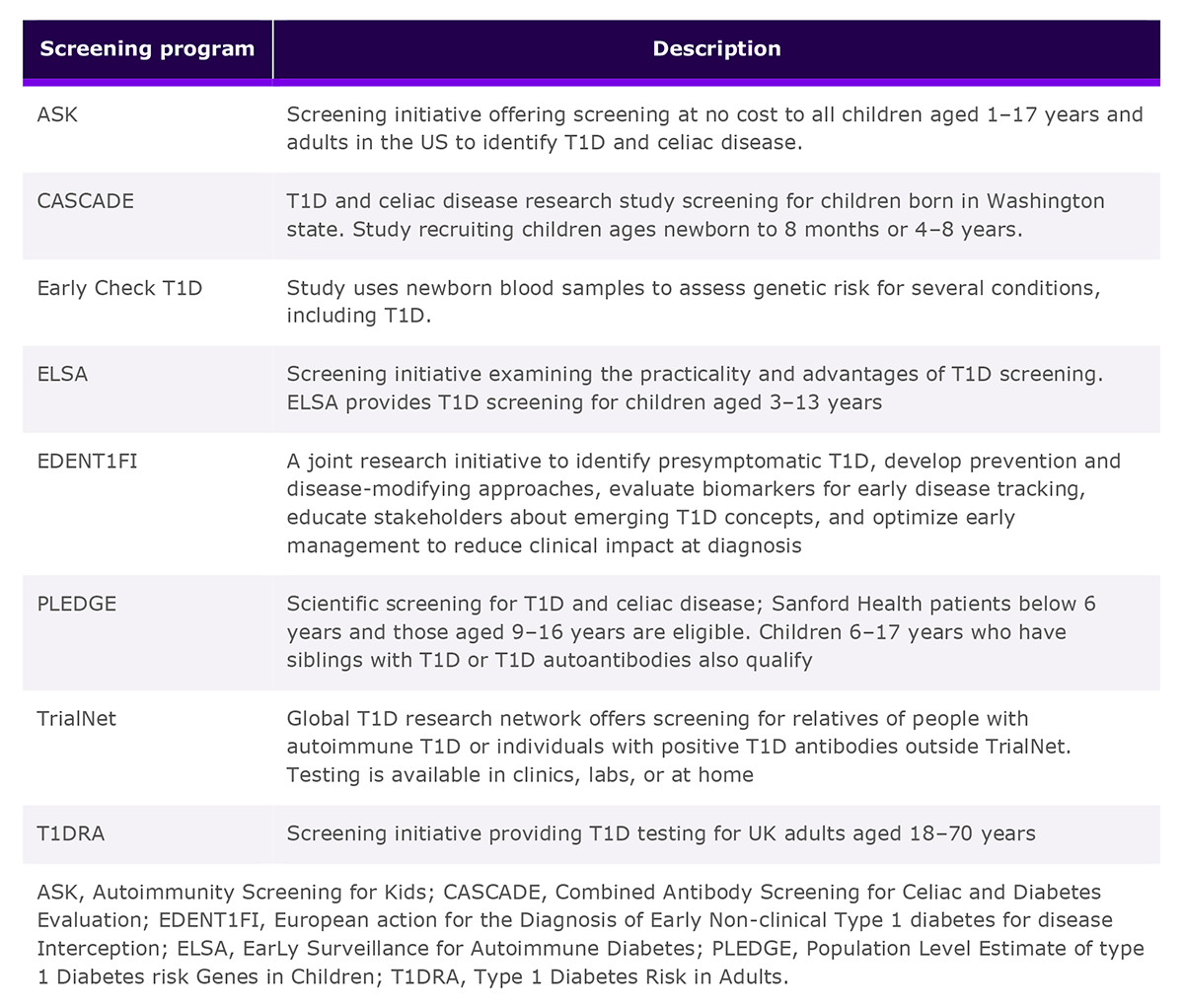
Existing population-wide screening programs for early detection of T1D are2
Conclusion
T1D progresses silently through stages 1 and 2 before becoming symptomatic at stage 3. Screening for T1D-associated autoantibodies significantly lowers the risk of DKA at diagnosis. Findings from the ASK study demonstrated that DKA rates dropped to about 5% in screened children, compared to 60% in unscreened populations in Colorado. Screening typically includes testing for specific autoantibodies against GAD, IAA, IA-2, and ZnT8. Early detection combined with metabolic monitoring can improve clinical outcomes and reduce risk of DKA at stage 3 onset. General population screening should be the ultimate goal to identify the majority of those that can/may develop T1D.
References
- Aamodt KI, Powers AC. The pathophysiology, presentation and classification of Type 1 diabetes. Diabetes Obes Metab. 2025;27 Suppl 6(Suppl 6):15–27. doi: 10.1111/dom.16628. Epub 2025 Jul 30. PMID: 40734585.
- Leichter SB, Felton JL, Geno Rasmussen C, Rizzuto P, Bellini N, Ebekozien O, et al. Establishing screening programs for presymptomatic type 1 diabetes: Practical guidance for diabetes care providers. J Clin Endocrinol Metab. 2025;110(8):2371–2382. doi: 10.1210/clinem/dgaf194. PMID: 40171881.
- Moore DJ, Leibel NI, Polonsky W, Rodriguez H. Recommendations for screening and monitoring the stages of type 1 diabetes in the immune therapy Era. Int J Gen Med. 2024;17:3003–3014. doi: 10.2147/IJGM.S438009. PMID: 39011423.
- Ogle GD, Wang F, Haynes A, Gregory GA, King TW, Deng K, et al. Global type 1 diabetes prevalence, incidence, and mortality estimates 2025: Results from the International diabetes Federation Atlas, 11th Edition, and the T1D Index Version 3.0. Diabetes Res Clin Pract. 2025;225:112277. doi: 10.1016/j.diabres.2025.112277.
- Evans-Molina C, Oram RA. Type 1 diabetes presenting in adults: Trends, diagnostic challenges and unique features. Diabetes Obes Metab. 2025;27 Suppl 6(Suppl 6):57–68. doi: 10.1111/dom.16402. Epub 2025 Apr 15. PMID: 40230204.
- Mauvais FX, van Endert PM. Type 1 diabetes: A guide to autoimmune mechanisms for clinicians. Diabetes Obes Metab. 2025;27 Suppl 6(Suppl 6):40–56. doi: 10.1111/dom.16460. Epub 2025 May 15. PMID: 40375390.
- Haller MJ, Bell KJ, Besser REJ, Casteels K, Couper JJ, Craig ME, et al. ISPAD Clinical Practice Consensus Guidelines 2024: Screening, staging, and strategies to preserve beta-cell function in children and adolescents with type 1 diabetes. Horm Res Paediatr. 2024;97(6):529–545. doi: 10.1159/000543035. Epub 2024 Dec 11. PMID: 39662065.
- Stages of type 1 diabetes & why they’re important | JDRF Australia. Available at: https://breakthrought1d.org.au/what-is-t1d/stages/. Last accessed on June 23, 2026.
- Phillip M, Achenbach P, Addala A, Albanese-O'Neill A, Battelino T, Bell KJ, et al. Consensus guidance for monitoring individuals with islet autoantibody-positive pre-stage 3 type 1 diabetes. Diabetes Care. 2024;47(8):1276–1298. doi: 10.2337/dci24-0042. PMID: 38912694.
- Anteby R, Lucander A, Bachul PJ, Pyda J, Grybowski D, Basto L, et al. Evaluating the prognostic value of islet autoantibody monitoring in islet transplant recipients with long-standing type 1 diabetes mellitus. J Clin Med. 2021;10(12):2708. doi: 10.3390/jcm10122708. PMID: 34205321.
- Bell KJ, Lain SJ. The changing epidemiology of type 1 diabetes: A global perspective. Diabetes Obes Metab. 2025 Aug;27 Suppl 6(Suppl 6):3–14. doi: 10.1111/dom.16501. Epub 2025. PMID: 40536127.
- Hummel S, Carl J, Friedl N, Winkler C, Kick K, Stock J, et al. Fr1da Study Group. Children diagnosed with presymptomatic type 1 diabetes through public health screening have milder diabetes at clinical manifestation. Diabetologia. 2023;66(9):1633–1642. doi: 10.1007/s00125-023-05953-0. Epub 2023 Jun 17. PMID: 37329450.
- Ziegler AG, Kick K, Bonifacio E, Haupt F, Hippich M, Dunstheimer D, et al; Yield of a public health screening of children for islet autoantibodies in Bavaria, Germany. JAMA. 2020;323(4):339–351. doi: 10.1001/jama.2019.21565. PMID: 31990315.
- Bonifacio E, et al. Effect of population-wide screening for presymptomatic early-stage type 1 diabetes on paediatric clinical care. Lancet Diabetes Endocrinol. 2024;12(6):376–378. doi: 10.1016/S2213-8587(24)00101-3.
MAT-GLB-2507094-1.0-07/2026