- Article
- Source: Campus Sanofi
- Jun 22, 2026
Autoimmune Diseases and Type 1 Diabetes: Understanding the Connection

Key Takeaways
Beyond family history: Identifying increased likelihood of autoimmune T1D in other autoimmune conditions
T1D is an autoimmune‑mediated destruction of pancreatic beta-cells leading to lifelong insulin dependence. It frequently coexists with other autoimmune diseases, reflecting shared genetic and environmental pathways that predispose to multi‑organ autoimmunity.1
Recognizing this autoimmune clustering is crucial: when celiac disease or autoimmune thyroid disease is present, the probability of future T1D rises meaningfully, even in the absence of family history.1
A recent multi-country observational analysis confirmed that individuals with celiac disease or autoimmune thyroid disease experienced a higher incidence of new-onset T1D compared with those without these conditions. These findings support expanding screening beyond the traditional first-degree relative approach.1
Large pediatric programs also showed that population-or risk-based screening uncovered presymptomatic autoimmune T1D that would otherwise have been presented late, often as DKA.2,5,6
Understanding the Connection: Shared Genetic Components and Immune System Factors
Autoimmune conditions frequently share overlapping human leukocyte antigen (HLA) risk alleles, antigen‑presentation abnormalities, and immune dysregulation, which together increase the likelihood of multiple autoimmune diagnoses in the same individual. Specific HLA class II genotypes, including DQ2 and DQ8, are linked to celiac disease, autoimmune thyroid disorders, and T1D.1

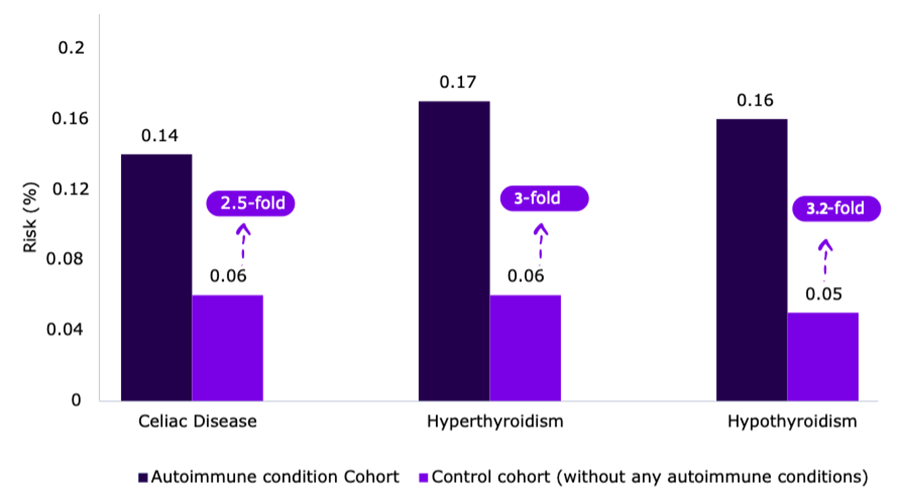
Increased likelihood of developing autoimmune T1D in individuals with other autoimmune conditions
- Individuals with celiac disease, hyperthyroidism, or hypothyroidism had a 3-fold higher risk of developing autoimmune T1D compared to the general population1
- Time to T1D onset was shorter in those with existing autoimmune diseases1
- Screening these individuals for autoimmune T1D-related autoantibodies could:
- Enable early detection of stage 1 T1D
- Reduce risk of acute onset complications2
Likelihood of Developing autoimmune T1D with other autoimmune conditions1
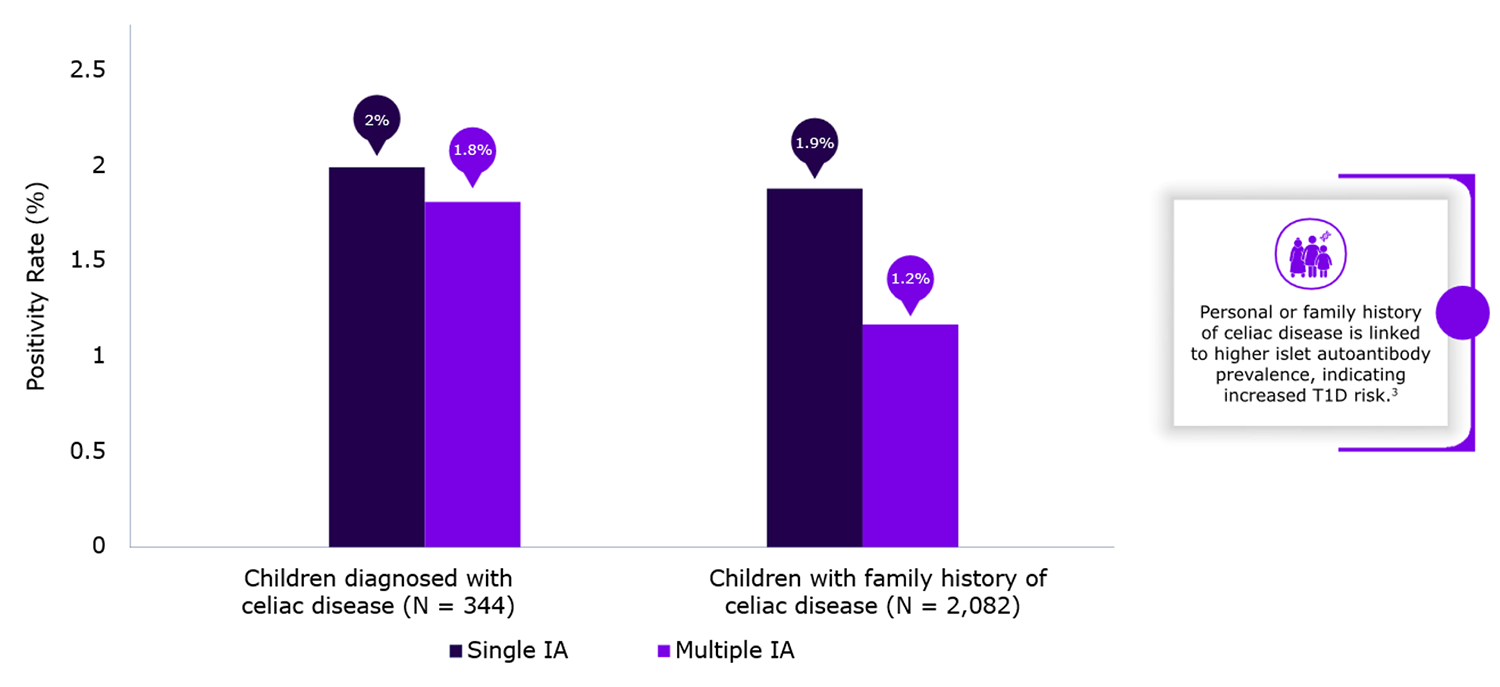
The Autoimmunity Screening for Kids (ASK) study further strengthened the importance of screening, demonstrating high prevalence of islet autoantibodies (IA) among children with personal or family history of celiac disease.3
Prevalence of IA in children with celiac disease3
A risk-stratified approach to screening can help prioritize individuals at the highest risk while building infrastructure for broader population screening programs.2
Risk Stratification Approach for AAb Screening Programs2

*For individuals without typical features of T2D.
Genetic Risk, Screening, and Disease Progression in people with autoimmune T1D
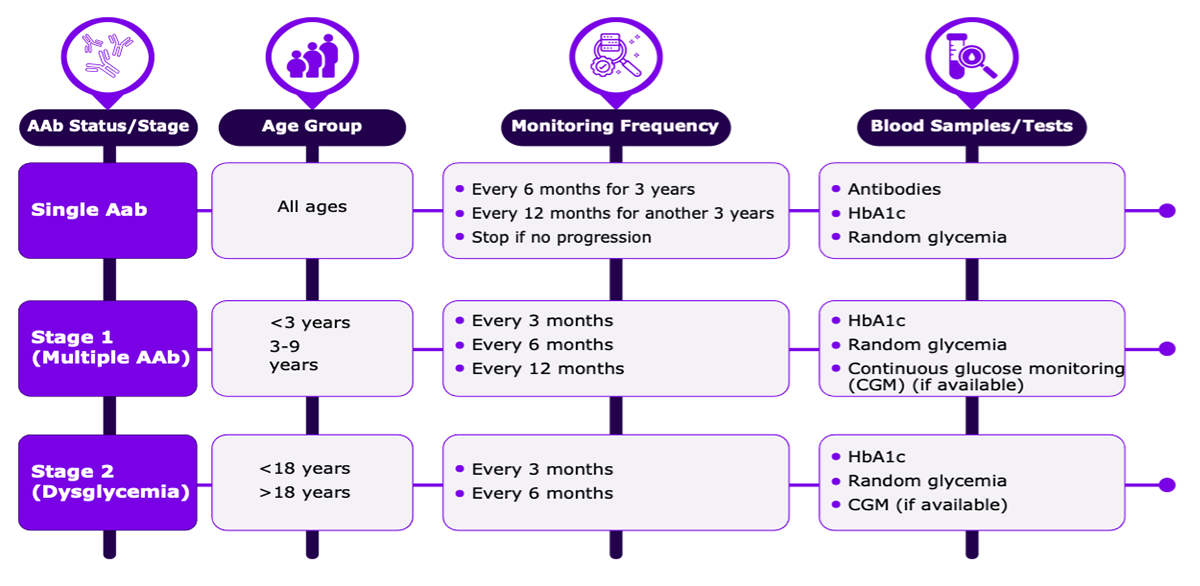
People with a first-degree relative with autoimmuneT1D had up to a 15-fold increased risk of developing T1D, while those with multiple IA have early-stage T1D with 90% progressing to Stage 3 within 15 years (compared to only 15% with a single autoantibody).4
Screening for IA twice during childhood (first between ages 2 and 6 years and again between ages 10 and 14 years) provides the most cost-effective approach for identifying those likely to develop autoimmune T1D.4 This strategy complements risk-stratified screening and enable appropriate monitoring based on autoantibody status.
ISPAD 2024 screening and monitoring recommendations by autoantibody status4
Screening programs and autoantibody testing for early T1D screening to identify risk
Diabetes-related autoantibody testing is available through HCP orders at commercial labs and as part of regional/national research programs (e.g., TrialNet, ASK, Combined Antibody Screening for Celiac and Diabetes Evaluation [CASCADE], Population Level Estimate of T1D Risk Genes in Children [PLEDGE]).5
- Assays used include radio binding assay (RBA), enzyme-linked immunosorbent assay (ELISA), electrochemiluminescence (ECL), and ADAP, antibody detection by agglutination-PCR (ADAP)
- These methods and others in development are evolving, with future improvements expected to enhance identification and prediction of autoimmune T1D progression5
Screening algorithm for autoimmune disease and diabetes-related autoantibodies5
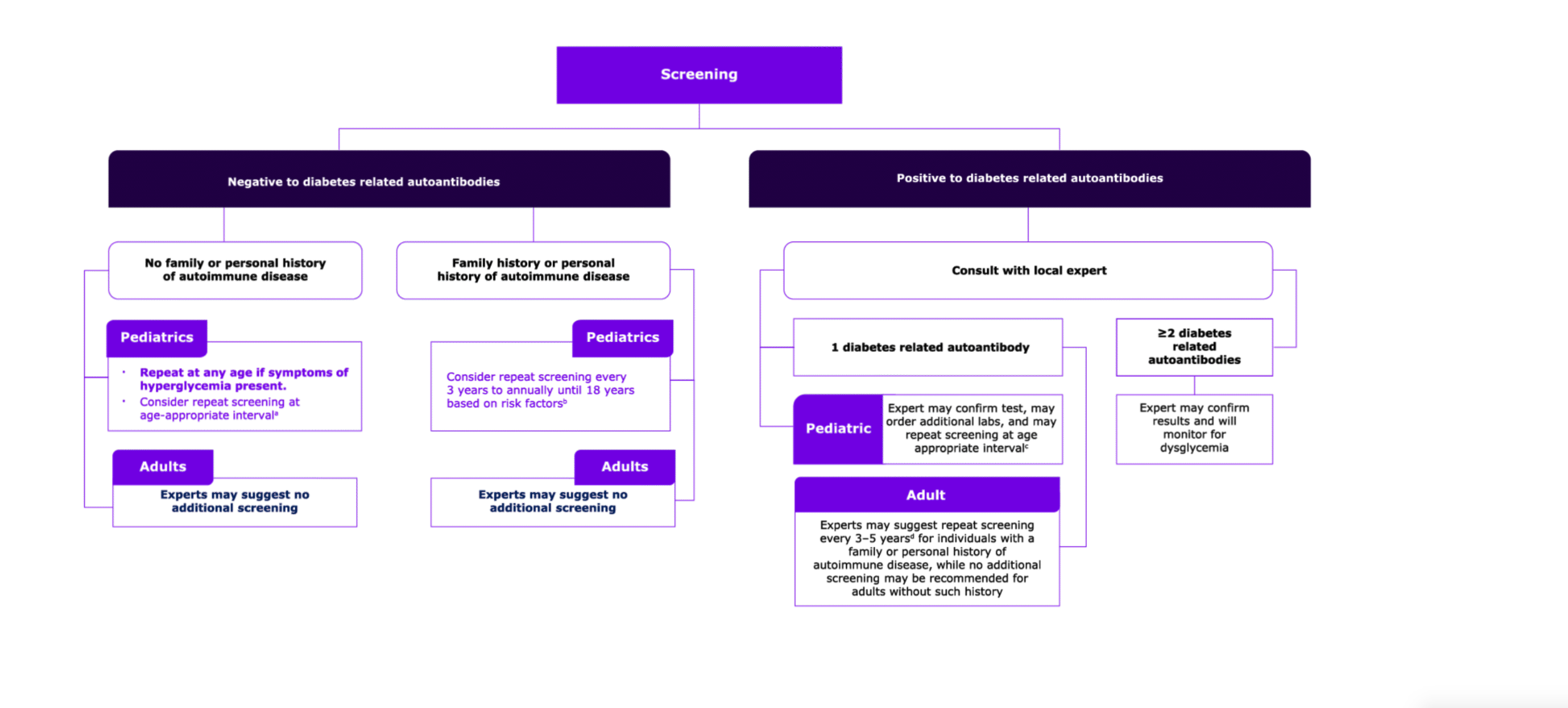
aPaediatric patients initially screened between the ages of 2 to 6 years may benefit from additional screening at 10 years of age.
bRisk factors include the age of the patient at the time of initial screening, family history, and the presence of autoimmunity. Identical twins are at higher risk of development of T1D than fraternal twins and may require more frequent monitoring.
cExperts may recommend repeat screening in 6 months to 2 years, depending on the age of the patient at the time of initial screening, family history, and presence of autoimmunity. A twin (fraternal or identical) with one positive antibody should be screened annually due to increased risk with the presence of diabetes autoantibodies.
dAt this time, rescreening is not recommended for adults with 1 positive autoantibody and no family history of disease; however, there are limited data, and guidance is currently lacking. Experts recommend that adults with one positive autoantibody and a positive family history of autoimmunity repeat screening every 3 to 5 years.
To complement autoantibody testing, several large-scale screening programs (The Environmental Determinants of Diabetes in the Young [TEDDY], TrialNet, T1Detect, ASK, and Fr1da) have been established globally to identify children at risk for T1D early in life.6
ADA screening guidelines for T1D and autoimmune diseases
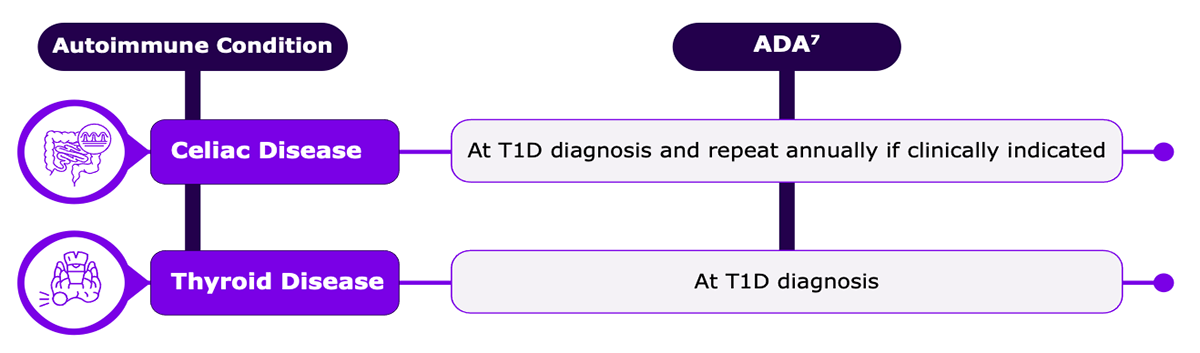
In addition to monitoring islet autoantibodies and disease progression, individuals with autoimmune T1D require systematic screening for associated autoimmune conditions due to their increased prevalence in this population. American Diabetes Association (ADA) guidelines provide specific recommendations for screening intervals to ensure early detection and appropriate management.7
Recommended screening intervals for associated immune conditions in patients with T1D7
Conclusion
Autoimmune T1D frequently coexists with conditions such as celiac disease and autoimmune thyroid disorders due to shared genetic and immune pathways, increasing risk, and accelerating the onset of T1D.1
Evidence from an observational study shows that individuals with these conditions have a higher incidence of T1D and a shorter time to onset of T1D compared to those without autoimmune comorbidities.1
Screening for islet autoantibodies enables early identification of presymptomatic stages, reducing the risk of acute complications and supporting timely intervention.4
Current evidence and guidelines recommend risk-based and population-level screening, including islet autoantibody testing, along with systematic monitoring to enable early detection, prevent complications, and improve disease management.4
References
- Edelman SV, Agardh D, Cui N, Hao L, Wieloch M, Meneghini L. Risk of new-onset type 1 diabetes in individuals with celiac disease and thyroid disease-An observational study. Diabetes Obes Metab. 2025;27(8):4229-4238. doi:10.1111/dom.16454
- Leichter SB, Felton JL, Geno Rasmussen C, et al. Establishing Screening Programs for Presymptomatic Type 1 Diabetes: Practical Guidance for Diabetes Care Providers. J Clin Endocrinol Metab. 2025;110(8):2371-2382. doi:10.1210/clinem/dgaf194
- Stahl M, Simmons KM, Dong F, et al; ASK Study Group. 2102-LB: The Autoimmunity Screening for Kids (ASK) Study Experience—Islet Autoimmunity Screening for Celiac Disease. Diabetes. 2025;74(Suppl 1):2102-LB. doi:10.2337/db25-2102-LB
- Haller MJ, Bell KJ, Besser REJ, et al. ISPAD Clinical Practice Consensus Guidelines 2024: Screening, Staging, and Strategies to Preserve Beta-Cell Function in Children and Adolescents with Type 1 Diabetes. Horm Res Paediatr. 2024;97(6):529-545. doi:10.1159/000543035
- Moore DJ, Leibel NI, Polonsky W, Rodriguez H. Recommendations for Screening and Monitoring the Stages of Type 1 Diabetes in the Immune Therapy Era. Int J Gen Med. 2024;17:3003-3014. doi: 10.2147/IJGM.S438009
- Gomez P, Sanchez J. Type 1 Diabetes Screening and Diagnosis. Endocrinol Metab Clin North Am. 2024;53(1):17-26. doi:10.1016/j.ecl.2023.09.008
- American Diabetes Association Professional Practice Committee for Diabetes. 4. Comprehensive Medical Evaluation and Assessment of Comorbidities: Standards of Care in Diabetes-2026. Diabetes Care January 2026;49(Suppl 1): S61–S88. https://doi.org/10.2337/dc26-S004
MAT-GLB-2507096-2.0-07/2026