
Dosing and administration instructions

Administration
TZIELD is administered by intravenous infusion over a minimum of 30 minutes, using body surface area-based (BSA) dosing1

Dosage form and strength
2 mg/2 mL (1 mg/mL), clear and colourless solution in a single-dose vial1

No same-day dosing
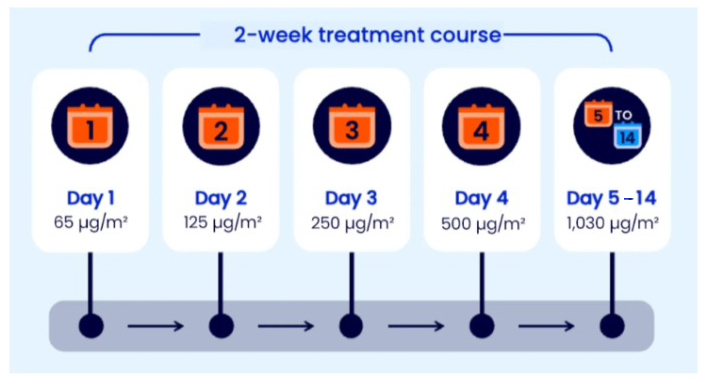
Do NOT administer two doses on the same day1

If an infusion is missed
Resume by administering all remaining doses on consecutive days to complete the 14-day course1
Recommended dosing schedule for TZIELD
The recommended TZIELD dosage for adults and paediatric patients aged 8 years and older uses BSA-based dosing and is administered according to the following regimen:*1
Calculating your patients' BSA using the Mosteller formula2
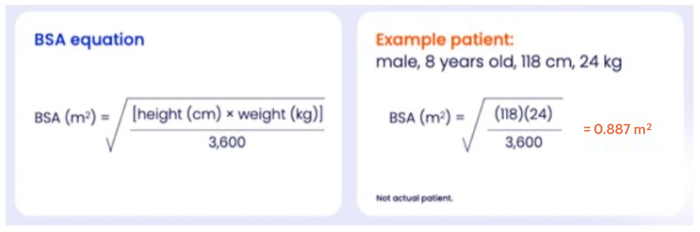
- When calculating BSA, round to the 100th using standard rounding rules (example: 0.89 m2)
- Based on BSA dosing requirements, two vials may be needed for some individuals (BSA >1.94 m2) for days 5–141
Use this interactive tool below to calculate individual dosing and support safe and confident infusion delivery in your clinical practice
TZIELD is a concentrate solution for infusion. Each vial contains 2 mg of teplizumab in 2 mL of concentrate. The product must be diluted prior to use.1
TZIELD should be administered by a healthcare professional with access to appropriate medical support to manage potential severe adverse reactions.
Patient selection1
Select adult and paediatric patients 8 years of age and older for TZIELD treatment who have a diagnosis of Stage 2 Type 1 diabetes (T1D)
- Confirm Stage 2 T1D by documenting:
- At least two positive pancreatic islet cell autoantibodies (AAbs)
- Dysglycaemia without overt hyperglycaemia
- Ensure the clinical history of the patient does not suggest Type 2 diabetes (T2D)
Premedication1
- Premedicate prior to TZIELD infusion for the first five days of dosing with a non-steroidal anti-inflammatory drug (NSAID) or paracetamol, an antihistamine, and/or an antiemetic
- Administer additional doses of premedication if needed
Laboratory and infection evaluation and vaccinations prior to treatment1
Prior to initiation of TZIELD, there are a number of laboratory and infection evaluations required to ensure that TZIELD is suitable for patients. All age-appropriate vaccinations must also be administered before treatment
Prior to initiating TZIELD, obtain a complete blood count and liver enzyme tests.
Patients should be evaluated for active Epstein-Barr Virus (EBV) and cytomegalovirus (CMV) infection to confirm undetectable viral load (e.g., polymerase chain reaction [PCR] testing).
Use of TZIELD is not recommended in patients with:
- Lymphocyte count <109 lymphocytes/L
- Haemoglobin <100 g/L
- Platelet count <150 x 109 platelets/L
- Absolute neutrophil count <1.0 x 10⁹ neutrophils/L in those of African descent and <1.5 x 10⁹ neutrophils/L in all other groups
- Elevated alanine aminotransferase (ALT) or aspartate aminotransferase (AST) >2 x upper limit of normal (ULN) or bilirubin greater than 1.5 times ULN
- Laboratory or clinical evidence of acute infection with EBV or CMV
- Active serious infection or chronic active infection other than localised skin infections
Administer all age-appropriate vaccinations prior to starting TZIELD:
- Administer live-attenuated (live) vaccines at least 8 weeks prior to treatment
- Administer inactivated (killed) vaccines or messenger ribonucleic acid (mRNA) vaccines at least 2 weeks prior to treatment
Post-treatment care and monitoring

Laboratory evaluations
1–4 weeks post treatment or until abnormalities are resolved3

Blood glucose monitoring
Glucose monitoring is critical to support timely initiation of insulin and to help prevent DKA3,4

Continue to set expectations
Reinforce to your patients that TZIELD delays progression but is not a definitive cure1

Educate on the signs and symptoms of Stage 3 T1D and DKA
Encourage your patients to report signs and symptoms promptly3

Keep vaccinations up-to-date
- Wait at least 6 weeks after treatment before administering inactivated vaccinations1
- Wait at least 52 weeks after treatment before administering live-attenuated vaccinations1

Monitor for infection & viral reactivation
Monitor patients for signs and symptoms of infection, including viral reactivation, for at least 2 months after the last TZIELD treatment dose.1 See section 4.4 of the SmPC for full information.
Get in Touch with Us
Questions? Leave your details and we'll reach out to you at your preferred time.
Get in touchINDICATION: TZIELD is indicated to delay the onset of Stage 3 T1D in adult and paediatric patients 8 years of age and older with Stage 2 T1D.1
*The dosing schedule in TN-10 was different to the recommended dosing schedule in the Summary of Product Characteristics (SmPC).1
AAbs, autoantibodies; ALT, alanine aminotransferase; AST, aspartate aminotransferase; BSA, body surface area; CMV, cytomegalovirus; DKA, diabetic ketoacidosis; EBV, Epstein-Barr virus; mRNA, messenger ribonucleic acid; NSAID, non-steroidal anti-inflammatory drug; SmPC, Summary of Product Characteristics; T1D, Type 1 diabetes; T2D, Type 2 diabetes; UK, United Kingdom; ULN, upper limit of normal.
MAT-XU-2500768 (v3.0) | September 2026