
T1D is an autoimmune disease that can affect anyone irrespective of age or family history1–4
However, people with certain family and personal history of autoimmunity may be at an increased risk of developing T1D.4,5
Risk factors for autoimmune T1D
Family history
Most people with autoimmune T1D have no family history of the condition
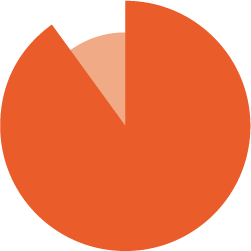
occur in people without a first-degree relative with autoimmune T1D, based on European registry data.*6
However, individuals with a family history of autoimmune T1D are at a greater risk of developing it, compared to the general population7

A child's risk is doubled if their parent developed autoimmune T1D before age 11 vs the risk if their parent developed autoimmune T1D after age 118,9
People with a first-degree relative with autoimmune T1D have up to
compared to the general population7

Familial risk doesn't end at first-degree relatives.
For people who have a second-degree relative with autoimmune T1D, the risk is doubled†10-12
Autoimmune disorders
There is a high co-occurence between autoimmune T1D and other autoimmune conditions13,14
Coeliac disease and autoimmune thyroid diseases are associated with increased risk of autoimmune T1D‡13,15,16
Having a first-degree relative with other autoimmune conditions may increase the likelihood of autoimmune T1D development17

of patients with autoimmune T1D also have an autoimmune thyroid disease5

People with hyperthyroidism (including Graves' disease) and hypothyroidism (including Hashimoto's thyroiditis) are at
2-3x
increased risk of autoimmune T1D§18
Which children are at risk of developing autoimmune T1D?

Children with a family history of autoimmune T1D
A child's risk is doubled if their parent developed autoimmune T1D before the age of 11.||8,9

Children without a family history of autoimmune T1D
Around 90% of new diagnoses occur in people without a first-degree relative with autoimmune T1D.*6

Children with associated autoimmune conditions
People with coeliac disease or autoimmune thyroid conditions are 2-3x more likely to develop autoimmune T1D vs those without.§18
Not actual patients.
Which adults are at risk of developing autoimmune T1D?

Those with a family history of autoimmune T1D
Individuals with a first-degree relative with autoimmune T1D have up to 15x higher risk of developing the condition compared to the general population.7

Those without a family history of autoimmune T1D
Around 90% of new diagnoses occur in people without a first-degree relative with autoimmune T1D.*6

Those with associated autoimmune conditions
People with coeliac disease or autoimmune thyroid conditions are 2–3x more likely to develop autoimmune T1D vs those without.§18

Those with suspected T2D
The clinical phenotype of autoimmune T1D can overlap with T2D.19,20
This makes it crucial to differentiate between the conditions.19,20
Not actual patients.
Get in Touch with Us
Questions? Leave your details and we'll reach out to you at your preferred time.
Get in touchINDICATION: TZIELD is indicated to delay the onset of Stage 3 T1D in adult and paediatric patients 8 years of age and older with Stage 2 T1D.21
*From a population-based observational study of 57,371 young people with autoimmune T1D across Germany, Austria, Switzerland and Luxembourg, using data from the Diabetes Prospective Follow-up Registry between 1995 and 2018. 93.4% had no first-degree relative with T1D vs 6.6% who had a first-degree relative with T1D.6
†Compared to the general population or calculated relative risk.10-12
‡While autoimmune conditions like coeliac disease and autoimmune thyroid disease are associated with increased risk of autoimmune T1D, the risk of developing additional autoimmune conditions is particularly elevated in individuals already diagnosed with autoimmune T1D.13,15,16
§From a retrospective, observational, matched-cohort study based on real-world data from the Optum Clinformatics claims database. Of those with hypothyroidism, T1D developed in 0.16% (n=118/74,095) compared to 0.05% (n=38/74,095) of controls. Of those with hyperthyroidism, T1D developed in 0.17% (n=281/164,830) compared to 0.06% (n=99/164,830) of controls.18
‖Compared to if their parent developed autoimmune T1D after age 11.9
T1D, Type 1 diabetes, T2D, Type 2 diabetes.
MAT-XU-2500761 (v3.0) | September 2026