- Article
- Source: Campus Sanofi
- May 8, 2026
3 min
From Registry to Reality: Reduced Stroke Incidence with Agalsidase Beta in Fabry Disease
|
Reduced Incidence of Stroke with Agalsidase beta in Patients with Fabry Disease: An Analysis from Fabry Registry |
Background 123 |
|
Methods4 |
|
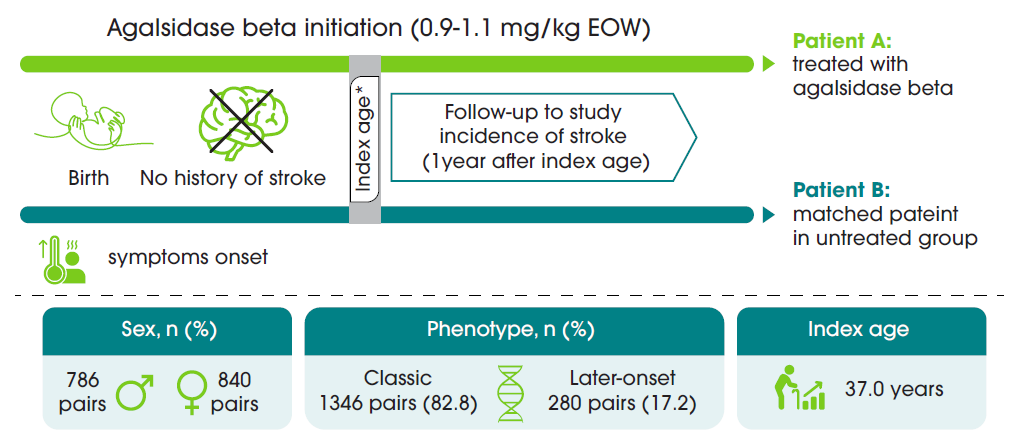
Incidence of stroke4 |
|
|
Agalsidase beta-treated
|
Untreated patients
|
| Number of events/person-year |
0.61% |
1.48% |
| Median age at first stroke (Years) |
54.0 |
44.3 |
| Median time of follow-up (years) |
5.0 |
2.0 |
| Incidence rate per 1000 person-years |
6.19 |
14.86 |
New evidence from real-world Fabry registry data suggests4 |
|
- Hung CL, Wu YW, Kuo L, Sung KT, Lin HH, Chang WT, et al. 2024 Update of the TSOC Expert Consensus of Fabry Disease. Acta Cardiol Sin. 2024 Sept;40(5):544.
- Moreno-Martínez D, León-Cejas L, Reisin R. Cerebrovascular disorders and Fabry disease. Rare Dis Orphan Drugs J. 2024 Mar 25;3(2):N/A-N/A.
- Ruiz-Franco ML, Vélez-Gómez B, Martínez-Sánchez P, Garófano-López R, Gómez-Navarro C, Arjona-Padillo A. Cryptogenic strokes and neurological symptoms of Fabry disease. Front Neurol. 2025 Mar 5;16:1529267.
- Reduced incidence of stroke in patients with Fabry disease treated with agalsidase beta: A matched analysis from the Fabry Registry. Mol Genet Metab. 2025 Feb 1;144(2):108669.
MAT-BH-2600199 -v1- April 2026