

Delay in CABLIVI Start - Active Disease
An acute episode of aTTP is caused by ADAMTS13 deficiency, which results in extensive, spontaneous formation of microthrombi
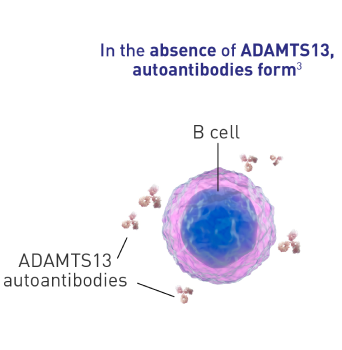

The presence of systemic microvascular thrombi results in4,5:
- Severe thrombocytopenia
- Microangiopathic hemolytic anemia
- Organ ischemia
May lead to4,5:
- Stroke
- MI
- Early death
- Neurological complications
ADAMTS13=a disintegrin and metalloproteinase with a thrombospondin type 1 motif, 13; MI=myocardial infarction; ULvWF=ultra-large von Willebrand factor.
aTTP is a rare, life-threatening TMA4,6
Without treatment, the acute mortality rate of aTTP is3,7,8:

Despite plasma exchange and immunosuppression4,9:
Patients with aTTP remain at risk of thrombotic complications such as myocardial infarction, ischemic stroke, kidney failure, and other organ damage

acute mortality; the median time from diagnosis to death is 9 days9,10

of patients with aTTP experience unpredictable refractoriness8

of patients with aTTP experience exacerbations11

of patients with aTTP remain at long-term risk of relapse12
Because aTTP is a medical emergency, diagnosing and starting treatment early
may help guard against the high risk of early, preventable death in aTTP3
TMA=thrombotic microangiopathy.
CABLIVI efficacy: aTTP-related events | Exacerbation
| HERCULES13,14 | ||
| CABLIVI
(n=72) | Placebo
(n=73) |
|
| 3 (4%) | 28 (38%) | |
| INTEGRATED ANALYSIS15 | ||
| CABLIVI
(n=108) | Placebo
(n=112) |
|
| 6 (5.6%) | 39 (34.8%) | |
During blinded treatment period.
Exacerbation: Defined as a recurrence (new drop in platelet count after normalization) within 30 days after the end of daily PEX.
| CNR-MAT REGUSTRY STUDY16 | ||
| Triplet regimen
(n=90) | Historical cohort
(n=180) |
|
| 3 (3.4%) | 70 (44%) | |
Exacerbation: Defined as initial treatment response but reappearance of clinical manifestations and/or thrombocytopenia (platelet count <100 × 103/mm3 for at least 2 days) before durable remission (complete response with no further thrombocytopenia or clinical worsening for >30 consecutive days of platelet count recovery)
CABLIVI significantly reduces the risk of aTTP exacerbations, which can be as harmful as the
initial aTTP episode, compared with PEX and immunosuppression alone10,14-16
CNR-MAT=French Reference Centre for Thrombotic Microangiopathies.
| SPANISH2 | |||
| CABLIVI first-line
(n=44) | CABLIVI + PEX + IS overall
(n=77) |
PEX and IS alone
|
|
| 2 (4.5%) | 4 (5.2%) | 16 (20.5%) | |
Exacerbation: Defined as an unjustified decrease in platelet count and elevation of LDH within 30 days of the suspension of treatment for clinical remission and requiring the reinitiation of PEX.
First-line therapy: Indicates intention to use a drug or therapy from the beginning of treatment.
| REACT-20201 | |||
| CABLIVI first-line use
(n=70) | CABLIVI non-first-line use
(n=43) |
| |
| 21 (30%) | 25 (60%) | ||
Exacerbation: Defined as a decrease in platelet count ≤150 × 109/L after a clinical response within 30 days of stopping PEX and/or CABLIVI.
First-line therapy: Defined as drug administration within ≤72 hours after diagnosis.
| AGGREGATED ANALYSIS1 | |||
| CABLIVI
(n=396) | Non-CABLIVI
(n=450) |
| |
| 57 (14%) | 158 (39%) | ||
Exacerbation: In TITAN, HERCULES, and the UK cohort, an exacerbation was defined as a recurrence within 30 days after completion of PEX. CNR-MAT defined it as an initial treatment response but reappearance of clinical manifestations and/or thrombocytopenia (<100 × 103/mm3 for at least 2 days) before durable remission. REACT-2020 defined it as a decrease in platelet count ≤150 × 109/L after a clinical response within 30 days of stopping PEX and/or CABLIVI.
CABLIVI significantly reduces the risk of aTTP exacerbations, which can be as harmful as the initial aTTP episode, compared with PEX and immunosuppression alone10,14-16
IS=immunosuppression; LDH=lactate dehydrogenase.
CABLIVI efficacy: aTTP-related events | Relapse
| HERCULES13,14 | |||
| CABLIVI
(n=72) | Placebo
(n=73) |
| |
| 6 (8%) | 0 | ||
During blinded treatment period.
Relapse: Defined as a recurrence that occurs >30 days after the end of daily PEX.
| INTEGRATED ANALYSIS15 | |||
| CABLIVI
(n=108) | Placebo
(n=112) |
| |
| 14 (13%) | 0 | ||
During follow-up period.
Relapses: Defined as a recurrence (new drop in platelet count after normalization) >30 days after the end of daily PEX.
| CNR-MAT REGUSTRY STUDY16 | |||
| Triplet regimen
(n=90) | aTTP patients treated without CABLIVI
(n=22) |
| |
| 1 (1.11%) | 70 (44%) | ||
Exacerbation: Relapse: Defined as reappearance of clinical features of aTTP (thrombocytopenia [platelet count <100 × 103/mm3 for at least 2 days], associated or not with organ involvement) (ie, a new episode of aTTP) after durable remission had been achieved
Overall, patients who experienced a relapse still had severely suppressed ADAMTS13 activity (<10%) when CABLIVI treatment was interrupted, suggesting the importance of continuing CABLIVI treatment until resolution of autoimmune disease14,15
ADAMTS13=a disintegrin and metalloproteinase with a thrombospondin type 1 motif, 13; CNR-MAT=French Centre for Thrombotic Microangiopathies.
HERCULES: Summary14
| Outcome | CABLIVI
(n=72) | Placebo
(n=73) | P value |
| Primary outcome | |||
| Time to normalization of platelet count | |||
| 25th Percentile (95% CI)—days | 1.75 (1.65-1.87) | 1.94 (1.70-2.64) | |
| 50th Percentile (95% CI)—days | 2.69 (1.89-2.83) | 2.88 (2.68-3.56) | |
| 75th Percentile (95% CI)—days | 2.95 (2.85-3.81) | 4.50 (3.78-7.79) | |
| Rate ratio for normalization of platelet count, CABLIVI vs placebo (95% CI) | 1.55 (1.09-2.19) | 0.01 | |
| Key secondary outcomes | |||
| Composite of TTP-related death, recurrence of TTP, or major thromboembolic event during the double-blind treatment period—no. (%) | 9 (12) | 36 (49) | <0.001 |
| TTP-related death | 0 | 3 (4) | |
| Recurrence of TTP: exacerbation* | 3 (4) | 28 (38) | |
| Major thromboembolic event | 6 (8) | 6 (8) | |
| Recurrence of TTP at any time during the trial—no. (%)* | 9 (12) | 28 (38) | <0.001 |
| Refractory TTP—no. (%)† | 0 | 3 (4) | 0.06 |
| Other secondary outcomes‡ | |||
| Mean number of days of PEX (95% CI) | 5.8 (4.8-6.8) | 9.4 (7.8-11.0) | |
| Mean volume of plasma exchanged (95% CI) | 21.3 L (18.1-24.6) | 35.9 L (27.6-44.2) | |
| Mean number of days of hospitalization (95% CI) | 9.9 (8.5-11.3) | 14.4 (12.0-16.9) | |
| Number of patients admitted to the ICU (%)§ | 28 (39) | 27 (37) | |
| Mean number of days in the ICU (95% CI) | 3.4 (2.6-4.2) | 9.7 (5.3-14.1) | |
CABLIVI addresses the pathophysiological platelet adhesion that leads to the formation of microthrombi and the resultant mortality and morbidity seen in aTTP13,14
- Patients treated with CABLIVI were 1.55 times more likely to achieve platelet count normalization at any given time point compared with patients treated with placebo (P<0.01)14
- Clinically relevant reduction in the composite of aTTP-related death, recurrence of aTTP, or a major thromboembolic event14
- Prevention of aTTP relapses when treatment was extended until resolution of underlying disease14
- Potential to prevent refractory disease and accelerate normalization of markers of organ damage14
- Reduction in use of PEX and length of stay in the ICU and hospital14
- Safety profile in line with previous study results and mechanism of action13,15
* Recurrence was defined as a new decrease in the platelet count after initial normalization of the platelet count, necessitating reinitiation of PEX. According to the consensus terminology, a recurrence within 30 days after the end of daily PEX is considered to be an exacerbation, and a recurrence that occurs more than 30 days after the end of daily plasma exchange is considered to be a relapse.
† Refractory TTP was defined as the lack of a doubling of the platelet count after 4 days of treatment and an LDH level that remained above the upper limit of the normal range.
‡These outcomes were assessed during the trial treatment period.
§ Admission to the ICU for administration of PEX is standard practice at some centers and is not necessarily indicative of more severe clinical presentation.
ICU=intensive care unit; LDH=lactate dehydrogenase.
Integrated analysis: Summary15
Integrated efficacy endpoints for the overall ITT population
| Efficacy endpoints | CABLIVI
(n=108) | Placebo
(n=112) | P |
| Proportion of participants with ≥1 of the events below while receiving blinded study drug treatment | 14 (13.0) | 53 (47.3) | <0.001 |
| TTP-related death | 0 (0.0) | 4 (3.6) | |
|
Major thromboembolic event | 8 (7.4) | 14 (12.5) | |
| TTP exacerbation | 6 (5.6) | 39 (34.8) | |
|
TTP recurrences* | 0.01 | ||
| TTP exacerbation during blinded treatment period | 6 (5.6) | 39 (34.8) | <0.001 |
| TTP relapses during treatment-free follow-up period | 14 (13.0) | 0 (0.0) | n/s |
| TTP exacerbation or relapse during overall study | 19 (17.6) | 39 (34.8) | 0.0040 |
| Refractory to treatment† | 0 (0.0) | 8 (7.1) | <0.01 |
| Mortality rate | |||
| During the blinded treatment periods | 0 (0.0) | 4 (3.6) | 0.0477 |
| During the overall study period | 1 (0.9)‡ | 5 (4.5)‡ | n/s |
Data are presented as n (%). n/s, not statistically significant (P≥0.05).
Overall, this integrated analysis provided new evidence that CABLIVI prevents mortality and refractory disease in aTTP and strengthened individual trial findings with a confirmed favorable safety and tolerability profile
- This integrated analysis showed that CABLIVI results in faster time to platelet count normalization, confirming efficacy outcomes that are consistent with the individual study findings
- In addition, this integrated analysis demonstrated that CABLIVI significantly reduces the number of deaths and incidence of refractory TTP compared with placebo during the treatment period
- No new safety signals were identified for CABLIVI, with mucocutaneous bleeding being the most frequent adverse event
* Recurrence was defined as a new drop in platelet count after initial platelet count normalization, necessitating re-initiation of PEX. Exacerbation is a recurrence within 30 days after the end of daily PEX. Relapse is a recurrence occurring more than 30 days after the end of daily PEX.
†Defined as a lack of sustained platelet count increment or platelet counts <50 × 109/L throughout the assessment period and persistently increased lactate dehydrogenase (>1.5 × ULN) despite 5 PEX treatments and steroid treatment.
‡ In the TITAN trial, 1 participant in the placebo group died 2 days after study drug treatment was permanently discontinued by physician decision and was therefore counted as a death during the follow-up period, despite dying from severe refractory disease in the acute setting. In the HERCULES trial, 1 participant in the CABLIVI group died in the follow-up period after completing treatment and reaching complete remission. Both participants had a confirmed TTP diagnosis (ADAMTS13 <10%).
ADAMTS13=a disintegrin and metalloproteinase with a thrombospondin type 1 motif, 13; ITT=intent to treat; n/s=not statistically significant; ULN=upper limit of normal.
CNR-MAT Registry Study: Summary16
| Outcome | Triplet regimen
(n=90) | Historical cohort
(n=180) | P value |
| Primary Outcome | |||
| Composite of death and refractoriness (all patients) | 2 (2.2) | 22 (12.2) | 0.01 |
| Secondary outcomes | |||
| Death | 1 (1.1) | 12 (6.7) | 0.06 |
| Refractoriness | 1 (1.1) | 16 (18) | 0.01 |
| Exacerbations | 3 (3.4) | 70 (44) | <0.01 |
| Time to durable platelet count recovery | 5 (4-6) | 12 (6-17) | <0.01 |
| Number of daily PEX until remission | 5 (4-7) | 10 (6-16) | <0.01 |
| Volume of plasma (liters) until remission | 24.2 (18.3-30.2) | 44.4 (26.3-74.3) | <0.01 |
| Time to ADAMTS13 activity >20% (days) | 28 (14-42) | 48 (24-83) | <0.01 |
| Lenght of hospitalization (days) | 13 (9-19) | 22 (15-30) | 0.01 |
| Thromboembolic events | 11 (12) | 20 (11.1) | 0.79 |
Data are given as median (25th-75th percentile) for quantitative variables and as n (%) for qualitative variables. Patients at high risk of early death from aTTP were defined by a French severity score ≥3 (cerebral involvement: yes=1/no=0, LDH: >10 × ULN=1/≤10 × ULN=0, age: >60 years=2/>40 and ≤60 years=1/≤40 years=0).
Efficacy and safety of frontline CABLIVI confirmed in a real-world setting. Early treatment with CABLIVI significantly reduced unfavorable outcomes during very acute phase of aTTP
In this French RWE study, the frontline triplet regimen of CABLIVI, PEX, and immunosuppression (corticosteroids and rituximab*), compared with the historical cohort demonstrated:
- 6.2 times lower likelihood of death or refractory disease (P=0.013)
- Durable platelet count recovery 1.8 times as fast (P<0.01)
- 16.4 times lower likelihood of experiencing an exacerbation (P<0.01)
- 45% reduction of plasma volume (P<0.01)
- 41% reduction of days in hospital (P=0.01)
- Note: 1 patient died in the CABLIVI group due to massive pulmonary embolism
*Rituximab is not approved by most regulatory agencies worldwide for the treatment of aTTP (approved in Japan, 2020).17,18
ADAMTS13=a disintegrin and metalloproteinase with a thrombospondin type 1 motif, 13; CNR-MAT=French Reference Centre for Thrombotic Microangiopathies; LDH=lactate dehydrogenase; RWE=real-world evidence; ULN=upper limit of normal.
Spanish RWE confirms therapeutic benefits of initial treatment with CABLIVI2
In this Spanish RWE study, CABLIVI use vs non-CABLIVI use showed:

REDUCED EXACERBATIONS WITH CABLIVI*
5.2% (4) of patients treated with CABLIVI compared with 20.5% (16) of patients treated with PEX and immunosuppression alone

PATIENTS ACHIEVED FASTER PLATELET NORMALIZATION† WITH CABLIVI
8.5 days for patients treated with CABLIVI as initial treatment‡ (IQR, 6-12.5) compared with 14 days for patients treated with PEX and immunosuppression alone (IQR, 7-21) (P=0.009). 5 days for patients treated with CABLIVI as initial treatment compared with 15 days for patients treated with CABLIVI after exacerbation* or refractoriness§ (P<0.01) (HR: 2.30; 95% CI: 1.41-3.76). 14 days for patients treated with CABLIVI in conjunction with PEX and rituximab compared with 24 days for patients treated with PEX and rituximab alone (P<0.001) (HR: 1.96; 95% CI: 1.29-2.99)

REDUCED REFRACTORINESS WITH CABLIVI§
6.5% (5) of patients treated with CABLIVI compared with 14% (11) of patients treated with PEX and immunosuppression alone

REDUCED MORTALITY WITH CABLIVI||
3.8% (3) of patients treated with CABLIVI compared with 7.7% (6) of patients treated with PEX and immunosuppression alone

REDUCED HEALTHCARE RESOURCE UTILIZATION WITH CABLIVI¶
8.5 median number of PEX for patients treated with CABLIVI compared with 14 for patients treated with PEX and immunosuppression alone
12 days of hospitalization for patients treated with CABLIVI compared with 19 for patients treated with PEX and immunosuppression alone (P<0.001)
Bleeding events were reported in 20% of patients receiving CABLIVI (16/77). Only 2 were classified as grade ≥2. Gingivorrhagia and metrorrhagia were the most common (19% and 20%). 55% of events resolved spontaneously, with the remaining resolving after suspending CABLIVI for <48 hours. No hemostatic treatment was needed.
*Exacerbation was defined as an unjustified decrease in platelet counts and elevation of LDH within 30 days as of the suspension of treatment for clinical remission and requiring the reinitiation of PEX.
†Time to normalization of platelet count was defined as the time from the first PEX to the first day with a platelet count ≥150 × 109/L.
‡ The expression “initial treatment” is used to indicate the intention to use a drug or therapy from the beginning of treatment, although due to the procedures required to obtain the medication it could be delayed several days.
§Refractoriness was defined as platelet counts <50 × 109/L and persistently increased LDH levels (>1.5 ULN) despite 5 PEX.
||2 of 3 patients in the CABLIVI group died during an acute episode. The third patient was a 48-year-old patient who died 4 months after achieving clinical remission and normalization of ADAMTS13 in the context of cytomegalovirus and Aspergillus infection.
¶Based on a multivariate analysis against PEX and immunosuppression alone.
ADAMTS13=a disintegrin and metalloproteinase with a thrombospondin type 1 motif, 13; HR=hazard ratio; IQR=interquartile range; LDH=lactate dehydrogenase; RWE=real-world evidence; ULN=upper limit of normal.
REACT-2020: CABLIVI is efficacious independent of initiation, but benefits diminish if not used first line1
REACT-2020 study design: Data from 232 well-characterized episodes of aTTP (113 episodes treated with CABLIVI and 119 historical controls* treated without CABLIVI). The CABLIVI and historical cohorts did not significantly differ with regard to age and sex. REACT-2020 is an ongoing observational retrospective cohort study.

EXACERBATIONS OCCURRED WITH PREMATURE DISCONTINUATION†
Exacerbations were frequent and not significantly different between cohorts (41% with CABLIVI vs 43% with historical controls). Most exacerbations with CABLIVI occurred after premature discontinuation, which included stopping CABLIVI with increased platelet count or prior to achieving ADAMTS13 remission or ADAMTS13 >10%
FASTER NORMALIZATION WITH FIRST-LINE USE
CABLIVI first-line use led to robust and significantly faster time to platelet count normalization after diagnosis (median 5 days vs 20 days; P<0.05), mirroring results from clinical trials

REFRACTORINESS OCCURRED WITHOUT FIRST-LINE USE‡
Refractoriness was higher in the CABLIVI cohort, with most episodes occurring prior to CABLIVI initiation (20% vs 11%, P=0.09). Only 4 episodes occurred during CABLIVI treatment (2 with first-line use)

MORTALITY WAS INFREQUENT WITH NO DIFFERENCE BETWEEN COHORTS
2 deaths occurred in the first-line cohort. The 2 patients did not receive CABLIVI immediately, but rather after considerable delay (>24 and >48 hours after diagnosis, respectively)
SHORTER HOSPITAL STAY AND FEWER PEX SESSIONS WITH FIRST-LINE USE
CABLIVI resulted in decreased days in hospital (14 days vs 23 days; P<0.001) and number of PEX treatments (5 vs 14; P<0.0001)§
Adverse reactions were not related to a reduction in CABLIVI efficacy, but rather were a consequence of delayed initiation and premature discontinuation of CABLIVI, jeopardizing patient safety by increasing time with active disease, accumulating organ damage, and increasing the risk for adverse events.
* The historical control cohort included repeat acute aTTP episodes from single patients (119 episodes were reported in 96 patients). Data are reported as a “per event” analysis. All other cohorts, including the REACT-2020 cohort, represent “per person” analysis with 1 episode per patient reported.
†Exacerbation was defined as decrease in platelet count ≤150 × 109/L after a clinical response within 30 days of stopping PEX and/or CABLIVI.
‡Refractoriness was defined as not achieving a sustained platelet count ≥150 × 109/L after 5 consecutive days of PEX or CABLIVI treatment.
§Mann–Whitney U-test was used to test for statistical significance.
ADAMTS13=a disintegrin and metalloproteinase with a thrombospondin type 1 motif, 13.
Aggregated analysis: CABLIVI is efficacious, with a significant reduction in mortality with first-line use1,19
Aggregated analysis study design: Data from 846 episodes of aTTP were aggregated from the CABLIVI phase 2 and 3 trials with real-world data from France, the UK, Germany, and Austria (396 treated with CABLIVI and 450 historical controls treated without CABLIVI). The baseline characteristics and outcome data from the placebo groups and historical cohorts treated without CABLIVI were combined.

REDUCED EXACERBATIONS
Exacerbations were reduced with CABLIVI vs the non-CABLIVI cohorts (14% vs 39%), with premature discontinuation of CABLIVI driving occurrence in the CABLIVI cohort
FASTER NORMALIZATION WITH FIRST-LINE USE
CABLIVI decreased the time to final platelet count normalization* across all cohorts where CABLIVI was initiated first line (within 72 hours after diagnosis)

NO DIFFERENCE IN REFRACTORINESS
Rates of refractoriness were similar in the CABLIVI and non-CABLIVI cohorts (8% vs 9%)
INCREASED RELAPSES DRIVEN BY PHASE 2 STUDY DESIGN
Relapse rates were higher with CABLIVI vs the non-CABLIVI cohort (8% vs 3%), which were driven by the phase 2 trial (TITAN) protocol, which was set for a fixed period without considering active underlying disease

REDUCED MORTALITY WITH CABLIVI
30 aTTP-related deaths occurred, predominantly in the non- CABLIVI cohort (22 deaths). 8 deaths in the CABLIVI cohort were driven by 5 in the UK, which were attributed to delayed CABLIVI initiation
SHORTER HOSPITAL STAY AND FEWER PEX DAYS WITH CABLIVI
CABLIVI use resulted in decreased days in the hospital (14 vs 18), ICU (5 vs 9), and receiving PEX (7 vs 10) vs non-CABLIVI use
Overall findings indicate improved mortality and refractoriness with CABLIVI treatment—2.87% ARR and 59% RRR were seen in mortality across cohorts
* The definitions and calculation for platelet count normalization differed in the cohorts. HERCULES: Platelet count normalization was defined as initial platelet count ≥150 × 109/L with subsequent stop of daily PEX within 5 days; CNR-MAT Registry: Durable platelet count recovery was defined as recovery of normal platelet count (≥150 × 103/mm3) for at least 2 days; TITAN: Time to platelet count normalization was defined as repeat of platelet count ≥150 × 109/L at 48 hours and LDH that was ≤2 × ULN; UK RWE: In line with HERCULES definition.1,14,16,19,20
ARR=absolute risk reduction; CNR-MAT=French Reference Centre for Thrombotic Microangiopathies; ICU=intensive care unit; LDH=lactate dehydrogenase; RRR=relative risk reduction; RWE=real-world evidence; UK=United Kingdom; ULN=upper limit of normal.