

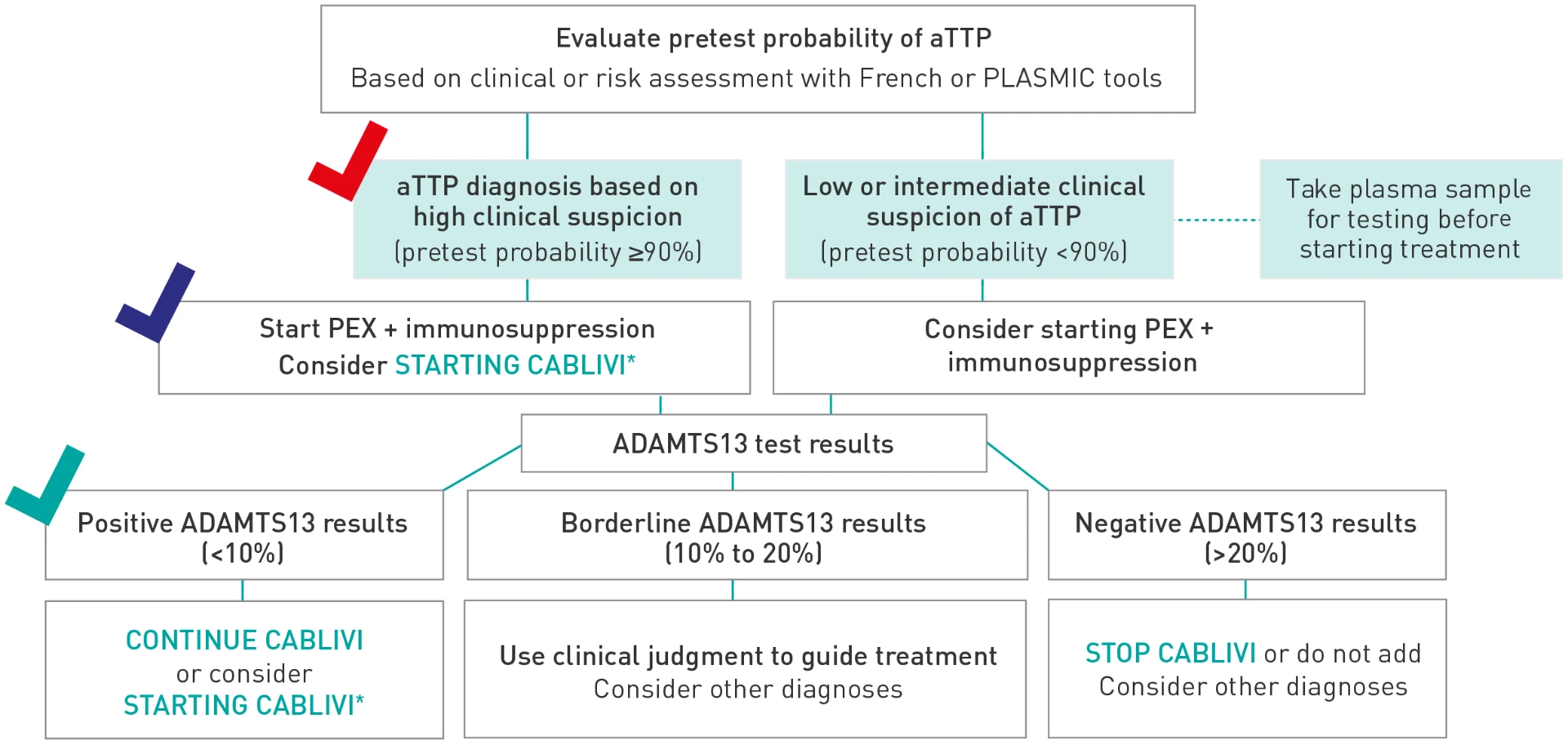
Start CABLIVI*—Consider early administration of CABLIVI in conjunction with PEX and immunosuppression1,22
Recommended diagnostic and management strategy for acute events with access to ADAMTS13 results in fewer than 7 days
CABLIVI therapeutic indication: Treatment of adults and adolescents 12 years of age and older weighing at least 40 kg experiencing an episode of aTTP, in conjunction with PEX and immunosuppression23
* Assumes high likelihood of aTTP (based on clinical assessment or a formal clinical risk assessment tool) and timely access to ADAMTS13 testing. In low or intermediate likelihood of aTTP, CABLIVI may be started after ADAMTS13 testing confirms a diagnosis.
ADAMTS13=a disintegrin and metalloproteinase with a thrombospondin type 1 motif, 13; ISTH=International Society on Thrombosis and Haemostasis; PLASMIC=platelet count + combined hemolysis variable + absence of active cancer + absence of stem cell or solid-organ transplant + mean corpuscular volume + international normalized ratio + creatinine.
See aTTP—Diagnosis determined through clinical assessment1
|
Clinical assessment Patient presentation prompting suspicion of aTTP:
|
|
Risk assessment tools† Available risk assessment tools include:
divider goes here The higher the risk assessment score, the more likely patients have severe ADAMTS13 deficiency and aTTP
|
Identifying aTTP is crucial for initiation of an appropriate therapeutic strategy
*Assumes high likelihood of aTTP (based on clinical assessment or a formal clinical risk assessment tool) and timely access to ADAMTS13 testing. In low or intermediate likelihood of aTTP, CABLIVI may be started after ADAMTS13 testing confirms a diagnosis.
†ISTH did not appraise the evidence for these 2 tools.
ADAMTS13=a disintegrin and metalloproteinase with a thrombospondin type 1 motif, 13; Hb=hemoglobin; ISTH=International Society on Thrombosis and Haemostasis; LDH=lactate dehydrogenase; PLASMIC=platelet count + combined hemolysis variable + absence of active cancer + absence of stem cell or solid-organ transplant + mean corpuscular volume + international normalized ratio + creatinine.
Risk assessment tools can be used to predict ADAMTS13 deficiency
PLASMIC score16,26
The PLASMIC score can predict severe ADAMTS13 deficiency as criteria for identifying a patient with probable TTP.
| PARAMETER | SCORE |
|
Platelet count <30 × 109/L | +1 |
|
Serum creatinine level <2.0 mg/dL | +1 |
|
Evidence of haemolysis*: Indirect bilirubin >2.0 mg/dL
| +1 |
|
No active cancer in previous year* | +1 |
|
No history of solid organ or stem cell transplantation* | +1 |
|
International normalized ratio (INR) <1.5* | +1 |
|
MCV <90 fL (<9.0 × 10⁻¹⁴/L)† | +1 |
|
Likelihood of severe
|
Low risk 0 to 4: 0% to 4%
|
French score1,16
| PARAMETER | SCORE |
|
Platelet count <30 × 109/L | +1 |
|
Serum creatinine level <2.25 mg/dL | +1 |
|
Prediction of severe ADAMTS13 deficiency (activity <10%) based on score‡ |
0: 2%
|
Adapted from Coppo P et al. Res Pract Thromb Haemost. 2018;16;3(1):26-37.
* The French score considers patients with a thrombotic microangiopathy syndrome (which includes hemolysis and schistocytes in the definition) and assumes that there is no history of or clinical evidence for associated cancer, transplantation, or disseminated intravascular coagulopathy, so these terms are intrinsic to the score.16
†MCV was not incorporated into the French score.16
‡ Results correspond to those of the derivation cohort and those of a validation by (French score) the bootstrap resampling technique (internal validation) or (PLASMIC score) different samples of patients from the same institution (internal validation) or from a different institution (external validation).16
ADAMTS13=a disintegrin and metalloproteinase with a thrombospondin type 1 motif, 13; MCV=mean corpuscular volume; PLASMIC=platelet count + combined hemolysis variable + absence of active cancer + absence of stem cell or solid-organ transplant + mean corpuscular volume + international normalized ratio + creatinine.