
UNMET NEED:
For patients who do not receive frontline transplant, is there an outcome gap vs transplant?
Historically, transplant-ineligible patients have had worse long-term outcomes than transplant patients

Adopted from Richter J et ol eJHoem. 2023:4(4):984-994.
A retrospective analysis of 5996 NDMM patients in the US evaluating real-world outcomes in frontline treatment.
To close the outcomes gap:
opt for frontline regimens that offer maximal depth and durability
of response for more transplant-ineligible patients
A key factor in the prognosis gap is the lower rate of deep responses seen with existing treatments in transplant-ineligible patients. In fact, according to two recent studies:
Transplant-ineligible patients who achieve a deep response can have similar PFS as their transplanted counterparts

Adapted from Richardson PG et al. N Engl J Med. 2022;387(2):132-147.
A phase 3 study of 722 NDMM patients in the US evaluating the effect of autologous stem cell transplant versus systemic therapy.
To close the outcomes gap:
opt for frontline regimens that offer maximal depth and durability
of response for more transplant-ineligible patients
Historically, transplant-ineligible patients have had worse long-term outcomes than transplant patients
Adopted from Richter J et ol eJHoem. 2023:4(4):984-994.
A retrospective analysis of 5996 NDMM patients in the US evaluating real-world outcomes in frontline treatment.
To close the outcomes gap:
opt for frontline regimens that offer maximal depth and durability
of response for more transplant-ineligible patients
A key factor in the prognosis gap is the lower rate of deep responses seen with existing treatments in transplant-ineligible patients. In fact, according to two recent studies:
Transplant-ineligible patients who achieve a deep response can have similar PFS as their transplanted counterparts
Adapted from Richardson PG et al. N Engl J Med. 2022;387(2):132-147.
A phase 3 study of 722 NDMM patients in the US evaluating the effect of autologous stem cell transplant versus systemic therapy.
To close the outcomes gap:
opt for frontline regimens that offer maximal depth and durability
of response for more transplant-ineligible patients
TRIAL DESIGN
For transplant-ineligible NDMM patients:
IMROZ: the only trial to evaluate an anti-CD38 + VRd therapy in a 100% transplant-ineligible population
Key patient characteristics?
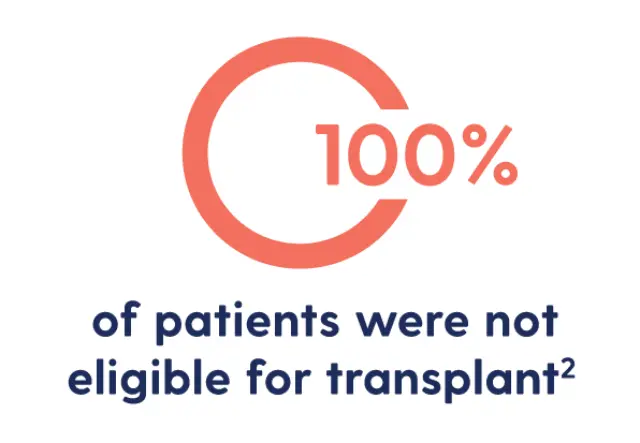
In the SARCLISA + VRd arm, the median age was 72 years. 3% of patients were <65 years, 71% were between 65 and 74 years, and 26% were ≥75 years. 26% of patients were considered frail, and 74% non-frail.* ECOG PS was 0 or 1 for 89% patients, and >l for 11% of patients. At study start, the patient breakdown by R-ISS was as follows: 88% for both stage I and Il, 11% for stage III, and 1% not classified 15% of patients had high cytogenetic risk, and 7% had high-risk chromosomal abnormalities and lq21+, while 78% were standard risk. Patient characteristics were similar between the 2 treatment arms.
SARCLISA + VRd was compared to VRd alone in transplant-ineligible, newly diagnosed multiple myeloma patients?
A large, randomised, open-label, multicentre, phase 3 trial

Primary endpoint: PFS. Key secondary endpoints: CR, MRD- in CR, 2VGPR, and OS.
*Based on the simplified IMWG frailty score. Patients with a frailty score of O/l were considered non-frai, scores ≥2 were frail.8
+The interim analysis of PFS was performed after 162 events of disease progression or death had occurred (73% of the planned 222 events for the final analysis)
TRIAL RESULTS
For transplant-ineligible NDMM patients:
SARCLISA + VRd: a benchmark for efficacy
Superior PFS rate with SARCLISA + VRd vs VRd alone

63% of patients remained alive and progression-free at a median follow-up of 60 months-among the highest PFS rates reported.
PFS results were assessed by an
Independent Response Committee based on central laboratory data for M-protein and central radiologic imaging review using the IMWG criteria.
For transplant-ineligible NDMM patients:
Deep and durable responses to extend frontline remissions
~80% of patients achieved complete response or better with SARCLISA + VRd vs VRd alone

- ORR: 91% SARCLISA + VRd vs 92% VRd
- ≥VGPR: 89% SARCLISA + VRd vs 83% VRd
- ≥VGPR was not statistically significant
For transplant-ineligible NDMM patients:
Deep and durable responses to extend frontline remissions
~60% of 1L non-transplant patients achieved MRD negativity

*47% of patients in the SARCLISA + VRd arm achieved MRD- and sustained it for 21 year.
1L=first line; ITT=intent to treat; MRD=minimal residual disease; MRD-=minimal residual disease negative/negativity: NDMM=newly diagnosed multiple myeloma; NGS=next-generation sequencing; RRMM=relapsed and/or refractory multiple myeloma: VRd=bortezomib. lenalidomide, dexamethasone.
A favourable OS trend was observed for SARCLISA + VRd, with a 22% risk reduction vs VRd
At 60-month median follow-up, the estimated OS was 72% of patients for SARCLISA + VRd vs 66% of patients in the control arm

The OS results are from an interim analysis, are not yet mature, and did not yet reach statistical significance at this time point.
In the maintenance phase, patients randomised to the VRd arm who experienced disease progression during the Rd treatment period may cross over to receive SARCLISA + Rd.
HR=hazard ratio; NDMM=newly diagnosed multiple myeloma; OS=overall survival; Rd=lenalidomide and dexamethasone; RRMM=relapsed and/or refractory multiple myeloma; VRd bortezomib, lenalidomide, dexamethasone.
For transplant-ineligible NDMM patients:
SARCLISA + VRd delivered equivalent PFS for 1q21+ and standard-risk patients
PFS based on 1q21+ status (30% cutoff)*

*Out of 265 patients in the SARCLISA - VRd arm and 181 patients in the VRd arm enrolled in the IMROZ trial, 35.9% and 38.7% had lq21, status, respectively
For transplant-ineligible NDMM patients:
SARCLISA + VRd: a benchmark for efficacy
Superior PFS rate with SARCLISA + VRd vs VRd alone
63% of patients remained alive and progression-free at a median follow-up of 60 months-among the highest PFS rates reported.
PFS results were assessed by an
Independent Response Committee based on central laboratory data for M-protein and central radiologic imaging review using the IMWG criteria.
For transplant-ineligible NDMM patients:
Deep and durable responses to extend frontline remissions
~80% of patients achieved complete response or better with SARCLISA + VRd vs VRd alone
- ORR: 91% SARCLISA + VRd vs 92% VRd
- ≥VGPR: 89% SARCLISA + VRd vs 83% VRd
- ≥VGPR was not statistically significant
For transplant-ineligible NDMM patients:
Deep and durable responses to extend frontline remissions
~60% of 1L non-transplant patients achieved MRD negativity
*47% of patients in the SARCLISA + VRd arm achieved MRD- and sustained it for 21 year.
1L=first line; ITT=intent to treat; MRD=minimal residual disease; MRD-=minimal residual disease negative/negativity: NDMM=newly diagnosed multiple myeloma; NGS=next-generation sequencing; RRMM=relapsed and/or refractory multiple myeloma: VRd=bortezomib. lenalidomide, dexamethasone.
A favourable OS trend was observed for SARCLISA + VRd, with a 22% risk reduction vs VRd
At 60-month median follow-up, the estimated OS was 72% of patients for SARCLISA + VRd vs 66% of patients in the control arm
The OS results are from an interim analysis, are not yet mature, and did not yet reach statistical significance at this time point.
In the maintenance phase, patients randomised to the VRd arm who experienced disease progression during the Rd treatment period may cross over to receive SARCLISA + Rd.
HR=hazard ratio; NDMM=newly diagnosed multiple myeloma; OS=overall survival; Rd=lenalidomide and dexamethasone; RRMM=relapsed and/or refractory multiple myeloma; VRd bortezomib, lenalidomide, dexamethasone.
For transplant-ineligible NDMM patients:
SARCLISA + VRd delivered equivalent PFS for 1q21+ and standard-risk patients
PFS based on 1q21+ status (30% cutoff)*
*Out of 265 patients in the SARCLISA - VRd arm and 181 patients in the VRd arm enrolled in the IMROZ trial, 35.9% and 38.7% had lq21, status, respectively
SAFETY
SARCLISA + VRd demonstrated a safety profile similar to triplet therapy
Median treatment duration
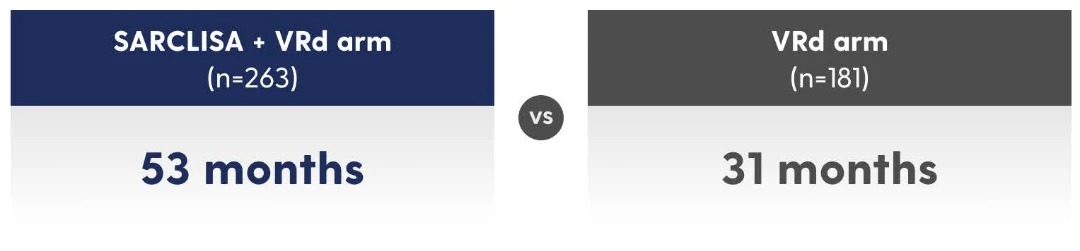
As the median duration of exposure was longer in the SARCLISA + VRd group (53.2 months) than in the VRd group (31.3 months), TEA incidence was assessed based on duration of exposure
Safety overview: event rate per patient-year1
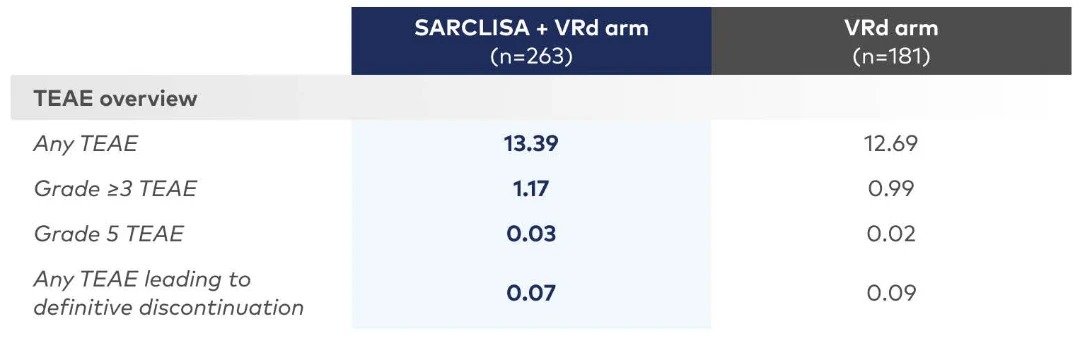
The exposure-adjusted incidence rates suggest the difference in incidence of serious TEAEs (Grade ≥3) and Grade 5 TEAs between arms was largely driven by the difference in treatment exposure.
NDMM=newly diagnosed multiple myeloma; RRMM=relapsed and/or refractory multiple myeloma; TEAE=treatment-emergent adverse event; VRd=bortezomib, lenalidomide, dexamethasone.
For transplant-ineligible NDMM patients:
SARCLISA: no new safety signals when added to VRd
Treatment-emergent adverse events occurring in ≥20% of patients in the SARCLISA + VRd arm
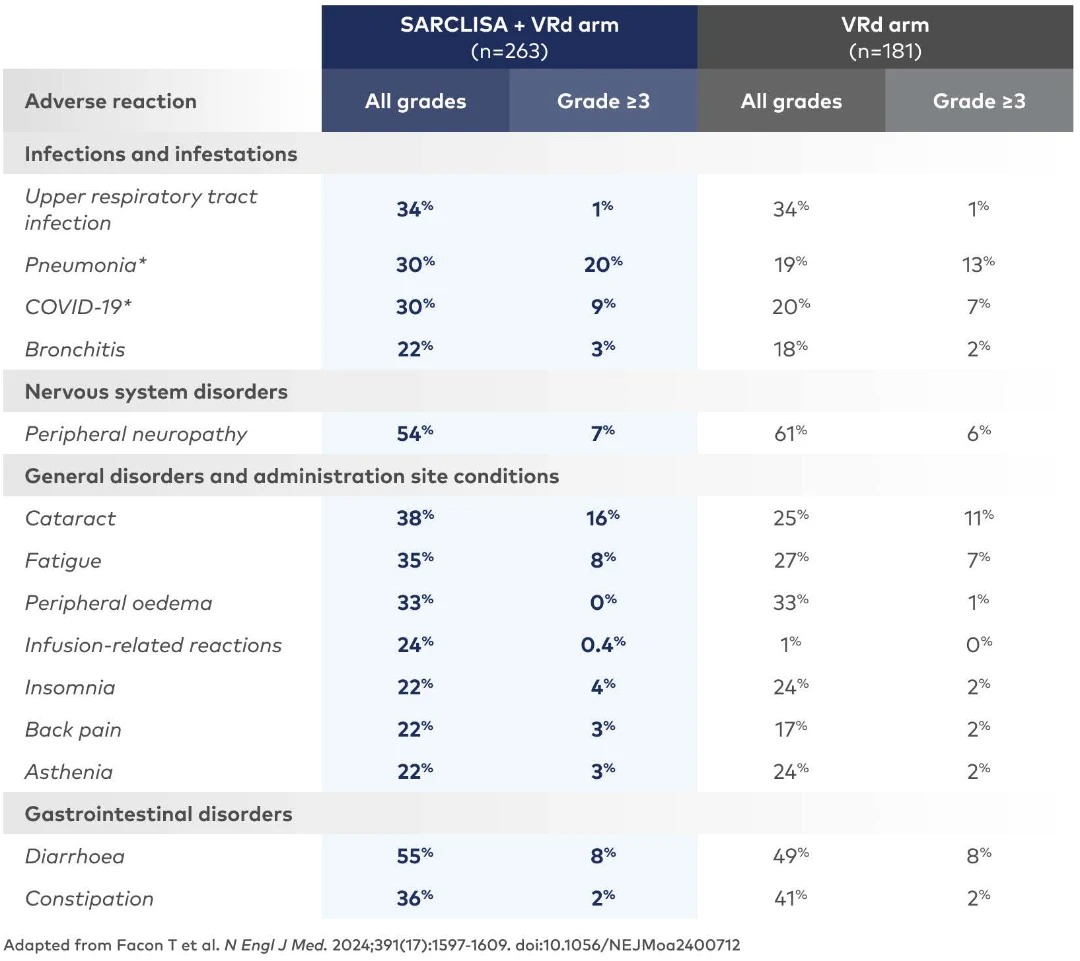
- Additional adverse events included neutropenia (30.0%) as an adverse reaction in the active arm of the IMROZ study
- Grade 5 TEAEs were 11% for SARCLISA + VRd vs 5.5% for VRd alone
- Grade 5 TEAEs were mainly caused by infections (7% for patients on SARCLISA + VRd, 4% for VRd), including COVID-19 (3% for patients on SARCLISA + VRd and 1% for VRd)
- Grade 3 or 4 peripheral neuropathy was comparable in both arms
- Discontinuations due to adverse events were similar across arms: 23% for SARCLISA + VRd and 26% for VRd
*TEAEs listed under pneumonia excluded COVID-19-related pneumonia. TEAEs listed under COVID-19 combine COVID-19 infection plus COVID-19 pneumonia.
- Additional adverse events included neutropenia (30.0%) as an adverse reaction in the active arm of the IMROZ study?
- Grade 5 TEAs were 11% for SARCLISA + VRd vs 5.5% for VRd alone
- Grade 5 TEAEs were mainly caused by infections (7% for patients on SARCLISA + VRd, 4% for VRd), | including COVID-19 (3% for patients on SARCLISA + VRd and 1% for VRd)
- Grade 3 or 4 peripheral neuropathy was comparable in both arms
- Discontinuations due to adverse events were similar across arms: 23% for SARCLISA + VRd and 26% for VRd
*TEAEs listed under pneumonia excluded COVID-19 related pneumonia. TEAEs listed under COVID-19 infection plus COVID-19 pneumonia.
SARCLISA + VRd was well tolerated
and the safety profile remains consistent with the known safety of each agent
NDMM=newly diagnosed multiple myeloma; RRMM=relapsed and/or refractory multiple myeloma: TEAE=treatment-emergent adverse event; VRd=bortezomib, lenalidomide, dexamethasone.
SARCLISA + VRd demonstrated a safety profile similar to triplet therapy
Median treatment duration
As the median duration of exposure was longer in the SARCLISA + VRd group (53.2 months) than in the VRd group (31.3 months), TEA incidence was assessed based on duration of exposure
Safety overview: event rate per patient-year1
The exposure-adjusted incidence rates suggest the difference in incidence of serious TEAEs (Grade ≥3) and Grade 5 TEAs between arms was largely driven by the difference in treatment exposure.
NDMM=newly diagnosed multiple myeloma; RRMM=relapsed and/or refractory multiple myeloma; TEAE=treatment-emergent adverse event; VRd=bortezomib, lenalidomide, dexamethasone.
For transplant-ineligible NDMM patients:
SARCLISA: no new safety signals when added to VRd
Treatment-emergent adverse events occurring in ≥20% of patients in the SARCLISA + VRd arm
- Additional adverse events included neutropenia (30.0%) as an adverse reaction in the active arm of the IMROZ study
- Grade 5 TEAEs were 11% for SARCLISA + VRd vs 5.5% for VRd alone
- Grade 5 TEAEs were mainly caused by infections (7% for patients on SARCLISA + VRd, 4% for VRd), including COVID-19 (3% for patients on SARCLISA + VRd and 1% for VRd)
- Grade 3 or 4 peripheral neuropathy was comparable in both arms
- Discontinuations due to adverse events were similar across arms: 23% for SARCLISA + VRd and 26% for VRd
*TEAEs listed under pneumonia excluded COVID-19-related pneumonia. TEAEs listed under COVID-19 combine COVID-19 infection plus COVID-19 pneumonia.
- Additional adverse events included neutropenia (30.0%) as an adverse reaction in the active arm of the IMROZ study?
- Grade 5 TEAs were 11% for SARCLISA + VRd vs 5.5% for VRd alone
- Grade 5 TEAEs were mainly caused by infections (7% for patients on SARCLISA + VRd, 4% for VRd), | including COVID-19 (3% for patients on SARCLISA + VRd and 1% for VRd)
- Grade 3 or 4 peripheral neuropathy was comparable in both arms
- Discontinuations due to adverse events were similar across arms: 23% for SARCLISA + VRd and 26% for VRd
*TEAEs listed under pneumonia excluded COVID-19 related pneumonia. TEAEs listed under COVID-19 infection plus COVID-19 pneumonia.
SARCLISA + VRd was well tolerated
and the safety profile remains consistent with the known safety of each agent
NDMM=newly diagnosed multiple myeloma; RRMM=relapsed and/or refractory multiple myeloma: TEAE=treatment-emergent adverse event; VRd=bortezomib, lenalidomide, dexamethasone.
Dosing
For transplant-ineligible NDMM patients:
In IMROZ, SARCLISA dosing frequency decreases over time
SARCLISA dosing in IMROZ trial

Cycles 2 to 4 are 6 weeks; cycles 5 and beyond are 4 weeks each.
SARCLISA: 10 mg/kg
VRd dosing schedule
Initiation 42-day cycles:
- V 1.3 mg/m2 (SC): days 1, 4, 8, 11, 22, 25, 29, 32
- R. 25 mg (PO): days 1-14 and 22-35
- d 20 mg (PO or IV*): days 1, 2, 4, 5, 8, 9, 11, 12, 15, 22, 23, 25, 26, 29, 30, 32, 33
Maintenance treatment period, 28-day cycles:
- R 25 mg (PO): days 1-21
- d 20 mg (PO or IV): days 1, 8, 15, and 22
Infusion time can be decreased to 75 minutes by the third infusion+

No posttreatment medications were necessary following infusion of
SARCLISA in clinical trials
*Dexamethasone is given by IV on days SARCLISA is administered."
+Incremental infusion rate escalation only in the absence of infusion reactions. Premedication should be used prior to SARCLISA infusion with the following medications to reduce the risk and severity of infusion reactions: dexamethasone 20 mg orally or IV, montelukast 10 mg orally or (or equivalent) at least at cycle 1, acetaminophen 650 mg to 1000 mg orally (or equivalent), H2 antagonists (ranitidine 50 mg IV or equivalent [eg, cimetidine]), or oral proton pump inhibitors (eg, omeprazole, esomeprazole), diphenhydramine 25 mg to 50 mg IV or orally (or equivalent [eg, cetirizine, promethazine, dexchlorpheniramine]). The IV route is preferred for at least the first 4 infusions
Patients Profiles
For transplant-ineligible NDMM patients:
Proven benefit across a broad range of patient types, including those difficult to treat


|
Age |
Patient characteristics |
Relevant information |
|---|---|---|
| 52 | ECOG PS: 0
R-ISS: I Cytogenetic risk: Standard Comorbidities: Well-controlled hypertension | Actively employed. Declined option to proceed with transple at this time. |
Choose SARCLISA + VRd for your transplant-ineligible NDMM patients
|
Age |
Patient characteristics |
Relevant information |
|---|---|---|
| 70 | ECOG PS: 0
R-ISS: I Cytogenetic risk: Standard Comorbidities: None | Volunteers at her local community centre and lives independently. |
Choose SARCLISA + VRd for your transplant-ineligible NDMM patients
|
Age |
Patient characteristics |
Relevant information |
|---|---|---|
| 74 | ECOG PS: 1
R-ISS: II Cytogenetic risk: Standard Comorbidities: None | Well-controlled type I diabetes, no organ damage |
Choose SARCLISA + VRd for your transplant-ineligible NDMM patients
|
Age |
Patient characteristics |
Relevant information |
|---|---|---|
| 79 | ECOG PS: 2
R-ISS: III Cytogenetic risk: 1q21+ Comorbidities: None | Mild renal impairment (eGFR- 50 mL/min/1.73 m2) |
Choose SARCLISA + VRd for your transplant-ineligible NDMM patients
|
Age |
Patient characteristics |
Relevant information |
|---|---|---|
| 52 | ECOG PS: 0
R-ISS: I Cytogenetic risk: Standard Comorbidities: Well-controlled hypertension | Actively employed. Declined option to proceed with transple at this time. |
Choose SARCLISA + VRd for your transplant-ineligible NDMM patients
|
Age |
Patient characteristics |
Relevant information |
|---|---|---|
| 70 | ECOG PS: 0
R-ISS: I Cytogenetic risk: Standard Comorbidities: None | Volunteers at her local community centre and lives independently. |
Choose SARCLISA + VRd for your transplant-ineligible NDMM patients
|
Age |
Patient characteristics |
Relevant information |
|---|---|---|
| 74 | ECOG PS: 1
R-ISS: II Cytogenetic risk: Standard Comorbidities: None | Well-controlled type I diabetes, no organ damage |
Choose SARCLISA + VRd for your transplant-ineligible NDMM patients
|
Age |
Patient characteristics |
Relevant information |
|---|---|---|
| 79 | ECOG PS: 2
R-ISS: III Cytogenetic risk: 1q21+ Comorbidities: None | Mild renal impairment (eGFR- 50 mL/min/1.73 m2) |
Choose SARCLISA + VRd for your transplant-ineligible NDMM patients
▼ This medicinal product is subject to additional monitoring. This will allow quick identification of new safety information. Healthcare professionals are asked to report any suspected adverse reactions.