

Efficacy and burden data

Improvement in nasal congestion sustained over 52 weeks1–4
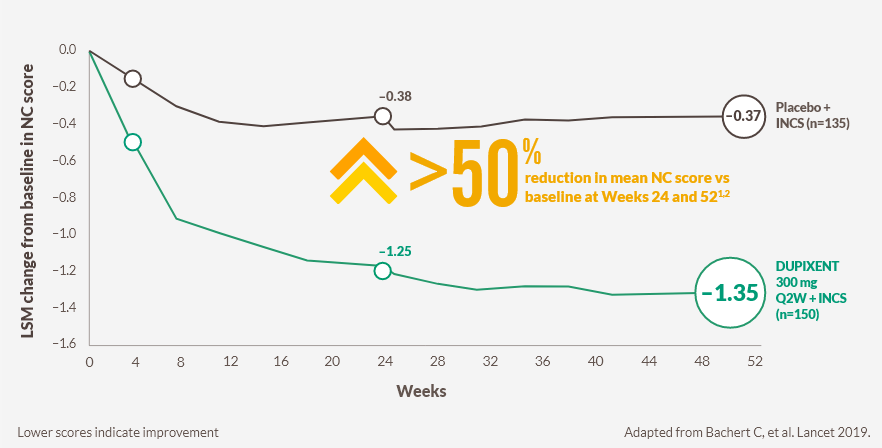
DUPIXENT improved NC score vs placebo as early as Day 2 (post-hoc analysis),d with significant results at Week 24 (primary endpoint) and sustained through Week 52 in patients receiving INCS1–4
Change in NC score through Week 52 in SINUS-52 (secondary endpoint)1,2
CI, confidence interval; INCS, intranasal corticosteroids; LSM, least squares mean; NC, nasal congestion; Q2W, every 2 weeks
Week 24 (primary endpoint): −1.25-point improvement from a baseline score of 2.46 with DUPIXENT (n=295, pooled DUPIXENT armse) vs −0.38-point improvement from a baseline score of 2.38 with placebo (n=153; LSM difference −0.87, 95% CI −1.03 to −0.71; P<0.0001)1,2
Week 52 (secondary endpoint): −1.35‑point improvement from a baseline score of 2.48 with DUPIXENT (n=150) vs −0.37-point improvement from a baseline score of 2.38 with placebo (n=153; −0.98, 95% CI −1.17 to −0.79; P<0.0001)1,2
dPooled SINUS-24/SINUS-52 Day 1 LSM difference between DUPIXENT (n=438) and placebo (n=286): –0.07 (95% CI –0.13 to –0.01; nominal P<0.05).4
eBoth DUPIXENT arms in SINUS-52 received DUPIXENT 300 mg Q2W from baseline to Week 24.2
NC score is a patient-reported scale rating the severity of nasal blockage, from 0 = no symptoms to 3 = severe symptoms.2
The first biologic to report a >2‑point NPS improvement in Phase 3 trials1,6,7
DUPIXENT significantly reduced the size of nasal polyps vs placebo, as measured by bilateral endoscopic NPS, as early as Week 4 (post-hoc analysis)f and sustained through Week 52, in patients receiving INCS1–3
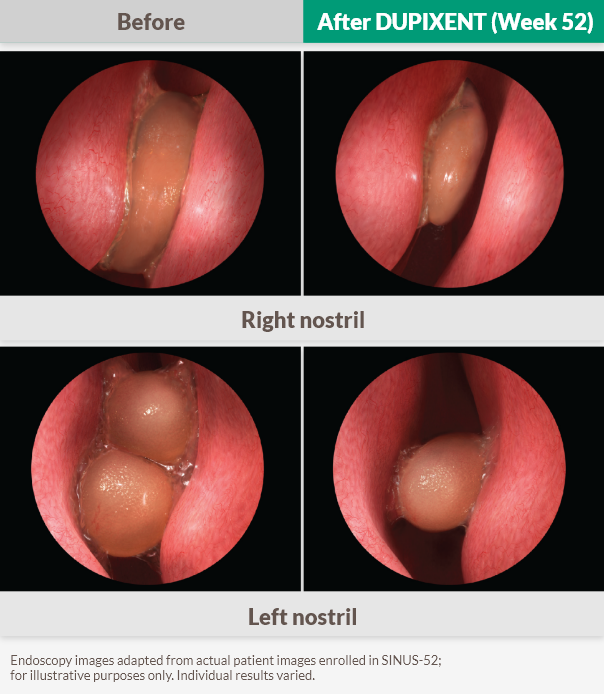

37% improvement vs baseline at Week 52 (SINUS-52 secondary endpoint)1
Week 24 (primary endpoint): −1.71-point improvement in NPS from a baseline score of 6.18 with DUPIXENT (n=295, pooled DUPIXENT arms) vs 0.10-point worsening from a baseline score of 5.96 with placebo (n=153; LSM difference −1.80, 95% CI −2.10 to −1.51; P<0.0001)1,2
Week 52 (secondary endpoint): −2.24-point improvement in NPS from a baseline score of 6.07 with DUPIXENT (n=150) vs 0.15-point worsening from a baseline score of 5.96 with placebo (n=153; LSM difference −2.40, 95% CI −2.77 to −2.02; P<0.0001)1,2
fSINUS-52 Week 4 LSM difference between DUPIXENT (n=295, pooled DUPIXENT arms) and placebo (n=153): −1.15 (95% CI, −1.40 to −0.91; nominal P<0.0001).3
Both DUPIXENT arms in SINUS-52 received DUPIXENT 300 mg Q2W from baseline to Week 24.2
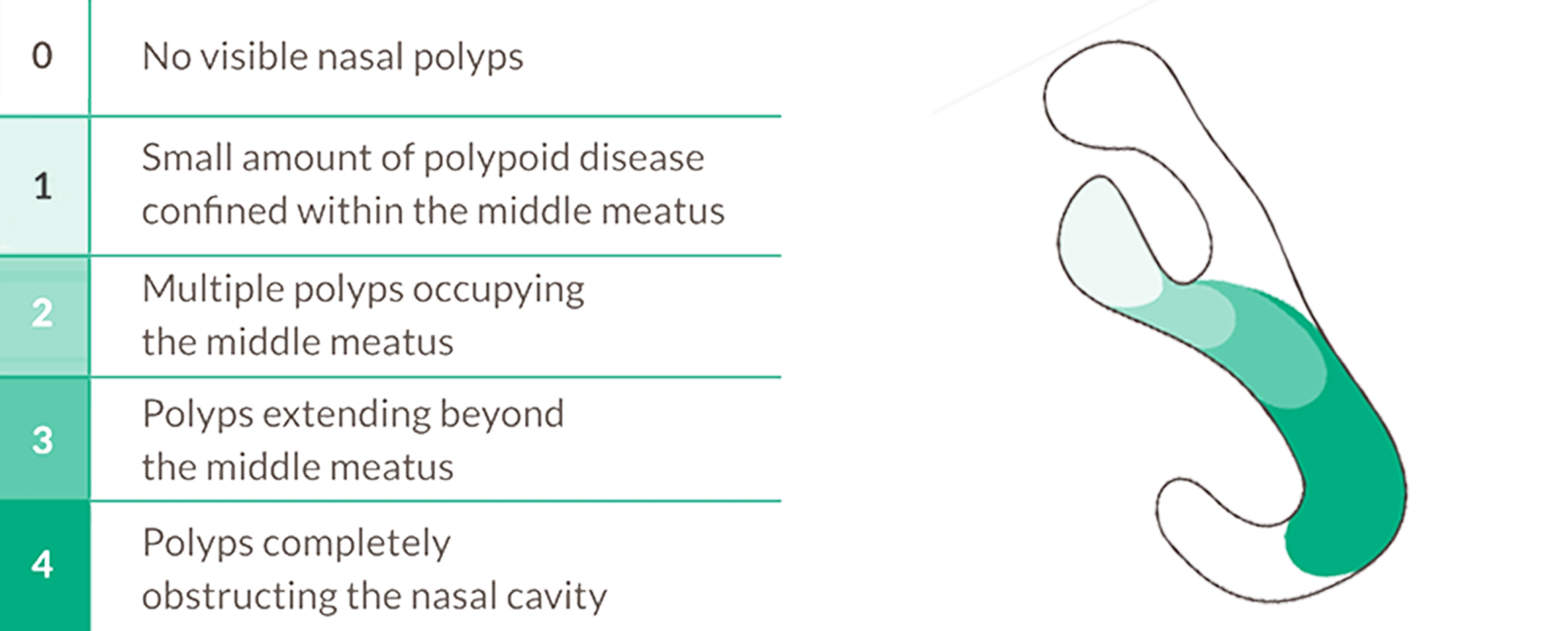
Bilateral endoscopic NPS is a grading system used during nasal endoscopy to quantify the size and extent of nasal polyps in each nasal cavity. Each cavity is scored from 0 (no polyps) to 4 (polyps completely obstructing the nasal cavity). The bilateral score is the sum of both sides, ranging from 0 to 8.10
Patients regained smell as early as Day 3 (post-hoc analysis)g,3
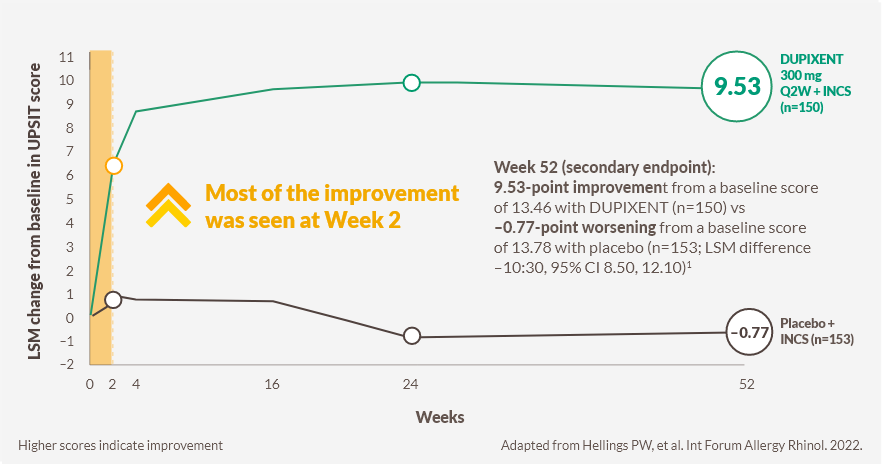
DUPIXENT improved loss of smell score (LoS) as early as Day 3g (post-hoc analysis) vs placebo, and improved sense of smell, as measured by UPSIT score, from Week 2h (post-hoc analysis) sustained through Week 52, in patients receiving INCS1–4
Change in UPSIT score through Week 52 in SINUS-52 (secondary endpoint)3
CI, confidence interval; INCS, intranasal corticosteroids; LSM, least squares mean; Q2W, every 2 weeks; UPSIT, University of Pennsylvania Smell Identification Test
LoS is a patient‑collected assessment of the daily symptom severity of decreased or loss of smell, from (0 no symptoms) to 3 (severe symptoms).4
UPSIT is a standardised 40-item scratch-and-sniff test in which patients identify odours from multiple-choice options, yielding a score from 0 to 40.4

2 out of 3 patients treated with DUPIXENT had improved sense of smell at week 24 (n=295, pooled DUPIXENT armsi)1,2
SINUS-52: 79.4% (n=228/287) of patients in the pooled DUPIXENT arms had anosmia (UPSIT score ≤18) at baseline, which was reduced to 30.0% (n=84/280) at Week 24, with almost no change observed in the placebo group (76.7% [n=115/150] at baseline vs 76.6% [n=111/145] at Week 24).2
gPooled SINUS-24/SINUS-52 Day 3: LSM difference between DUPIXENT (n=438) and placebo (n=286); –0.07 (95% difference CI –0.12 to –0.02; nominal P<0.01).4
hPooled SINUS-24/SINUS-52 Week 2: DUPIXENT (n=438) significantly improved UPSIT scores from baseline by an LSM difference of 6.81 (95% CI 5.90 to 7.73) vs 1.28 (95% CI 0.23 to 2.33) in the placebo group (n=286) (nominal P<0.001).4
iBoth DUPIXENT arms in SINUS-52 received DUPIXENT 300 mg Q2W from baseline to Week 24.2
Less surgery for a majority of patients2
In a prespecified pooled analysis, DUPIXENT significantly reduced the need for sinus surgery vs placebo over 52 weeks in patients receiving INCS2

83% reduction in the need for initial or repeat sinus surgery vs placebo1,2
1.1% required rescue nasal polyp surgery with DUPIXENT (pooled DUPIXENT Q2W arms, n=438) vs 7.7% with placebo (pooled placebo, n=286) (hazard ratio [HR] 0.174; 95% CI 0.066 to 0.462)i,1,2
DUPIXENT targets type 2 inflammation to reduce the need for systemic steroids2
In a prespecified pooled analysis, DUPIXENT reduced the need for systemic steroids vs placebo over 52 weeks in patients receiving INCS2
74% reduction in the need for systemic corticosteroid use vs placebo1,2
9.4% required rescue systemic corticosteroids with DUPIXENT (pooled DUPIXENT Q2W arms, n=438) vs 30.8% with placebo (pooled placebo, n=286) (HR 0.261; 95% Cl 0.179 to 0.379)i,1,2
iFor the proportion of patients requiring systemic corticosteroids or nasal polyp surgery (actual or planned) during the treatment period, the entire DUPIXENT Q2W treatment period was pooled (group A up to 52 weeks and B up to 24 weeks from SINUS-52 and the DUPIXENT group from SINUS-24) from both studies, and a forced censor was included for the SINUS-52 group B at week 24. The entire placebo treatment period, of up to 52 weeks for SINUS-52 and up to 24 weeks for SINUS-24, was pooled as well.1,2
Patients reported improved symptoms and HRQoL1,2
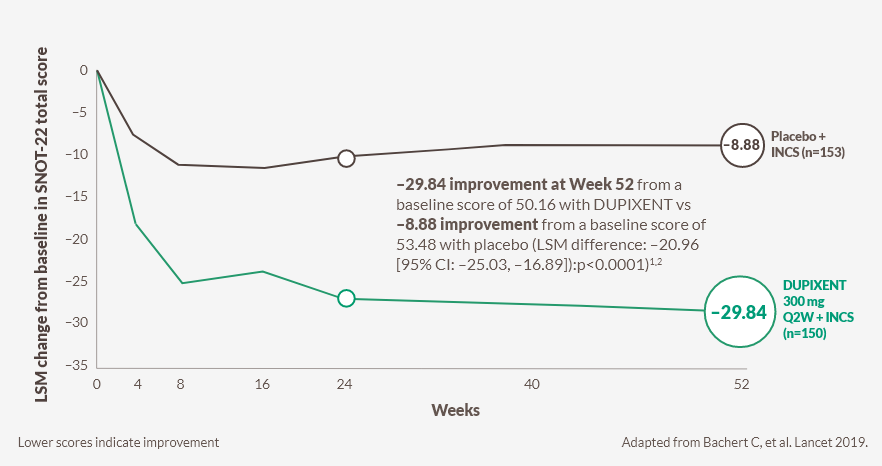
DUPIXENT significantly decreased SNOT-22 scores vs baseline at Week 24k sustained through Week 52, in patients receiving INCS2
Change in SNOT‑22 score through Week 52 in SINUS-52 (secondary endpoint)2
The maximum SNOT‑22 score is 110.26
The meaningful clinically important difference is 8.9. Lower scores indicate better health‑related quality of life.27
CI, confidence interval; INCS, intranasal corticosteroids; LSM, least squares mean; Q2W, every 2 weeks; SNOT ‑22, 22 ‑item Sinonasal Outcome Test
DUPIXENT significantly decreased SNOT-22 score vs placebo as early as Week 8 (post-hoc analysis)J,2
jPooled SINUS‑24/SINUS‑52 Week 8 (post-hoc analysis): DUPIXENT (n=438) significantly improved SNOT‑22 scores vs placebo by an LSM difference of –14.8 (95% CI –17.4 to –12.2: P<0.0001).3
kWeek 24 ( SINUS‑52): –27.77 improvement from a baseline score of 50.16 with DUPIXENT vs –10.40 improvement from a baseline score of 53.46 with placebo (LSM difference: –17.36 [95% CI –20.87 to –13.85]: p<0.0001).1,2
DUPIXENT improved a composite score, including physical symptoms, sleep and fatigue issues, and psychosocial limitations2
SNOT-22 questionnaire is a patient‑reported assessment of 22 symptoms and consequences of CRSwNP:26
1. Need to blow nose
2. Nasal blockage
3. Sneezing
4. Runny nose
5. Cough
6. Post-nasal discharge
7. Thick nasal discharge
8. Decreased sense of smell/taste
9. Ear fullness
10. Dizziness
11. Ear pain
12. Facial pain/pressure
13. Difficulty falling asleep
14. Wake up at night
15. Lack of a good night’s sleep
16. Wake up tired
17. Fatigue
18. Reduced productivity
19. Reduced concentration
20. Frustrated/restless/irritable
21. Sad
22. Embarrassed
ABBREVIATIONS
ACQ-6, six-item Asthma Control Questionnaire; CI, confidence interval; CRSwNP, chronic rhinosinusitis with nasal polyps; EPOS, European Position Paper on Rhinosinusitis and Nasal Polyps 2020; EUFOREA, European Forum for Research and Education in Allergy and Airway; FEV1, forced expiratory volume in 1 second; HRQoL, health‑related quality of life; ICAR‑RS, International Consensus Statement on Allergy and Rhinology; IL‑4/13, interleukin‑4/13; INCS, intranasal corticosteroids; LoS, loss of smell score; LSM, least squares mean; LMK‑CT, Lund‑Mackay computed tomography; NC, nasal congestion/obstruction; NP, nasal polyps; NPS, nasal polyp score; OCS, oral corticosteroids; OSN, olfactory sensory neurons; Q2/4W, every 2/4 weeks; SD, standard deviation; SNOT‑22, 22‑item Sinonasal Outcome Test; UPSIT, University of Pennsylvania Smell Identification Test
REFERENCES
- DUPIXENT (dupilumab) Summary of Product Characteristics (UK).
- Bachert C, et al. Lancet. 2019;394(10209):1638‑50.
- Hellings PW, et al. Int Forum Allergy Rhinol. 2022;12(7):958‑62.
- Canonica GW, et al. J Allergy Clin Immunol Pract. 2022;10(6):1515‑26.
- Bachert C, et al. J Asthma Allergy. 2021;14127‑34.
- XOLAIR (omalizumab). Summary of Product Characteristics.
- NUCALA (mepolizumab). Summary of Product Characteristics.
- Gandhi NA, et al. Nat Rev Drug Discov. 2016;15(1):35‑50.
- Maspero J, et al. ERJ Open Res. 2022;8(3):00576‑2021.
- Han JK, et al. Laryngoscope. 2022;132(2):265-271.
- Ferguson BJ, et al. Categorization of nasal polyps. In: Önerci TM, J. FB, editors,eds. Nasal Polyposis: Springer‑Verlag; 2010. p. 103‑10.
- Bachert C, et al. J Allergy Clin Immunol. 2020;145(3):725‑39.
- Sanofi. Data on File. SUPP‑2202664. 10 November 2022.
- Chung JH, et al. Ann Otol Rhinol Laryngol. 2015;124(8):663‑70.
- De Corso E et al. Acta Otolaryn. 2023;43(suppl 1):S3–S13.
- Yan X, et al. Laryngoscope Investig Otolaryngol. 2020;5(6):992‑1002.
- Macchi A, et al. Front Allergy. 2023;41083964.
- Mullol J, et al. J Allergy Clin Immunol. 2020;145(3):773‑76.
- DeConde AS, et al. Laryngoscope. 2017;127(3):550‑55.
- Smith KA, et al. Int Forum Allergy Rhinol. 2019;9(4):402‑08.
- Hopkins C, Lund V. Rhinology. 2021;59(3):277‑83.
- Lourijsen ES, et al. Lancet Respir Med. 2022;10(4):337‑46.
- Fokkens WJ, et al. Rhinology. 2023;61(3):194‑202.
- Hox V, et al. Clin Transl Allergy. 2020;101.
- Orlandi RR, et al. Int Forum Allergy Rhinol. 2016;6 Suppl 1S22‑209.
- Khan AH, et al. Laryngoscope. 2022;132(5):933‑41.
- Hopkins C, et al. Clin Otolaryngol. 2009;34(5):447–54.
- Juniper EF et al. Respir Med. 2005;99:553–58.