- Article
- Source: Campus Sanofi
- 19 Dec 2025
Unmet needs
Current therapies: Gaps in disease control and persistent burden. While current therapies for ITP, wAIHA, and SCD may target specific immune pathways, they often fail to address the complex immune dysregulation underlying these diseases or are hindered by safety and tolerability concerns.
| Class | MOA | Limitations and AEs |
| Streoids1-3 | Broad immunosuppression | • Avoid long-term use due to safety concerns |
| IVIg and Anti-D3-5 | Blockade of FcRs, targeting autoantibody-mediated destruction | • Transient results |
| Hematopoietic growth factors4 | Simulate production and maturation of blood cells | • Do not impact B cells or address autoantibody production or inflammation |
| Biologics1,6,7 | Target specific cells or cytokines | • Might not address the multiple dysregulated pathways involved |
| First-generation kinase inhibitors1 | Block intracellular kinase signaling | • Can lead to off-target effects due to limited selectivity, resulting in safety concerns |
Advances in kinase inhibitor design have led to the development of more selective agents, with the goal of reducing off-target effects1
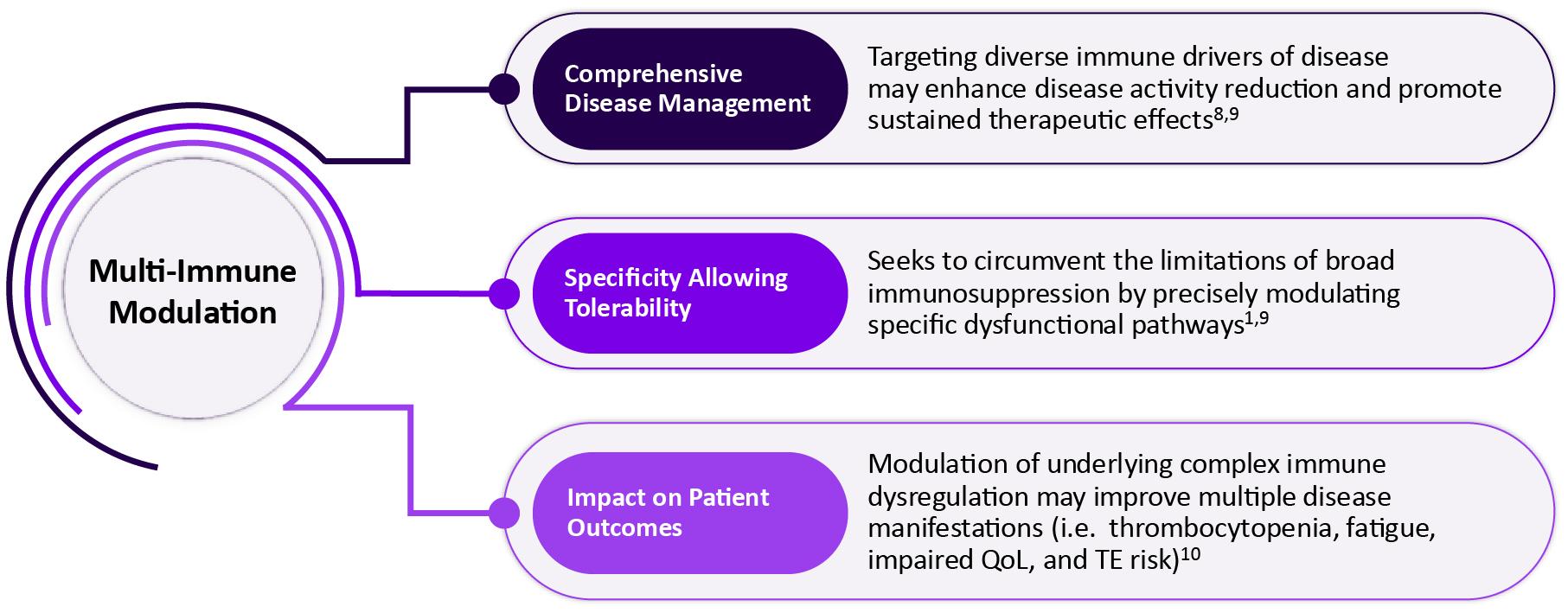
Multi-immune modulation: A comprehensive yet targeted approach for complex immune dysregulation
.jpg)
Abbreviations:
FcR, Fc receptor; IVIg, intravenous immune globulin; ITP, immune thrombocytopenia; MOA, mechanism of action; SCD, sickle cell disease; wAIHA, warm autoimmune hemolytic anemia. QoL, quality of life, TE, thromboembolism
- Jung SM, Kim WU. Immune Netw. 2022;22(1):e9.
- Cooper N, Ghanima W. N Engl J Med. 2019;381(10):945-955.
- Liu XG, et al. J Hematol Oncol. 2023;16(1):4.
- Labanca C, et al. Eur J Haematol. 2025;115(1):4-15.
- Almizraq JA, Branch DR. Ann Blood. 2021;6:2.
- Cooper N, et al. Presented at American Society of Hematology Congress 2024. Poster 3836.
- Mahadevia H, et al. Ann Hematol. 2025;104(2):881-893.
- Langrish CL, et al. J Immunol. 2021;206:1454-1468.
- McDonald C, et al. Immunology. 2021;164(4):722-736.
- Kuter DJ, Ghanima W. Immunotherapy. 2025;17(11):767-782.
MAT-KW-2600101-V1-Mar-2026