


Treatment recommendations have evolved to include CABLIVI, PEX, and immunosuppression1

Early initiation of CABLIVI is recommended for acute aTTP events (initial and relapsing)1*

Starting CABLIVI early is believed to have the greatest benefit during an acute aTTP event (initial or relapsing)1*
A conditional recommendation,* defined as desirable effects of the recommendation probably outweighing the undesirable effects. Assumes timely access to ADAMTS13 testing and clinical diagnosis based on high likelihood of aTTP. If ADAMTS13 testing is not available, do not add CABLIVI13
*Assumes high likelihood of aTTP (based on clinical assessment or a formal clinical risk assessment tool) and timely access to ADAMTS13 testing. In low or intermediate likelihood of aTTP, CABLIVI may be started after ADAMTS13 testing confirms a diagnosis.13
ADAMTS13=a disintegrin and metalloproteinase with a thrombospondin type 1 motif, 13; ISTH=International Society on Thrombosis and Haemostasis.
CABLIVI-specific treatment recommendation1

Recommendation 5
- For patients with aTTP experiencing an acute event (first event or relapse), the panel suggests using CABLIVI over not using CABLIVI (a conditional recommendation in the context of moderate certainty evidence)

Recommendation informed by data of moderate certainty, based on randomized controlled trials
- The panel also believed that the greatest benefit of CABLIVI is accrued if it is started in the early phase of an acute TTP event (ie, at the time when a diagnosis is confirmed)
- Use of CABLIVI depends on the accessibility of clinicians to timely* and reliable ADAMTS13 testing (either for the initiation of therapy or for confirming the diagnosis if therapy has been started)
- When treating physicians are considering CABLIVI, they should consider administration of the drug before the results of ADAMTS13 activity become available. The panel noted this raises the possibility of overuse in patients who do not actually have aTTP
*The panel considered ADAMTS13 activity test with results available in less than 72 hours to be ideal and the results available between 72 hours and 7 days as being acceptable.
ADAMTS13=a disintegrin and metalloproteinase with a thrombospondin type 1 motif, 13.
Clinical presentation13
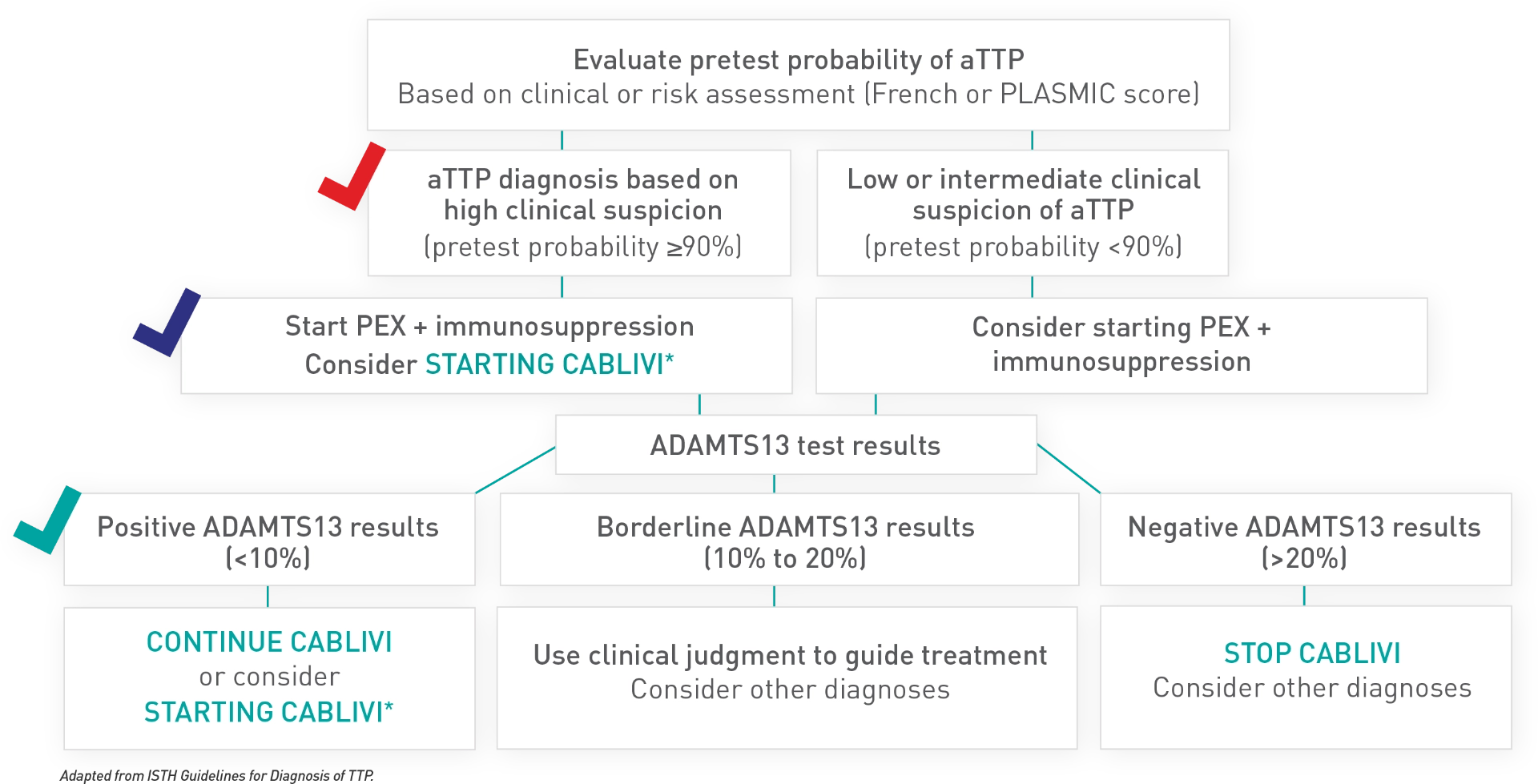
*Assumes high likelihood of aTTP (based on clinical assessment or a formal clinical risk assessment tool) and timely access to ADAMTS13 testing. In low or intermediate likelihood of aTTP, CABLIVI may be started after ADAMTS13 testing confirms a diagnosis.
ADAMTS13=a disintegrin and metalloproteinase with a thrombospondin type 1 motif, member 13; ISTH=International Society on Thrombosis and Haemostasis ; PLASMIC=platelet count + combined hemolysis variable + absence of active cancer + absence of stem cell or solid-organ transplant + mean corpuscular volume + international normalized ratio + creatinine.
Risk assessment tools can be used to predict ADAMTS13 deficiency
- Risk assessment tools—French and PLASMIC scores—can be used to predict ADAMTS13 deficiency13
- Scores are based on laboratory parameters such as platelet count and creatinine level13
- Evidence for specific scores was not evaluated; therefore, no specific scoring system is recommended13
PLASMIC and French scores do not confirm an aTTP diagnosis, which is based on the activity of ADAMTS13 and anti-ADAMTS13 antibodies, but they can be a valid help in cases of diagnostic suspicion to quickly identify if a patient needs emergency treatment.14-16
ADAMTS13=a disintegrin and metalloproteinase with a thrombospondin type 1 motif, 13; PLASMIC=platelet count + combined hemolysis variable + absence of active cancer + absence of stem cell or solid-organ transplant + mean corpuscular volume + international normalized ratio + creatinine.
PLASMIC score14,15
The PLASMIC score can predict severe ADAMTS13 deficiency as criteria for identifying a patient with probable TTP.
| PARAMETER | SCORE |
| Platelet count <30 × 109/L | +1 |
| Serum creatinine level <2.0 mg/dL | +1 |
|
Evidence of haemolysis*: Indirect bilirubin >2.0 mg/dL
| +1 |
| No active cancer in previous year* | +1 |
| No history of solid organ or stem cell transplantation* | +1 |
| International normalized ratio (INR) <1.5* | +1 |
| MCV <90 fL (<9.0 × 10⁻¹⁴/L)† | +1 |
|
Likelihood of severe
|
Low risk 0 to 4: 0% to 4%
|
FRENCH score14,15
| PARAMETER | SCORE |
| Platelet count <30 × 109/L | +1 |
| Serum creatinine level <2.25 mg/dL | +1 |
|
Prediction of severe ADAMTS13 deficiency (activity <10%) based on score‡ | 0: 2%
1: 70% 2: 94% |
Adapted from Coppo P et al. Res Pract Thromb Haemost. 2018;16;3(1):26-37.
* The French score considers patients with a thrombotic microangiopathy syndrome (which includes hemolysis and schistocytes in the definition) and assumes that there is no history of or clinical evidence for associated cancer, transplantation, or disseminated intravascular coagulopathy, so these terms are intrinsic to the score.15
†MCV was not incorporated into the French score.15
‡ Results correspond to those of the derivation cohort and those of a validation by (French score) the bootstrap resampling technique (internal validation) or (PLASMIC score) different samples of patients from the same institution (internal validation) or from a different institution (external validation).15
ADAMTS13=a disintegrin and metalloproteinase with a thrombospondin type 1 motif, 13; MCV=mean corpuscular volume; PLASMIC=platelet count + combined hemolysis variable + absence of active cancer + absence of stem cell or solid-organ transplant + mean corpuscular volume + international normalized ratio + creatinine.
ISTH Guidelines: Key points
| CABLIVI is recommended with PEX and immunosuppression to treat both initial and relapsing events in adults with aTTP1 | Reinforces the CABLIVI label and validates the efficacy and safety seen in the HERCULES trial17 |
| For adult patients with aTTP (pretest probability is ≥90%), consider starting CABLIVI early with PEX and immunosuppression prior to receiving ADAMTS13 results13 | Validates the early use of CABLIVI in accordance with the HERCULES trial design and CABLIVI label17 |
| Continue (or start) CABLIVI when ADAMTS13 activity is <10%13 | Reinforces the CABLIVI label and validates the efficacy and safety seen in the HERCULES trial17 |
A conditional recommendation defined as desirable effects of the recommendation probably outweighing the undesirable effects. Assumes timely access to ADAMTS13 testing and clinical diagnosis based on high likelihood of aTTP. If ADAMTS13 testing is not available, do not add CABLIVI.13
ADAMTS13=a disintegrin and metalloproteinase with a thrombospondin type 1 motif, 13; ISTH=International Society on Thrombosis and Haemostasis