- Article
- Source: Campus Sanofi
- Dec 9, 2025
Learn how to recognize and manage Gaucher disease type 3

Gaucher disease at a glance
Gaucher disease is:
- A rare, heterogeneous condition that is classified into 3 types based on the presence or absence and the progression rate of neurologic symptoms1,2
- An inherited lysosomal disorder caused by pathogenic variants in the GBA1 gene encoding acid β-glucosidase3
- Estimated to occur in about 1 in 40,000 to 1 in 100,000 individuals in the general population, depending on subtype4
Gaucher disease has 3 subtypes

Gaucher disease type 1 is the non-neuronopathic type. It is the most common subtype in the United States with a much higher prevalence in the Ashkenazi Jewish population (1 in 500 to 1 in 1000).3,5 56% of patients with Gaucher disease type 1 experience symptoms before 20 years old.6

Less than 10% of patients with Gaucher disease in the United States have neurological symptoms, although the prevalence may be higher in other parts of the world.7 These patients are classified as having either Gaucher disease type 2 or Gaucher disease type 3.6 Gaucher disease type 2 is the acute neuronopathic type that affects patients in infancy—typically fatal by age 4 years, except when extreme life support measures are applied.2,3
Gaucher disease type 3 is the chronic neuronopathic type, but progresses more slowly and is more common than Gaucher disease type 2.3,7
Approximately 50% of patients with Gaucher disease type 3 will display some signs of neurological manifestations by 2 years of age8
Within Gaucher disease type 3, symptom type, onset, and severity are markedly variable7
Patients with Gaucher disease type 3 can exhibit early onset of severe hematological and visceral disease and growth delay throughout childhood, which can be accompanied or followed by the development of neurological symptoms.1,9,10
Gaucher disease type 3–specific symptoms

Eye abnormalities, which may be observed as gaze palsy with markedly slow or absent horizontal saccades11

Movement disorders, which are observed as ataxia, seizures, myoclonic epilepsy, tremor, and/or dystonia11

Cognitive symptoms, manifesting as a spectrum ranging from mild cognitive impairment to severe intellectual disability12

Hydrocephalus13
Aortic calcification and coronary artery disease13

Hyperreflexia—where exaggerated deep tendon reflexes are observed2,14

Bulbar disorders, which are observed as stridor, dysphagia, and/or dysarthria2
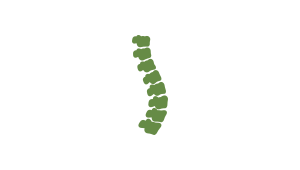
Excessive curving of the spine (kyphosis)2
Symptoms of Gaucher disease type 3 that overlap with other subtypes
Visceral, including hepatomegaly and splenomegaly9

Hematologic, including anemia and thrombocytopenia9
Skeletal, including bone pain, bone marrow infiltration, and loss of bone density2,11
Identifying Gaucher disease type 3
Gaze palsy and extensive visceral involvement are symptoms that are commonly found together in patients with Gaucher disease type 3.2,13 However, other manifestations of Gaucher disease type 3, such as myoclonic epilepsy, aortic calcification, coronary artery disease, or hydrocephalus may occur together, independent of more common symptoms.2,13
What to know about an important symptom, gaze palsy:
- Can be the first manifestation specific to type 32
- Can occur early in childhood2
- Head thrusts and/or blinking may be signs of a patient compensating for ocular dysfunction2
- May be isolated or associated with other neurological symptoms2
- Absence does not rule out a diagnosis of type 315
Gaze palsy, a pivotal sign of neuronopathic Gaucher disease, is often the first observed manifestation of Gaucher disease type 32
Hallmark differences between Gaucher disease type 1 and Gaucher disease type 3
Variable and overlapping manifestations of Gaucher disease type 1 and Gaucher disease type 3 can lead to delays in proper subtyping/classification.10,11
|
Visceral |
Hematologic |
Skeletal |
Neurologic |
Cardiovascular calcifications | |
| Type 17,9,* (non-neuronopathic) |
X |
X |
X | ||
| Type 32,9,11,* (chronic neuropathic) |
X |
X |
X** |
X† |
X‡ |
*Patients don’t always have all symptoms.
**Including excessive curving of the spine (kyphosis).2
†Including central nervous system manifestations.2
‡In some rare cases, only with GD3c subtype.
Challenges of proper classification
Identifying the symptoms that distinguish Gaucher disease type 1 from Gaucher disease type 3 is not straightforward. Over time, patients should be frequently assessed for the emergence of neurological symptoms.10,16
Central nervous system symptoms may appear several years after visceral symptoms present, even in patients initially identified as having Gaucher disease type 1 who were subsequently treated.11 As Gaucher disease type 3 progresses, the range of neurologic symptoms experienced by patients expands and worsens in severity.1,11,17
Timely identification of neurological symptoms is crucial to distinguishing Gaucher disease type 1 from Gaucher disease type 3, avoiding diagnostic delays, and addressing symptoms before they progress to a severe stage7,11
Importance of early diagnosis, classification, and management of Gaucher disease
Gaucher disease can be diagnosed and confirmed with enzyme and genetic testing18

Deficiency in the enzyme β-glucosidase confirms a diagnosis of Gaucher disease18

Confirmation of Gaucher disease can also be based on detecting pathogenic variants in the GBA1 gene2
Proper monitoring is key
All patients with Gaucher disease should have a comprehensive baseline evaluation of their hematologic, visceral, pulmonary, skeletal, and neurological health.11 Because symptoms that impact the central nervous system may appear several years after visceral symptoms, careful and consistent neurological examinations are critical to the proper classification and management of Gaucher disease.11,16
Regular monitoring of neurologic onset and progression

Neurological examinations are recommended every 3 months during Year 1, every 6 months thereafter in recently diagnosed patients, and once a year in patients whose systemic manifestations have stabilized after treatment16

If patients initially present with normal eye movement, testing should be repeated, and peripheral hearing tests should be performed every 2 or 3 years16
Management goals
Proper classification of Gaucher disease is useful in determining prognosis and management while helping healthcare teams provide proactive and comprehensive care.11

Management strategies should be based on an individualized approach to care, as uncontrolled progression or the emergence of skeletal or neurological manifestations could necessitate changes in care regimens.19,20

Although approved therapies cannot address the neurological symptoms of Gaucher disease type 3, early detection and treatment can help avoid irreversible bone and visceral damage.1
An individualized approach to patient care is essential when monitoring and managing Gaucher disease type 319
References: 1. Gary SE, Ryan E, Steward AM, Sidransky E. Recent advances in the diagnosis and management of Gaucher disease. Expert Rev Endocrinol Metab. 2018;13(2):107-118. 2. Schiffmann R, Sevigny J, Rolfs A, et al. The definition of neuronopathic Gaucher disease. J Inherit Metab Dis. 2020;43(5):1056-1059. 3. Nalysnyk L, Rotella P, Simeone JC, Hamed A, Weinreb N. Gaucher disease epidemiology and natural history: a comprehensive review of the literature. Hematology. 2017;22(2):65-73. 4. Mistry PK, Belmatoug N, vom Dahl S, Giugliani R. Understanding the natural history of Gaucher disease. Am J Hematol. 2015;90(suppl 1):S6-S11. 5. National Human Genome Institute. About Gaucher disease. National Institutes of Health. Updated January 4, 2012. www.genome.gov/Genetic-Disorders/Gaucher-Disease 6. Stirnemann J, Belmatoug N, Camou F, et al. A review of Gaucher disease pathophysiology, clinical presentation and treatments. Int J Mol Sci. 2017;18(2):441. 7. El-Beshlawy A, Tylki-Szymanska A, Vellodi A, et al. Long-term hematological, visceral, and growth outcomes in children with Gaucher disease type 3 treated with imiglucerase in the International Collaborative Gaucher Group Gaucher Registry. Mol Genet Metab. 2017;120(1-2):47-56. 8. Tylki-Szymańska A, Vellodi A, El-Beshlawy A, Cole JA, Kolodny E. Neuronopathic Gaucher disease: demographic and clinical features of 131 patients enrolled in the International Collaborative Gaucher Group Neurological Outcomes Subregistry. J Inherit Metab Dis. 2010;33(4):339-346. 9. Deegan PB, Cox TM. Imiglucerase in the treatment of Gaucher disease: a history and perspective. Drug Des Devel Ther. 2012;6:81-106. 10. Weinreb NJ, Goker-Alpan O, Kishnani PS, et al. The diagnosis and management of Gaucher disease in pediatric patients: where do we go from here? Mol Genet Metab. 2022;136(1):4-21. 11. Zhong W, Li D, Fei Y, Hong P. A review of type 3 Gaucher disease: unique neurological manifestations and advances in treatment. Acta Neurol Belg. 2024;124(4):1213-1223. 12. Daykin EC, Ryan E, Sidransky E. Diagnosing neuronopathic Gaucher disease: new considerations and challenges in assigning Gaucher phenotypes. Mol Genet Metab. 2021;132(2):49-58. 13. Mistry PK, Lopez G, Schiffmann R, Barton NW, Weinreb NJ, Sidransky E. Gaucher disease: progress and ongoing challenges. Mol Genet Metab. 2017;120(1-2):8-21. 14. Cleveland Clinic. Hyperreflexia. Reviewed May 9, 2023. Accessed: October 20, 2025. https://my.clevelandclinic.org/health/symptoms/24967-hyperreflexia 15. Lu WL, Chien YH, Tsai FJ, et al. Changing clinical manifestations of Gaucher disease in Taiwan. Orphanet J Rare Dis. 2023;18(1):293-303. 16. Vellodi A, Tylki-Szymanska A, Davies EH, et al. Management of neuronopathic Gaucher disease: revised recommendations. J Inherit Metab Dis. 2009;32(5):660-664. 17. El-Beshlawy A, Abdel-Azim K, Abdel-Salam A, et al. Egyptian Gaucher disease type 3 patients: a large cohort study spanning two decades. J Rare Dis. 2023;2(7). doi:10.1007/s44162-023-00011-0 18. Grabowski GA. Phenotype, diagnosis, and treatment of Gaucher's disease. Lancet. 2008;372(9645):1263-1271. 19. Pastores GM, Weinreb NJ, Aerts H, et al. Therapeutic goals in the treatment of Gaucher disease. Semin Hematol. 2004;41(suppl 5):4-14. 20. Weinreb NJ, Aggio MC, Andersson HC, et al. Gaucher disease type 1: revised recommendations on evaluations and monitoring for adult patients. Semin Hematol. 2004;41(4 suppl 5):15-22.
MAT-US-2512260-v1.0-10/2025
