Lantus® (insulin glargine) injection 100 Units/mL logo

Lantus® (insulin glargine) injection 100 Units/mL Demonstrated Safety and Improved Glycemic Control Vs NPH (Neutral Protamine Hagedorn)1,2

Healthcare professionals have chosen Lantus for over 25 years¹


Lantus was evaluated for 52 weeks in adults with type 2 diabetes poorly controlled with OADs

Mean A1C Levels
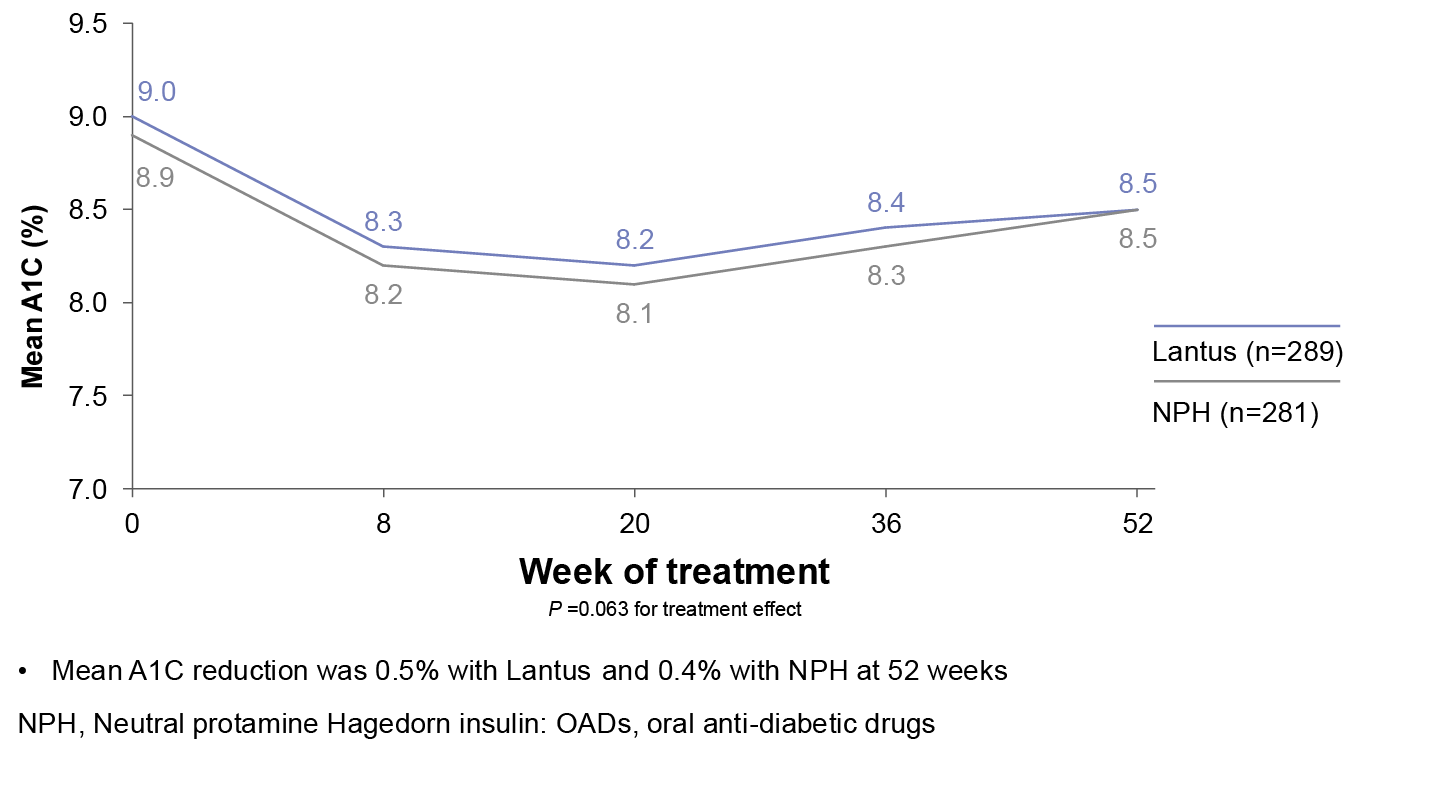
Line graph showing mean A1C (%) over 52 weeks for Lantus (n=289) and NPH (n=281). The y-axis ranges from 7.0% to 9.5%, and the x-axis shows weeks of treatment. At baseline, Lantus is at 9.0% and NPH is at 8.9%. At week 8, Lantus is at 8.3% and NPH at 8.2%. Around week 20 shows Lantus at 8.2% and NPH at 8.1%. At week 36, Lantus is at 8.4% and NPH at 8.3%. At week 52, Lantus and NPH are at 8.5%. A note under the x-axis reads: “P=0.063 for treatment effect.”

Insulin dose and reductions in FPG (Fasting plasma glucose) during a 52-week study
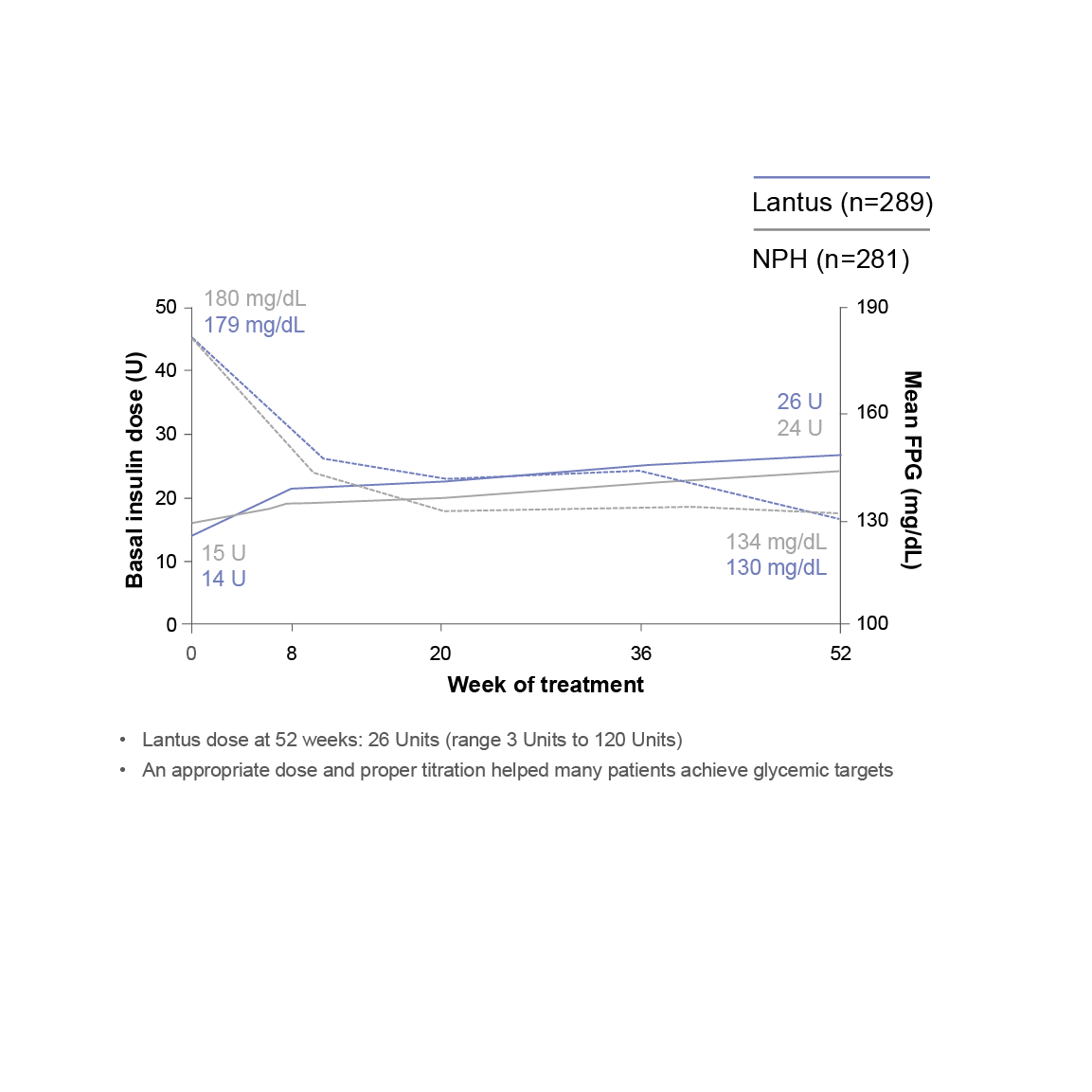
Line graph of Lantus (n=289) and NPH (n=281) over 52 weeks. The x-axis shows week of treatment, the left y-axis shows basal insulin dose (U), and the right y-axis shows mean FPG (mg/dL). At Week 0, Lantus: 15 U and 180 mg/dL; NPH: 14 U and 179 mg/dL. At week 52, Lantus: 26 U and 134 mg/dL; NPH: 24 U and 130 mg/dL.
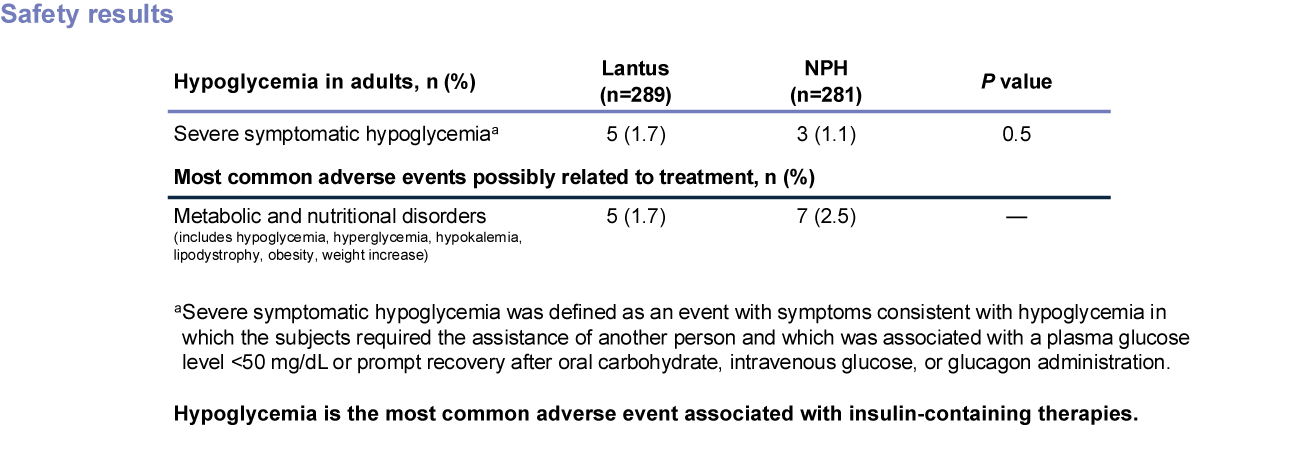
Table listing hypoglycemia, (n%) and most common adverse events possibly related to treatment, n(%) Lantus (n=289) and NPH (n=281). For severe symptomatic hypoglycemia, 1.7% of patients (5 individuals) in the Lantus group and 1.1% (3 individuals) in the NPH group, with a p-value of 0.5. For most common adverse events possibly related to treatment, metabolic and nutritional disorders (includes hypoglycemia, hyperglycemia, hypokalemia, lipodystrophy, obesity, and weight increase) occurring in 1.7% (5 individuals) for Lantus and 2.5% (7 individuals) for NPH. The p-value for this is not provided. A note *Severe symptomatic hypoglycemia was defined as an event with symptoms consistent with hypoglycemia in which the subjects required the assistance of another person and which was associated with a plasma glucose level <50mg/dL or prompt recovery after oral carbohydrate, intravenous glucose, or glucagon administration.


Hypoglycemia is the most common adverse event associated with insulin-containing therapies.

Study Design

A 52-week randomized study (N=570) designed to compare efficacy and safety of Lantus plus OADs vs NPH plus OADs in patients with type 2 diabetes poorly controlled with OADs. Patients were randomized to either Lantus (n=289) or NPH (n=281) at bedtime to reach a target FPG of <120 mg/dL. OADs were continued. Initial insulin dose and titration schedule were left to the discretion of the individual investigators. Primary endpoint was change in A1C.

IN A TREAT-TO-TARGET PEDIATRIC TRIAL WITH NPH1,3

In a pediatric clinical study, children and adolescents with T1DM had a higher incidence of severe symptomatic hypoglycemia in the 2 treatment groups (Lantus or NPH) compared to adult trials with type 1 diabetes.

  • Baseline A1C was 8.48% and 8.81% for the Lantus and NPH groups, respectively
  • The relative change in A1C at 28 weeks was +0.28% for the Lantus group (n=174) and +0.27% for the NPH group (n=175)

Once-daily pediatric dosing

In the same pediatric trial

  • 35% of patients on NPH needed to inject twice as often as patients on once-daily Lantus in order to maintain comparable A1C levels
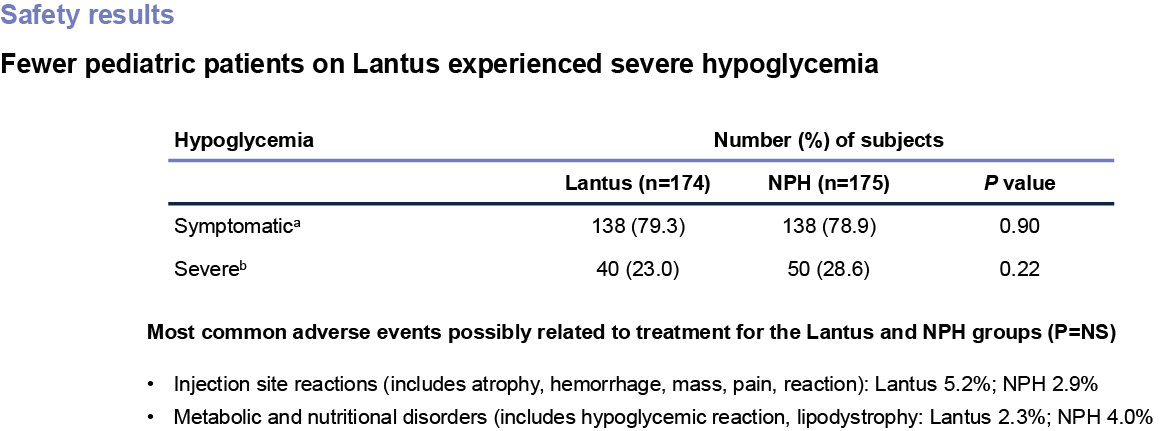
   

Table showing hypoglycemia rates in Lantus (n=174) and NPH (n=175) groups. For symptomatic hypoglycemia, Lantus had 138 subjects (79.3%) and NPH had 138 subjects (78.9%), with a p-value of 0.90. For severe hypoglycemia, Lantus had 40 subjects (23.0%) and NPH had 50 subjects (28.6%), with a p-value of 0.22.

Hypoglycemia is the most common adverse event associated with insulin-containing therapies.

Study Design

A 28-week, randomized, open-label, multicenter study of 349 patients with type 1 diabetes (aged 6-15) who received once-daily Lantus (n=174) or once- or twice-daily NPH (n=175) in combination with regular human insulin as the mealtime insulin. The primary efficacy measure was mean change in A1C from baseline.

aSymptomatic hypoglycemia was defined as any event with clinical symptoms that could be confirmed by BG level <50 mg/dL.
bSevere hypoglycemia was defined as an event with symptoms consistent with hypoglycemia in which the subjects required the assistance of another person and which was associated with a BG level <50 mg/dL or prompt recovery after oral carbohydrate, intravenous glucose, or glucagon administration. This definition is consistent with that used in the Diabetes Control and Complications Trial.

Important Safety Information

Important Safety Information for Lantus (insulin glargine injection) 100 Units/mL

Contraindications
Lantus is contraindicated during episodes of hypoglycemia and in patients with hypersensitivity to insulin glargine or any of the excipients in LANTUS.

Warnings and Precautions
Insulin pens, needles, or syringes must never be shared between patients. Do NOT reuse needles.

Monitor blood glucose in all patients treated with insulin. Modify insulin regimen only under medical supervision. Changes in insulin regimen including, strength, manufacturer, type, injection site or method of administration may result in the need for a change in insulin dose or an adjustment in concomitant drugs.

Repeated insulin injections into areas of lipodystrophy or localized cutaneous amyloidosis may result in hyperglycemia; sudden change in the injection site (to unaffected area) has been reported to result in hypoglycemia. Advise patients to rotate injection site to unaffected areas and closely monitor for hypoglycemia.

Do not dilute or mix Lantus with any other insulin or solution. If mixed or diluted, the solution may become cloudy, and the onset of action/time to peak effect may be altered in an unpredictable manner. Do not administer Lantus via an insulin pump or intravenously because severe hypoglycemia can occur.

Hypoglycemia is the most common adverse reaction of insulin therapy, including Lantus, and may be life-threatening.

Hypoglycemia due to medication errors, such as accidental mix-ups between basal insulin products and other insulins, particularly rapid-acting insulins, have been reported. Patients should be instructed to always verify the insulin label before each injection.

Severe life-threatening, generalized allergy, including anaphylaxis, can occur. Discontinue Lantus, treat and monitor until symptoms resolve.

A reduction in the Lantus dose may be required in patients with renal or hepatic impairment.

As with all insulins, Lantus use can lead to life-threatening hypokalemia. Untreated hypokalemia may cause respiratory paralysis, ventricular arrhythmia, and death. Closely monitor potassium levels in patients at risk of hypokalemia and treat if indicated.

Fluid retention, which may lead to or exacerbate heart failure, can occur with concomitant use of thiazolidinediones (TZDs) with insulin. These patients should be observed for signs and symptoms of heart failure. If heart failure occurs, dosage reduction or discontinuation of TZD must be considered.

Drug Interactions
Certain drugs may affect glucose metabolism, requiring insulin dose adjustment and close monitoring of blood glucose. The signs of hypoglycemia may be reduced in patients taking anti-adrenergic drugs (e.g., beta-blockers, clonidine, guanethidine, and reserpine).

Adverse Reactions
Adverse reactions commonly associated with Lantus include hypoglycemia, allergic reactions, injection site reactions, lipodystrophy, pruritus, rash, edema and weight gain.

Important Safety Information for Lantus SoloSTAR

Lantus SoloSTAR is a disposable single-patient-use prefilled insulin pen. To help ensure an accurate dose each time, patients should follow all steps in the Instruction Leaflet accompanying the pen: otherwise they may not get the correct amount of insulin, which may affect their blood glucose.

Indication

Indication and Use
LANTUS is a long-acting human insulin analog indicated to improve glycemic control in adult and pediatric patients with diabetes mellitus.

Limitations of Use
Lantus is not recommended for the treatment of diabetic ketoacidosis.

Important Safety Information

Indication

References:
1. Lantus Prescribing Information.
2. Yki-Järvinen H, Dressler A, Ziemen M, HOE 901/300s Study Group. Diabetes Care. 2000;23(8):1130-1136.
3. Schober E, Schoenle E, Van Dyk J, Wernicke-Panten K. Pediatric Study Group of Insulin Glargine. J Pediatr Endocrinol Metab. 2002;15(4):369-376.

LANTUS, TOUJEO, TOUJEO Max SoloStar, SOLIQUA, SoloStar and Sanofi are registered trademarks of Sanofi or an affiliate. All the other trademarks above are the property of their respective owners, who have no affiliation or relationship with Sanofi. MAT-US-2003884-v6.0-11/2025