- Article
- Source: Campus Sanofi
- Mar 19, 2025
Mucopolysaccharidosis type I (MPS I) disease types
Mucopolysaccharidoses (MPS) are a range of metabolic diseases caused by the dysregulation of glycosaminoglycans and classified into several clinical variants from MPS I - MPS IX.1
MPS I is a progressive multisystemic disease with a broad spectrum of clinical presentation, including disease onset, the severity of symptoms, the rate of disease progression, and the level of cognitive impairment.2,3
MPS I is a continuous spectrum of disease with three phenotypes - Hurler syndrome, Hurler-Scheie syndrome and Scheie syndrome.1,2 These are also known by two classifications: severe and attenuated.2,3
Types of MPS I disease
A wide range of mild to severe symptoms, which often begin in early childhood, characterize Hurler, Hurler-Scheie, and Scheie.3 Hurler describes a severe form, while Hurler-Schreie or Scheie encompass the attenuated forms of the condition.2 From severe to attenuated, all patients with MPS I face progressive and potentially life-threatening manifestations.4
Differentiating MPS I phenotypes can be challenging due to the overlap in clinical presentations.3 Key considerations for establishing a diagnosis and typing are the patient’s genetic phenotype, the age of first symptoms, and the speed of disease progression.2
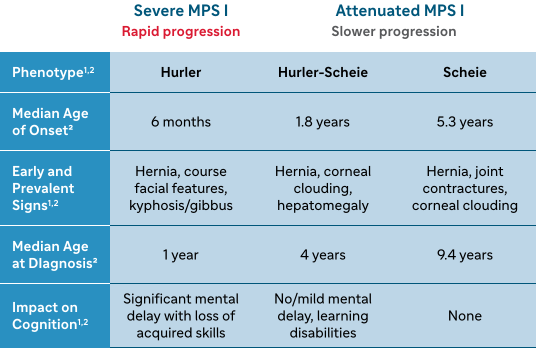
Types of MPS I disease: Severe (Hurler) and attenuated (Hurler-Scheie and Scheie)
Hurler syndrome (severe MPS I)
The most severe phenotype of MPS I, Hurler, progresses rapidly.4 Infants with Hurler syndrome may appear unaffected at birth; however, they experience the onset of symptoms at a median age of 6 months.2 The median age of diagnosis is 1 year old.
The early clinical signs of Hurler are typically non-specific, including2:
- Hernias
- Coarse facial features
- Kyphosis/Gibbus deformity
- Corneal Clouding
- Hepatomegaly
Hurler should not be confused with Pseudo-Hurler polydystrophy, another rare genetic condition that is characterized by similar but milder symptoms encompassing joint stiffness, skeletal deformities of the hands, corneal clouding, and coarse facial features.5
Without disease management, patients with severe MPS I usually die within the first decade of life, as a result of cardiorespiratory failure and other disease manifestations.

How common is Hurler?
The prevalence of Hurler syndrome is approximately 1 in 100,000 births, with male and female children equally affected.3 All races and ethnicities are at the same risk of inheriting the condition.
Hurler-Scheie syndrome (attenuated MPS I)
Hurler-Scheie is an attenuated subtype of MPS I characterized by a slower progression compared to the severe form of MPS I.3 The median age of onset for this subtype of MPS I is around 2 years old, while the median age of diagnosis is between 2 and 6 years.3
The early signs of Hurler-Scheie include2,3:
- Hernias
- Coarse facial features
- Cognitive impairment
- Enlarged tongue
- Sleep disturbances/snoring
Hurler-Scheie is an intermediate phenotype. Facial features are less coarse than Hurler syndrome. Those affected usually have mild cognitive impairment.4
Without disease management, patients with Hurler-Scheie syndrome may face premature death by the age of 30 years.3

How common is Hurler-Scheie?
Hurler-Scheie is a form of MPS I affecting 435,000 newborns. Twenty-three percent of MPS I cases have been attributed to Hurler-Scheie.6
Scheie syndrome (attenuated MPS I)
Scheie is an attenuated type of MPS I with the mildest symptoms compared to Hurler and Hurler-Scheie.7 The median age of onset of this subtype is around 5 years old.
As symptoms of Scheie are mild and differ between patients, the condition is often difficult to recognize and leads to delayed diagnosis.7
Early signs of this attenuated form of MPS I include hernias and joint contractures, and later in the course of the disease, corneal clouding becomes prevalent.2,3 Over the course of the disease, individuals with this form of MPS I generally develop serious disease-related morbidities including cardiac valve abnormalities and carpal tunnel syndrome.
In contrast to severe MPS I, this phenotype does not impact cognition, and patients typically survive into adulthood.2,4
For patients and caregivers struggling with MPS I, early diagnosis and management can help relieve disease burden and improve quality of life.2
How common is Scheie?
Fewer than 5,000 people in the US have been diagnose with Scheie but potentially many others have yet to be diagnosed.8 Historically, it is the rarest form of MPS I with only 12.9% of MPS I cases attributed to Scheie.2
Suspect, refer, and manage symptoms of MPS I early
MPS I manifests as a highly heterogeneous spectrum of severity, signs, symptoms, and affected organ systems, with symptoms often onset in early childhood.
Early multidisciplinary management is the best approach to slow progression, individualizing interventions to a specific genetic variant and presentation.
References: 1. National Institute of Neurological Disorders and Stroke. Mucopolysaccharidoses. Accessed June 5, 2025. https://www.ninds.nih.gov/health-information/disorders/mucopolysaccharidoses 2. Beck M et al. Genet Med. 2014;16(10):759-765. 3. Clarke LA. GeneReviews® [Internet]. Accessed May 1, 2025. https://www.ncbi.nlm.nih.gov/books/NBK1162/ 4. Sakuru R, Bollu PC. In: StatPearls. StatPearls Publishing;2025. Accessed May 1, 2025. https://www.ncbi.nlm.nih.gov/books/NBK2261/ 5. National Organization for Rare Disorders. Pseudo Hurler Polydystrophy. Accessed May 1, 2025. https://rarediseases.org/rare-diseases/pseudo-hurler-polydystrophy/ 6. Orphanet: Hurler-Scheie syndrome. Accessed May 8, 2025. http:/orpha.net/en/disease/detail/93476 7. Thomas JA, Beck M, Clark JTR, Cox GF. J Inherit Metab Dis. 2010;33(4):421-427. 8. Scheie syndrome. Accessed May 8, 2025. https://rarediseases.info.nih.gov/diseases/12561/scheie-syndrome
MAT-US-2509587-v1.0-02/2026
