Qfitlia® (fitusiran) logo

Qfitlia® (fitusiran) offers tailored dosing with the lowest treatment frequency1-14*


Qfitlia does not require weight-based dosing, so all of your patients treated with Qfitlia will start on the same dose1

Less time treating with as few as 6 injections a year1*

  • As few as 1 dose every other month—the fewest of any prophylactic treatment1-14
  • 90% of patients required 0-1 dosing change15
  • Qfitlia is available as a 50 mg single-use prefilled pen and as a vial and syringe for the 10 mg and 20 mg doses1

Reliably measure antithrombin levels to guide Qfitlia dosing1,16

  • The AT-DR of Qfitlia targets antithrombin activity levels between 15% and 35%1
  • Qfitlia does not require weight-based dosing, and all patients have the same starting dose1
  • Antithrombin testing is done with an FDA-cleared antithrombin assay to determine if the dose of Qfitlia should be adjusted1

FDA-cleared antithrombin testing to support your patients

  • The Sanofi-Labcorp Support Program offers an FDA-cleared assay that makes antithrombin measurement, and when coinciding with antithrombin testing, LFTs available to patients taking Qfitlia
  • Blood samples can be collected at your local HTC and sent to Labcorp, or at a Labcorp facility (including select Walgreens locations)†
  • Sanofi has a mobile phlebotomy program for eligible patients to complete required testing. Contact Sanofi at 1-833-723-5463 to learn more

Transitioning from factor replacement or BPA prophylaxis1

First 7 Days

Patients may continue their prior factor or BPA prophylaxis for the first 7 days of Qfitlia treatment. 

Next 7 Days

Seven days after the initial dose of Qfitlia, discontinue factor or BPA prophylaxis.


In the clinical trial, 35% of patients required no dose adjustments and 55% required one dose adjustment.15

Understanding Qfitlia dosing guidelines1

Antithrombin activity levels can be reliably measured to guide a personalized dosing experience.
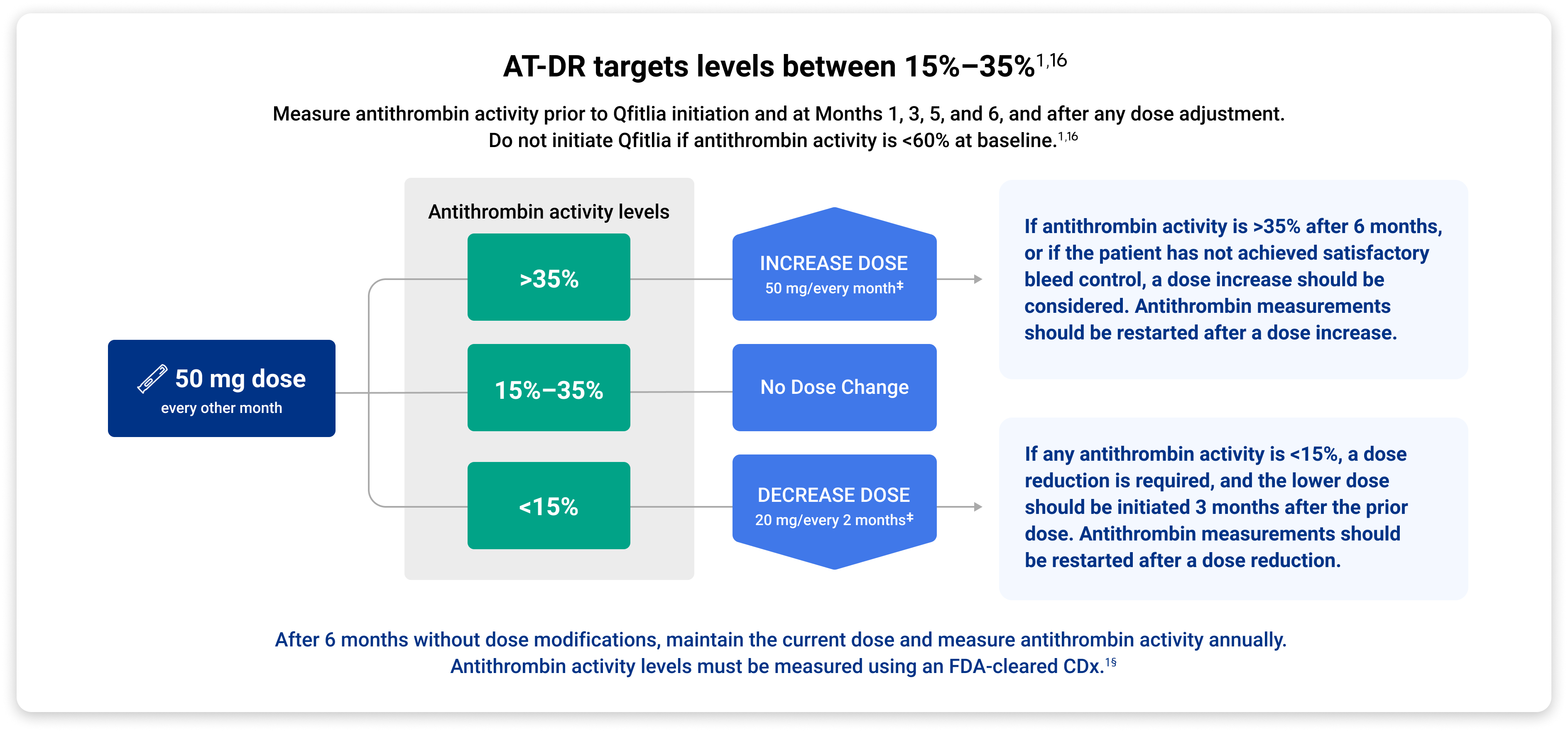
* In the clinical study of 227 people with hemophilia, ~67% took Qfitlia every other month, and ~19% took it monthly.1    
† If a sample is collected at a local HTC, Sanofi will not cover any associated blood-draw costs.    
‡ These are the most common dose adjustments for Qfitlia.    
§ Additional measurements can be considered if bleeding control is not adequate.1

How to administer Qfitlia—a video for patients

The Qfitlia prefilled pen is available in the 50 mg dose. Watch this video to learn and help teach your patients about self-injecting Qfitlia.

To help your patients who use the vial and syringe for administration, download this administration guide

Find the right dose for your patients with the interactive dosing tool

Clock icon

This tool for Qfitlia was created to help visualize dosing modification guidelines.

Learn the simple steps to Qfitlia onboarding
 

Help your patients seamlessly start Qfitlia.

Understand breakthrough bleed guidance

Learn the guidelines for using on-demand factor replacement or BPA treatments to manage breakthrough bleeds while on Qfitlia.

AT-DR=antithrombin-based dosing regimen; BPA=bypassing agent; CDx=companion diagnostic; FDA=Food and Drug Administration; HTC=hemophilia treatment center; LFT=liver function test. 

INDICATION

Qfitlia® (fitusiran) is an antithrombin (AT)-directed small interfering ribonucleic acid (siRNA) indicated for routine prophylaxis to prevent or reduce the frequency of bleeding episodes in adult and pediatric patients aged 12 years and older with hemophilia A or B with or without Factor VIII or IX inhibitors.

IMPORTANT SAFETY INFORMATION

WARNING: THROMBOTIC EVENTS AND ACUTE AND RECURRENT GALLBLADDER DISEASE

THROMBOTIC EVENTS
Serious thrombotic events have occurred in Qfitlia-treated patients with risk factors for thromboembolism including persistent antithrombin (AT) activity less than 15%, use of Qfitlia 80 mg once monthly, presence of indwelling venous catheters, and in the post-operative setting when Bleed Management Guidelines were not followed. 

Monitor AT activity using an FDA-cleared test and target AT activity 15-35% to reduce the risk of thrombosis. Monitor patients for signs and symptoms of thrombotic events. Interrupt Qfitlia in patients with a thrombotic event and manage as clinically indicated.

ACUTE AND RECURRENT GALLBLADDER DISEASE
Acute and recurrent gallbladder disease, including cholelithiasis and cholecystitis have occurred in Qfitlia-treated patients, some of whom required cholecystectomy or had complications (e.g., pancreatitis) related to gallbladder disease. Monitor patients for signs and symptoms of acute and recurrent gallbladder disease. 

Consider interruption or discontinuation of Qfitlia if gallbladder disease occurs. Consider alternative treatment for hemophilia in patients with a history of symptomatic gallbladder disease.

WARNINGS AND PRECAUTIONS
Thrombotic Events:  

  • Serious thrombotic events have been reported in Qfitlia-treated patients. Thrombotic events were reported in 2.6% of patients receiving the 80 mg once monthly dose, including a fatal event of cerebral venous sinus thrombosis. The 80 mg once monthly dose is not approved or recommended for use. Thrombotic events were reported in 1.4% of patients receiving Qfitlia prophylaxis using the AT-based dose regimen (AT-DR) that targeted AT activity 15-35%
  • The risk of thrombosis is greater in patients with certain risk factors (see Boxed WARNING). Treatment of breakthrough bleeding episodes with clotting factor concentrate (CFC) or bypassing agent (BPA) at a dose greater or more frequent than recommended may also increase thrombotic risk

Acute and Recurrent Gallbladder Disease: 

  • Treatment with Qfitlia is associated with an increased occurrence of acute and recurrent gallbladder disease, including cholelithiasis and cholecystitis (see Boxed WARNING). In the 270 patients in the clinical studies who received Qfitlia at a fixed dose of 80 mg once monthly, 17% experienced gallbladder events and 4% underwent cholecystectomy. In 286 patients who received the AT-DR, 3.8% experienced gallbladder events and 0.3% underwent cholecystectomy

Hepatotoxicity: 

  • In the two randomized studies testing Qfitlia 80 mg once monthly, alanine transaminase (ALT) and aspartate transaminase (AST) elevations above 3 times the upper limit of normal (ULN) occurred in 32% of patients with hemophilia with inhibitors and 18% of patients with hemophilia without inhibitors. There was one case of moderate hepatic injury attributable to Qfitlia use. On the AT-DR, 3.4% of patients treated with Qfitlia had at least one ALT value >3x ULN
  • Avoid use of Qfitlia in patients with hepatic impairment (Child-Pugh Class A, B, and C)
  • Obtain baseline liver tests, including AST, ALT, and total bilirubin, prior to initiating Qfitlia, monthly for at least the first 6 months of Qfitlia use, monthly for at least 6 months after a dose increase, and periodically thereafter as clinically indicated  
  • If new or worsening liver test abnormalities occur, initiate medical management as appropriate and monitor until they return to baseline. If ALT or AST elevations >5x ULN occur, interrupt Qfitlia treatment. If Qfitlia is restarted and ALT or AST elevations >5x ULN reoccur or the patient experiences jaundice due to hepatotoxicity with other causes of liver test elevation ruled out, permanently discontinue Qfitlia

DRUG INTERACTIONS
Hypercoagulability with Concomitant Use of CFC or BPA: Qfitlia prophylaxis leads to increased thrombin generation with additive increase in peak thrombin when used concomitantly with CFC or BPA.

ADVERSE REACTIONS
Common adverse reactions (incidence ≥10%) are viral infection, nasopharyngitis, and bacterial infection.

INDICATION

IMPORTANT SAFETY INFORMATION

References: 1. Qfitlia Prescribing Information. Genzyme Corporation. Cambridge, MA. 2. Advate Prescribing Information. Takeda Pharmaceuticals U.S.A., Inc. Lexington, MA. 3. Adynovate Prescribing Information. Takeda Pharmaceutical U.S.A., Inc. Lexington, MA. 4. Afstyla Prescribing Information. CSL Behring LLC. Kankakee, IL. 5. Esperoct Prescribing Information. Novo Nordisk Inc. Plainsboro, NJ. 6. Helixate Prescribing Information. CSL Behring LLC. Kankakee, IL. 7. Hemlibra Prescribing Information. Genentech, Inc. San Francisco, CA. 8. Hympavzi Prescribing Information. Pfizer Inc. New York, NY. 9. Jivi Prescribing Information. Bayer HealthCare LLC. Whippany, NJ. 10. Kogenate Prescribing Information. Bayer HealthCare LLC. Whippany, NJ. 11. Kovaltry Prescribing Information. Bayer HealthCare LLC. Whippany, NJ. 12. Novoeight Prescribing Information. Novo Nordisk Inc. Plainsboro, NJ. 13. Nuwiq Prescribing Information. Octapharma USA, Inc. Paramus, NJ. 14. Xyntha Prescribing Information. Wyeth Pharmaceuticals LLC. Philadelphia, PA. 15. Data on file CSR. SAR439774-LTE15174 - fitusiran. November 2023. 16. Data on file.

©2026 Sanofi. All rights reserved. All trademarks mentioned are the property of the Sanofi group except where trademarks are owned by third parties. MAT-US-2413078-v2.0-09/2026 Last Updated: September 2026