
Toujeo® U-300 (insulin glargine) injection 300 Units/mL logo

Toujeo® U-300 (insulin glargine) injection 300 Units/mL Resources and Clinical Studies


Resources are here to help you and your patients taking Toujeo®

Open book icon within a green gradient circle.

Resources for Providers

Select a resource below to view, download, or print.

Starting your appropriate patients on Toujeo

For Patient Resources visit https://www.toujeo.com/

HCP Connection Portal—your one-stop support site for Sanofi insulin brand resources

Gain access to patient resources, samples, product information, and so much more. Visit the HCP Connection Portal to get started.

Smartphone Icon


Want quick access to the HCP Connection Portal?


Add the HCP Connection Portal to your home screen for Apple iOS and Android
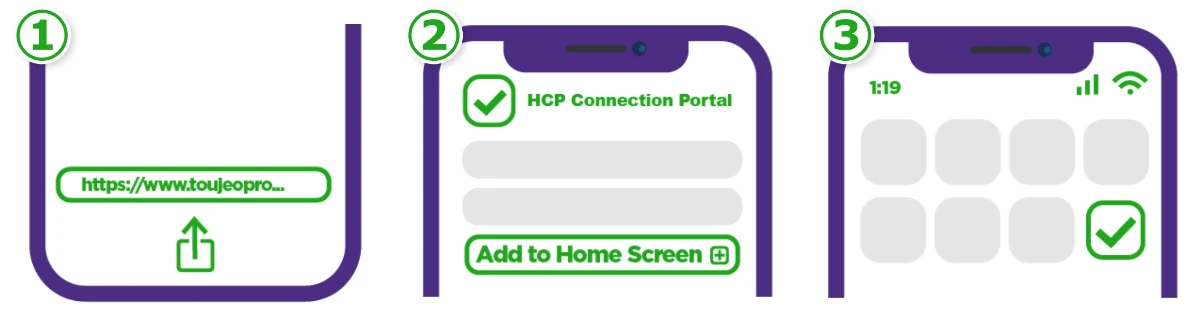
Add to your Home Screen

Steps to add HCP Connection Portal to home screen: 1. Open URL, 2. Select 'Add to Home Screen,' 3. Confirm on home screen.

For iPhone users: With the HCP Connection Portal page open in Safari, select the middle icon with an arrow located below the search bar. Scroll down and press “Add to Home Screen.” In the following window, you can rename the webpage as you’d like it to appear on your home screen, then select “Add” in the top right corner. The HCP Connection Portal is now on your home screen so you can access it directly anytime.

For Android users: With the HCP Connection Portal page open in Chrome, select the three dot icon in the top right. Scroll down and press “Add to Home Screen.” In the popup window, you can rename the webpage as you’d like it to appear on your home screen, then press “Add.” The HCP Connection Portal is now on your home screen so you can access it directly anytime.

Publications

Page icon in green color.

BRIGHT: The first head-to-head study of Toujeo vs Tresiba® in patients with T2DM

Page icon in green color.

InRange: Comparing Toujeo vs Tresiba in adults with T1DM using time-in-range as the primary endpoint

Page icon in green color.

EDITION 1*: Patients with type 2 diabetes mellitus using basal and mealtime insulin

Page icon in green color.

EDITION 2*: Patients with type 2 diabetes mellitus using oral antidiabetic agents and basal insulin

Page icon in green color.

EDITION 3*: Insulin-naive patients with type 2 diabetes mellitus on oral glucose-lowering drugs

Page icon in green color.

EDITION 4*: Patients with type 1 diabetes mellitus

Page icon in green color.

Deliver G: Retrospective analysis of patients with T2DM receiving GLP-1 RA therapy

Page icon in green color.

Clamp Study 1: Evaluated the steady-state PK/PD profile of Toujeo

Page icon in green color.

Clamp Study 2: Evaluated the day-to-day and intra-day variability of Toujeo

Toujeo has been studied versus Lantus® in 4 pivotal clinical trials (the EDITION Trials)* involving more than 3000 patients and in 2 euglycemic clamp studies to assess PK and PD.1-3

*All studies in the EDITION clinical program were 26-week, open-label, controlled, titrate-to-target, noninferiority studies in adults with diabetes not at A1C goal (range: 7%-10% or 11%), randomized to Toujeo or Lantus once daily. All patients were titrated to an FPG goal of 80 to 130 mg/dL (T2DM) or 80 to 130 mg/dL (T1DM).1,4


Paper with green checkmark icon with yellow-green gradient box.

Need help with access support?

Sanofi Patient Connection® can help your office obtain prior authorizations for Toujeo.

CONNECT NOW
Pen sample box in a green circle icon with yellow-green gradient box.

Order samples today†‡

Have samples delivered to your office.

US-licensed prescribers are required to register to request samples.

ORDER NOW

Important Safety Information

Contraindications

Toujeo is contraindicated during episodes of hypoglycemia and in patients hypersensitive to insulin glargine or any of the excipients in Toujeo.

Warnings and Precautions

Toujeo contains the same active ingredient, insulin glargine, as Lantus. The concentration of insulin glargine in Toujeo is 300 units per mL (U-300).

Insulin pens and needles must never be shared between patients. Do NOT reuse needles.

Monitor blood glucose in all patients treated with insulin. Modify insulin regimens only under medical supervision. Changes in insulin regimen, strength, manufacturer, type, injection site or method of administration may result in the need for a change in insulin dose or an adjustment in concomitant oral antidiabetic treatment. Changes in insulin regimen may result in hyperglycemia or hypoglycemia. Dosage adjustments are recommended to lower the risk of hypoglycemia when switching patients to Toujeo from another insulin therapy.

Repeated insulin injections into areas of lipodystrophy or localized cutaneous amyloidosis may result in hyperglycemia; sudden change in the injection site (to unaffected area) has been reported to result in hypoglycemia. Advise patients to rotate injection site to unaffected areas and closely monitor for hypoglycemia.

Unit for unit, patients started on, or switched to, Toujeo required a higher dose than patients controlled with Lantus. When switching from another basal insulin to Toujeo, patients experienced higher average fasting plasma glucose levels in the first few weeks of therapy until titrated to their individualized fasting plasma glucose targets. Higher doses were required in titrate-to-target studies to achieve glucose control similar to Lantus.

Hypoglycemia is the most common adverse reaction in patients treated with Toujeo and may be life-threatening. The long-acting effect of Toujeo may delay recovery from hypoglycemia compared to shorter-acting insulins.

Medication errors that may lead to hypoglycemia, such as accidental mix-ups between insulin products, have been reported. Patients should be instructed to always verify the insulin label before each injection.

Do not dilute or mix Toujeo with any other insulin or solution. If mixed or diluted, the solution may become cloudy, and the onset of action/time to peak effect may be altered in an unpredictable manner. Do not administer Toujeo via an insulin pump or intravenously because severe hypoglycemia can occur.

Severe, life-threatening, generalized allergy, including anaphylaxis, can occur. Discontinue Toujeo, monitor, and treat if indicated.

A reduction in the Toujeo dose may be required in patients with renal or hepatic impairment.

All insulins, including Toujeo, can lead to life-threatening hypokalemia. Untreated hypokalemia may cause respiratory paralysis, ventricular arrhythmia, and death. Closely monitor potassium levels in patients at risk of hypokalemia and treat if indicated.

Fluid retention, which may lead to or exacerbate heart failure, can occur with concomitant use of thiazolidinediones (TZDs) with insulin. These patients should be observed for signs and symptoms of heart failure. If heart failure occurs, dosage reduction or discontinuation of TZD must be considered.

Drug Interactions

Certain drugs may affect glucose metabolism, requiring insulin dosage adjustment and close monitoring of blood glucose. The signs of hypoglycemia may be reduced in patients taking anti-adrenergic drugs (e.g., beta-blockers, clonidine, guanethidine, and reserpine).

Adverse Reactions

Adverse reactions commonly associated with Toujeo include hypoglycemia, hypersensitivity reactions, injection site reactions, lipodystrophy, pruritus, rash, edema, and weight gain.

Important Safety Information for Toujeo U-300 (insulin glargine) injection SoloStar and Toujeo Max SoloStar

Toujeo SoloStar and Toujeo Max SoloStar are single-patient-use prefilled insulin pens. To help ensure an accurate dose each time, patients should follow all steps in the Instruction Leaflet accompanying their pen; otherwise, they may not get the correct amount of insulin, which may affect their blood glucose levels. It is especially important to perform a safety test when a patient is using a new pen for the first time.
Do not withdraw Toujeo from the SoloStar and Max SoloStar single-patient-use prefilled pens with a syringe.

Indication

Toujeo is a long-acting human insulin analog indicated to improve glycemic control in adults and pediatric patients 6 years and older with diabetes mellitus.

Limitations of Use: Toujeo is not recommended for the treatment of diabetic ketoacidosis.

Important Safety Information

Indication

FPG, fasting plasma glucose; PD, pharmacodynamics; PK, pharmacokinetics; T1DM, type 1 diabetes mellitus; T2DM, type 2 diabetes mellitus.

OHIO HCPs: Prescription drug samples may only be provided to a prescriber whose practice is licensed as a Terminal Distributor of Dangerous Drugs ("TDDD") or qualifies as exempt under Ohio law. For more information on the State of Ohio Board of Pharmacy Prescriber licensure requirements, how to obtain a TDDD license, and reasons for exemptions, please go to: http://www.pharmacy.ohio.gov/Licensing/TDDD.aspx

References:
1. Toujeo Prescribing Information. Sanofi.  2. Becker RHA, et al. Diabetes Care. 2015;38(4):637-643. 3. Becker RHA, et al. Diabetes Obes Metab. 2015;17(3):261-267. 4. Home PD, et al. Diabetes Care. 2015;38(12):2217-2225. 

LANTUS, TOUJEO, SoloStar, TOUJEO Max SoloStar, Sanofi Patient Connection, and Sanofi are registered trademarks of Sanofi or an affiliate. All the other trademarks above are the property of their respective owners, who have no affiliation or relationship with Sanofi. MAT-US-2209121-v4.0-10/2025