- Article
- Source: Campus Sanofi
- Oct 27, 2025
How ASMD Can Impact Quality of Life and Average Life Expectancy

ASMD can lead to morbidity and early mortality1
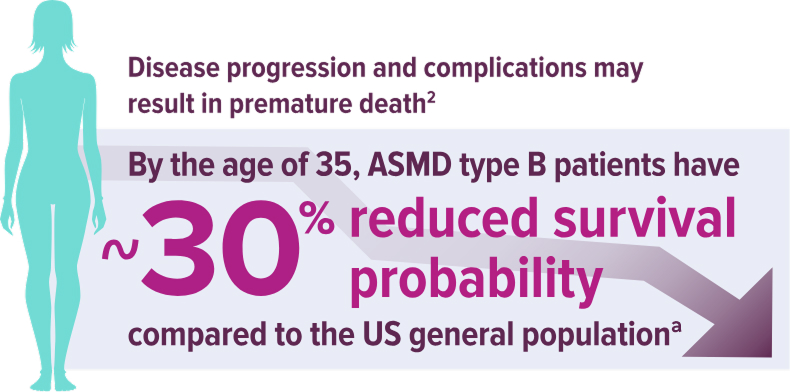.2026-02-05-13-26-13.jpg)
aData extrapolated from a Kaplan-Meier curve generated in a 11-year natural history study that evaluated morbidity and mortality in 59 patients with ASMD type B. At entry, 30 patients were in the pediatric age group (<18 years of age) and 29 patients were adults (≥18 years of age). There were 9 deaths during the follow-up period. Reduction in survival probability is absolute, not relative. US General Population as of 2017.2
Reduction in average life expectancy of untreated patients with ASMD compared to the general population3

ASMD can impact quality of life1,4
ASMD is associated with a high burden of disease that may limit physical, mental, and psychosocial well-being. A patient’s experience may include1,4:
- Frequent hospitalizations, medications for symptomatic care, medical procedures, and increased need for medical devices
- Reduced physical activity and difficulty navigating obligations at school, work, and in personal relationships
- Feelings of social isolation and rejection
bBased on data from a natural history study of 10 patients with ASMD type A, during which all 10 patients died.5
cBased on a natural history study of 85 patients with ASMD, 27 patients were identified with ASMD type A/B and 58 patients were identified with ASMD type B. Of the 27 patients with ASMD type A/B, 26 patients died. Of the 58 patients with ASMD type B, 52 patients died.6
References: 1. McGovern MM et al. Orphanet J Rare Dis. 2017;12(1):41. 2. McGovern MM et al. et al. Orphanet J Rare Dis. 2021;16(1):212. 3. Pulikottil-Jacob R et al. Mol Genet Metab Rep. 2023;38:101040. 4. Cox GF et al. JIMD Rep. 2018;41:119-129. 5. McGovern MM et al. Neurology. 2006;66(2):228-232. 6. Cassiman D et al. Mol Genet Metab. 2016;118(3):200-213.
MAT-US-2011634-v3.0-08/2025
