
Gaucher disease is a progressive genetic disorder with three subtypes.1,2
Gaucher disease is classified based on symptoms and progression1
Cerezyme is indicated for the treatment of non-CNS manifestations of Gaucher disease types 1 and 3. Cerezyme does not treat Gaucher disease type 2.
Type 1
- Non-neuronopathic1
- Most common subtype in the US (1 in 40,000)1,3
- Much higher prevalence among the Ashkenazi Jewish community (1 in 500 to 1 in 1,000)4
- Visceral, hematologic, and skeletal symptoms5,6
Type 3
- Chronic neuropathic1
- Less common than type 1 in the US1
- Same systemic symptoms as type 1 in addition to gaze palsy, motor and coordination deficits such as ataxia, variable cognitive impairment, and/or other neurological abnormalities5,7,8
- Progresses more slowly compared to type 21
Type 2
- Acute neuropathic1
- Least common subtype in the US7
- Severe, infantile onset with short life expectancy (2 to 4 years)7,9
- Rapidly progressing visceral and neurologic symptoms7,9
Onset of Gaucher disease types 1 and 3

56% of patients with Gaucher disease type 1 experience symptoms before age 2010
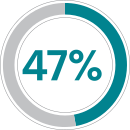
47% of patients with Gaucher disease type 3 display some signs of neurological manifestations by age 211
%20(1).2025-11-04-15-22-58.svg)

CNS=central nervous system; ERT=enzyme replacement therapy.
Indication
References: 1. Weinreb NJ, Goker-Alpan O, Kishnani PS, et al. The diagnosis and management of Gaucher disease in pediatric patients: where do we go from here? Mol Genet Metab. 2022;136(1):4-21. 2. Carubbi F, Cappellini MD, Fargion S, Fracanzani AL, Nascimbeni F. Liver involvement in Gaucher disease: a practical review for the hepatologist and the gastroenterologist. Dig Liver Dis. 2020;52(4):368-373. 3. Mistry PK, Belmatoug N, vom Dahl S, Giugliani R. Understanding the natural history of Gaucher disease. Am J Hematol. 2015;90(suppl 1):S6-S11. 4. National Human Genome Institute. About Gaucher disease. National Institutes of Health. Updated January 4, 2012. Accessed April 20, 2024. www.genome.gov/Genetic-Disorders/Gaucher-Disease 5. Deegan PB, Cox TM. Imiglucerase in the treatment of Gaucher disease: a history and perspective. Drug Des Devel Ther. 2012;6:81-106. 6. Goker-Alpan O. Therapeutic approaches to bone pathology in Gaucher disease: past, present and future. Mol Genet Metab. 2011;104(4):438-447. 7. Schiffmann R, Sevigny J, Rolfs A, et al. The definition of neuronopathic Gaucher disease. J Inherit Metab Dis. 2020;43(5):1056-1059. 8. El-Beshlawy A, Abdel-Azim K, Abdel-Salam A, et al. Egyptian Gaucher disease type 3 patients: a large cohort study spanning two decades. J Rare Dis. 2023;2(7). doi:10.1007/s44162-023-00011-0 9. El-Beshlawy A, Tylki-Szymańska A, Vellodi A, et al. Long-term hematological, visceral, and growth outcomes in children with Gaucher disease type 3 treated with imiglucerase in the International Collaborative Gaucher Group Gaucher Registry. Mol Genet Metab. 2017;120(1-2):47-56. 10. Stirnemann J, Belmatoug N, Camou F, et al. A review of Gaucher disease pathophysiology, clinical presentation and treatments. Int J Mol Sci. 2017;18(2):441. 11. Tylki-Szymańska A, Vellodi A, El-Beshlawy A, Cole JA, Kolodny E. Neuronopathic Gaucher disease: demographic and clinical features of 131 patients enrolled in the International Collaborative Gaucher Group Neurological Outcomes Subregistry. J Inherit Metab Dis. 2010;33(4):339-346.
