- Artikel
- Bron: Campus Sanofi
- 21 mei 2025
Diagnostic Algorithm

Differential diagnosis
The ability to correctly differentiate Gaucher disease from other diseases is essential to minimize delays in diagnosis and improve patient outcomes. However, diagnosing Gaucher disease can be a challenging task due to its rarity, its unpredictable and variable clinical course, and the fact that many of its clinical signs and symptoms may suggest other diseases.1,2 Despite the availability of definitive diagnostic tests that include enzyme activity assays and DNA analysis, considerable delays in diagnosis are quite common.
When a patient presents with Gaucher disease, a number of other diseases may be initially suspected.2 These may include:
- leukaemia
- lymphoma
- bleeding disorders
- multiple myeloma
Splenomegaly is an important presenting sign of Gaucher disease and is present in the vast majority of patients.3 A number of other signs and symptoms are particularly indicative of Gaucher disease and should be immediately followed:
- physicians should consider the diagnosis of type 1 (non-neuropathic) Gaucher disease in any patient presenting with unexplained splenomegaly, with or without skeletal manifestations, hepatomegaly, and bleeding disposition.4
- children presenting with hepatosplenomegaly and neurological symptoms should also be evaluated for Gaucher disease types 2 or 3.4
An international group has published useful diagnostic algorithms that show the frequencies of diseases associated with splenomegaly.5
Suggested diagnostic algorithm for individuals of non-Ashkenazi Jewish origin
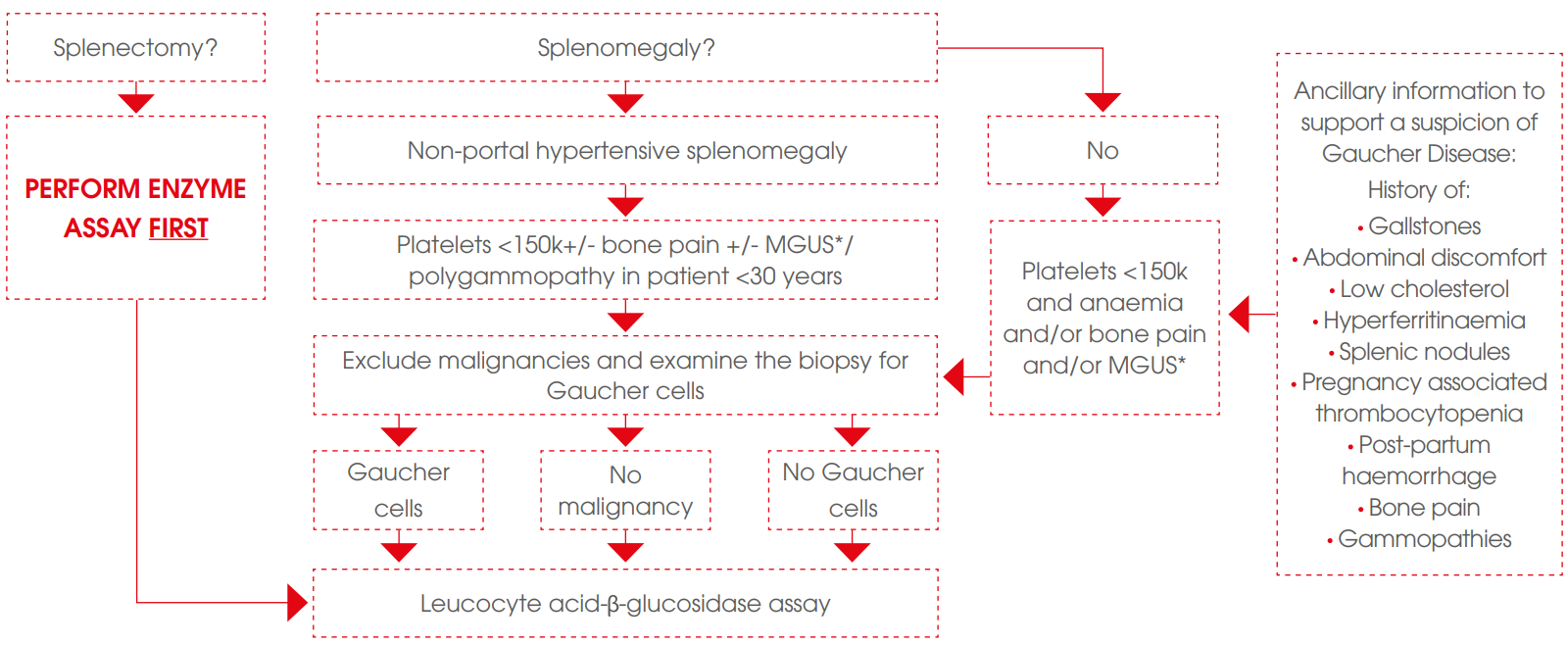
*MGUS = Monoclonal Gammopathy of Unknown Significance.
Image adapted from Mistry PK, Cappellini MD, Lukina E, et al. Am J Hematol. 2011;86(1):110-115.5
High-risk populations
High-risk populations worthy of further diagnostic investigation of Gaucher disease include siblings of people with the disease and those with Ashkenazi Jewish ancestry. In general, Gaucher disease should always be excluded in people with splenomegaly of unknown etiology, if they also have thrombocytopenia and/or bone pain and/or MGUS/polyclonal gammopathy in patients aged <30 years.5
-
Grabowski GA, Petsko GA, Kolodny EH. Gaucher Disease. In: Valle DL, Antonarakis S, Ballabio A, Beaudet AL, Mitchell GA. eds. The Online Metabolic and Molecular Bases of Inherited Disease. McGraw-Hill Education; 2019. Accessed October 06, 2025. https://ommbid.mhmedical.com/content.aspx?bookid=2709§ionid=225546056
-
Mistry PK, Sadan S, Yang R, Yee J, Yang M. Consequences of diagnostic delays in type 1 Gaucher disease: the need for greater awareness among hematologists-oncologists and an opportunity for early diagnosis and intervention. Am J Hematol 2007; 82:697–701.
-
Kaplan P, Andersson HC, Kacena KA, Yee JD. The clinical and demographic characteristics of non-neuronopathic Gaucher disease in 887 children at diagnosis. Arch Pediatr Adolesc Med 2006; 160:603–8.
-
Mistry PK, Abrahamov A. A practical approach to diagnosis and management of Gaucher's disease. Bailliere's Clinical Haematology. 1997; 10(4): 817-838.
-
Mistry PK, Cappellini M, Lukina E, et al. Consensus Conference: a reappraisal of Gaucher disease – diagnosis and disease management algorithms. Am J Hematol 2011; 86(1):110-115.
Neem contact op

MAT-BE-2501472