- Artikel
- Bron: Campus Sanofi
- 6 mei 2025
Understanding Gaucher Disease: Genetics, Transmission, and Family Screening
Genetics and Epidemiology
Incidence and prevalence
- Type 1 (non-neuropathic) Gaucher disease is the most common form, with a prevalence of 1 in 50,000 to 100,000 individuals.1 Although the disease is pan-ethnic, there is a high prevalence of type 1 Gaucher disease in certain ethnic groups, notably Ashkenazi Jews who have a prevalence of the disease of approximately 1 in 850 individuals.1 Type 1 disease is estimated to account for >90% of all Gaucher patients.1
- Type 2 diseases have a prevalence of <1 in 100,000 individuals, while in type 3 Gaucher disease this figure varies to <1 in 50,000 to 100,000.2
- Type 3 Gaucher disease has a higher prevalence reported in patients from the Norrbotten population in Sweden.3
However, as with any rare disease, it is difficult to know exactly how many people are actually affected.
Genotypes
More than 300 alleles carrying pathogenic variants have been identified in Gaucher disease.1 The clinical expression of Gaucher disease cannot usually be accurately predicted by analysis of the pathogenic variant alone. For most pathogenic variants, the genotype/phenotype relationship is weak.
Probabilities of Gaucher disease transmission
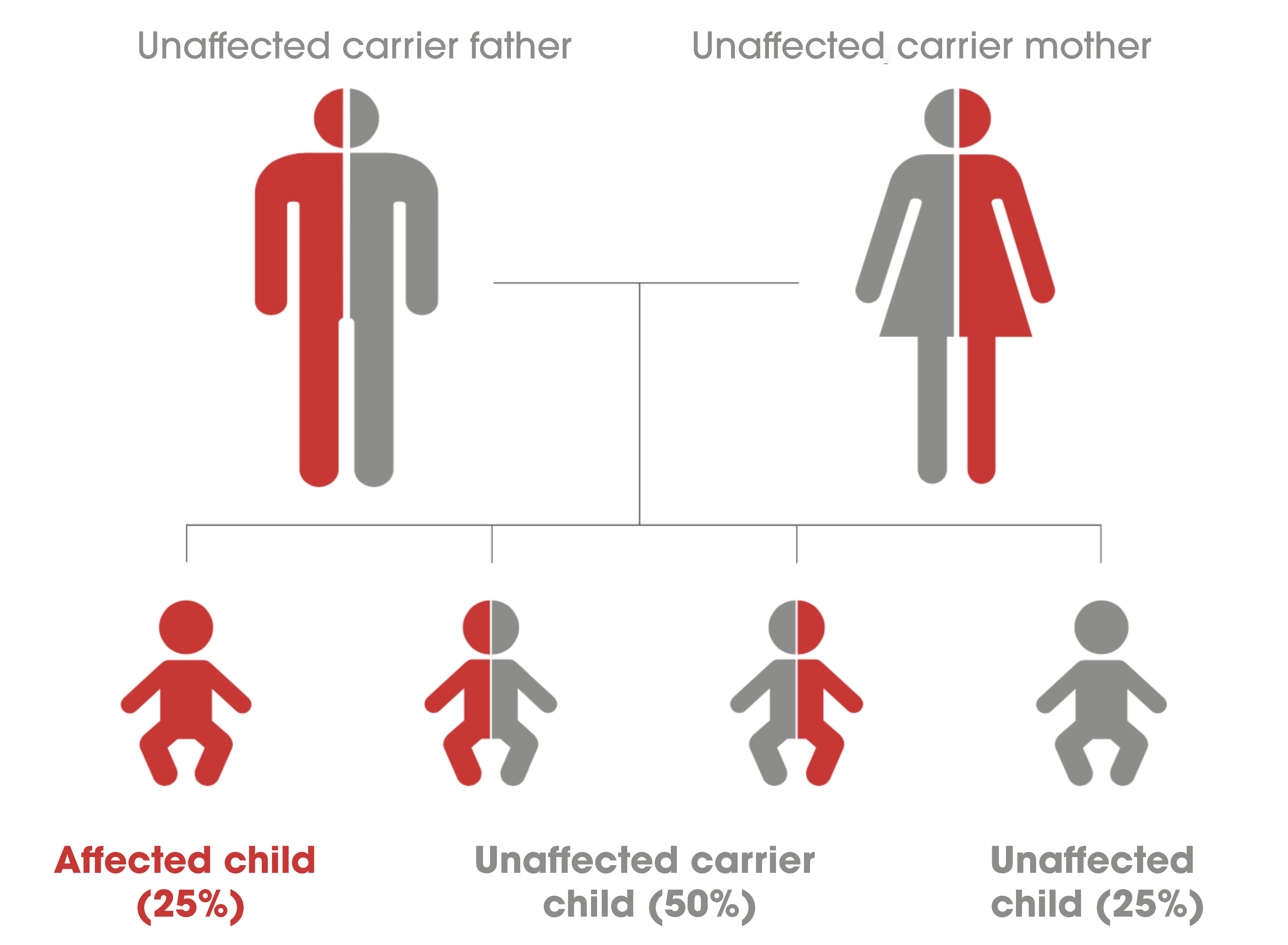
Because Gaucher disease is autosomal recessive, a carrier has a 50% chance of passing on a gene with a pathogenic variant to each offspring. If both parents are carriers, there is a 25% chance that the child will not be affected by the disease and a 25% chance that the child will develop Gaucher disease.1, 4-7
Situation in which both parents are carriers of Gaucher disease
Family screening
Since Gaucher disease is an inherited disease, if an individual has the disease it is very likely that other members of his family have at least one allele with the pathogenic variant of the gene that codes for acid β-glucosidase. It is very important that siblings of someone with Gaucher disease are tested, in case they are also affected.
Predicting the severity of the disease in a child is easier when parents already have a child with Gaucher disease, since there is a considerable degree of agreement between siblings. Occasionally, the degree of manifestation of the disease is completely different between siblings, but this is less common.4
If there are no children with Gaucher disease in the family, the genetics specialist relies on the genotype of the parents, who can provide some useful information. For example, if both parents are heterozygous for the pathogenic variant N370S, the probability of the future child not having neuropathic disease is very high.8
-
Mistry PK, Cappellini M, Lukina E, et al. Consensus Conference: a reappraisal of Gaucher disease – diagnosis and disease management algorithms. Am J Hematol 2011; 86(1):110-115
-
Davies EH, Surtees R, DeVile C, Schoon I, Vellodi A. A severity scoring tool to assess the neurological features of neuronopathic Gaucher disease. J Inherit Metab Dis. 2007 Oct; 30(5):768-82.
-
Dahl N, Lagerstrom M, Erikson A, Pettersson U. Gaucher disease type III (Norbottnian type) is caused by a single mutation in exon 10 of the acid-β glucosidase gene. Am J Hum Genet 1990; 47(2):275-8.
-
Grabowski GA, Petsko GA, Kolodny EH. Gaucher Disease. In: Valle DL, Antonarakis S, Ballabio A, Beaudet AL, Mitchell GA. eds. The Online Metabolic and Molecular Bases of Inherited Disease. McGraw-Hill Education; 2019. Accessed October 06, 2025. https://ommbid.mhmedical.com/content.aspx?bookid=2709§ionid=225546056
-
Mistry PK, Sadan S, Yang R, Yee J, Yang M. Consequences of diagnostic delays in type 1 Gaucher disease: the need for greater awareness among hematologists-oncologists and an opportunity for early diagnosis and intervention. Am J Hematol 2007; 82:697–701.
-
Kaplan P, Andersson HC, Kacena KA, Yee JD. The clinical and demographic characteristics of non-neuronopathic Gaucher disease in 887 children at diagnosis. Arch Pediatr Adolesc Med 2006; 160:603–8.
-
Mistry PK, Abrahamov A. A practical approach to diagnosis and management of Gaucher's disease. Bailliere's Clinical Haematology. 1997; 10(4): 817-838.
-
Cox TM, Schofield JP. Gaucher's disease: clinical features and natural history. Bailliere's Clinical Haematology. 1997; 10(4): 657-689.
Neem contact op

MAT-BE-2501474