
Who Is at Risk of Developing AATD?
On this page you'll learn:
- With alpha-1 antitrypsin deficiency (AATD), patients with below-normal alpha-1 antitrypsin (AAT) protein levels may face an increased risk of progressive lung disease and irreversible lung function decline1,2
- Risk is multifactorial and can be influenced by lifestyle and environmental factors3-5
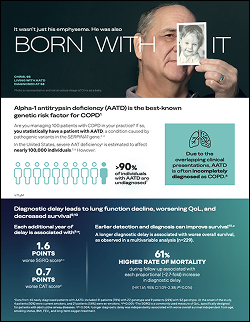
- Despite being the best-known genetic risk factor for COPD, >90% of individuals with AATD remain undiagnosed6,7
- Due to the overlapping clinical presentations, AATD is often incompletely diagnosed as COPD8-10
- In addition to COPD, patients with AATD may also present with emphysema, persistently obstructed asthma, and unexplained bronchiectasis11-13
AATD is a genetic disorder that can put patients at an increased risk of progressive lung disease3,5,13-15

The lower AAT levels are, the higher the risk of AATD-associated emphysema1
AATD is a genetic condition characterized by below-normal AAT protein levels.12 Patients with below-normal AAT levels (<20 µM) may present with obstructive forms of lung disease from irreversible damage and accelerated lung function decline.1,2,12
Risk is multifactorial and can be influenced by lifestyle and environmental factors.3-5
A diagnosis of AATD is frequently missed or delayed in clinical practice7,10,16
AATD is the best-known genetic risk factor for COPD, yet nearly all patients with AATD remain undiagnosed6,7

>90% of individuals with AATD are undiagnosed

~8 years is the median delay from symptom onset to diagnosis of AATD

3 doctors are typically seen before an AATD diagnosis is made
Sign up today: Learn how to recognize more patients with AATD.
AATD is often overlooked in patients with classic COPD symptoms8-10
Due to the overlapping clinical presentations, AATD is often incompletely diagnosed as COPD8-10
Symptoms of AATD can include11,12:
- Shortness of breath during daily activities
- Wheezing
- Decreased ability to exercise
- Excessive mucus production while coughing
- Cough
- Phlegm production
Patients may also present with11,12:
- Asthma
- Bronchiectasis
- Bronchial hyperresponsiveness
If your patient is experiencing persistent pulmonary symptoms, look deeper to determine whether AATD could be the underlying cause.12,17
Clinical presentation alone is not enough to determine which patients with COPD, emphysema, persistently obstructed asthma, or bronchiectasis may be living with AATD.12,17
Learn more about the relationship between AATD and emphysema.
Who should be tested for AATD?
Test for AATD in all patients diagnosed with COPD, emphysema, persistently obstructed asthma, and unexplained bronchiectasis9,12,13,18
ATS/ERS, CHEST/CTS, COPD Foundation, and GOLD recommend testing:
- All patients with a diagnosis of COPD
- Other symptomatic individuals:
- Adult-onset asthma (persistent, incompletely reversible airflow obstruction)
- ︎Unexplained bronchiectasis
- Unexplained chronic liver disease
- Necrotizing panniculitis
- Granulomatosis with polyangiitis (GPA)
- Asymptomatic individuals with persistent airflow obstruction (especially if they have identifiable risk factors [eg, heavy smoking history or occupational exposures])
- First-degree relatives of patients diagnosed with AATD

Don’t let the risk of irreversible lung decline go unrecognized.
Frequently asked questions
Guidelines recommend testing for alpha-1 antitrypsin deficiency in patients diagnosed with chronic obstructive pulmonary disease (COPD), emphysema, persistently obstructed asthma, or unexplained bronchiectasis.9,12,13,18
An alpha-1 antitrypsin test should be considered when evaluating any patient with a diagnosis of COPD, or other symptomatic individual, including those with adult-onset asthma (persistent, incompletely reversible airflow obstruction), unexplained bronchiectasis, unexplained chronic liver disease, necrotizing panniculitis, or granulomatosis with polyangiitis.9,12,13,18
An alpha-1 antitrypsin test should be ordered for asymptomatic individuals if they have persistent airflow obstruction (especially if they have identifiable risk factors such as smoking history or occupational exposure). Additionally, first-degree relatives of patients diagnosed with AATD should be tested.12
Definitions: AAT=alpha-1 antitrypsin; AATD=alpha-1 antitrypsin deficiency; ATS=American Thoracic Society; CHEST=American College of Chest Physicians; COPD=chronic obstructive pulmonary disease; CTS=Canadian Thoracic Society; ERS=European Respiratory Society; GOLD=Global Initiative for Chronic Obstructive Lung Disease; GPA=granulomatosis with polyangiitis.
References: 1. Mulkareddy V, Roman J. Pulmonary manifestations of alpha 1 antitrypsin deficiency. Am J Med Sci. 2024;368(1):1-8. 2. Teckman JH, Blomenkamp KS. Pathophysiology of alpha-1 antitrypsin deficiency liver disease. In: Borel F, Mueller C, eds. Alpha-1 Antitrypsin Deficiency: Methods in Molecular Biology. Humana Press; 2017:1-8. 3. Torres-Durán M, Lopez-Campos JL, Barrecheguren M, et al. Alpha-1 antitrypsin deficiency: outstanding questions and future directions. Orphanet J Rare Dis. 2018;13(1):114. doi:10.1186/s13023-018-0856-9 4. Kokturk N, Khodayari N, Lascano J, Riley EL, Brantly ML. Lung inflammation in alpha‑1‑antitrypsin deficient individuals with normal lung function. Respir Res. 2023;24(1):40. doi:10.1186/s12931-023-02343-3 5. COPD Foundation. Genetic COPD. Reviewed April 17, 2025. Accessed August 19, 2026. https://www.copdfoundation.org/Learn-More/I-am-a-Healthcare-Provider/Genetic-COPD.aspx 6. Craig TJ, Henao MP. Advances in managing COPD related to α1-antitrypsin deficiency: an under-recognized genetic disorder. Allergy. 2018;73(11):2110-2121. 7. Quinn M, Ellis P, Pye A, Turner AM. Obstacles to early diagnosis and treatment of alpha-1 antitrypsin deficiency: current perspectives. Ther Clin Risk Manag. 2020;16:1243-1255. 8. Global Initiative for Chronic Obstructive Lung Disease (GOLD). GOLD Report. Accessed February 3, 2026. https://goldcopd.org/2026-gold-report-and-pocket-guide/ 9. Kalfopoulos M, Wetmore K, ElMallah MK. Pathophysiology of alpha-1 antitrypsin lung disease. In: Borel F, Mueller C, eds. Alpha-1 Antitrypsin Deficiency: Methods in Molecular Biology. Humana Press; 2017:9-20. 10. American Thoracic Society; European Respiratory Society. American Thoracic Society/European Respiratory Society statement: standards for the diagnosis and management of individuals with alpha-1 antitrypsin deficiency. Am J Respir Crit Care Med. 2003;168(7):818-900. 11. Sandhaus RA, Turino G, Brantly ML, et al. The diagnosis and management of alpha-1 antitrypsin deficiency in the adult. Chronic Obstr Pulm Dis. 2016;3(3):668-682. 12. Smith DJ, Ellis PR, Turner AM. Exacerbations of lung disease in alpha-1 antitrypsin deficiency. Chronic Obstr Pulm Dis. 2021;8(1):162-176. 13. Cazzola M, Stolz D, Rogliani P, Matera MG. α1-Antitrypsin deficiency and chronic respiratory disorders. Eur Respir Rev. 2020;29(155):190073. doi:10.1183/16000617.0073-2019 14. Abboud RT, Nelson TN, Jung B, et al. Alpha1-antitrypsin deficiency: a clinical-genetic overview. Appl Clin Genet. 2011;4:55-65. 15. Stoller JK, Brantly M. The challenge of detecting alpha-1 antitrypsin deficiency. COPD. 2013;10(suppl 1):26-34. 16. Campos MA, Wanner A, Zhang G, Sandhaus RA. Trends in the diagnosis of symptomatic patients with alpha1-antitrypsin deficiency between 1968 and 2003. Chest. 2005;128(3):1179-1186. 17. Demeo DL, Sandhaus RA, Barker AF, et al. Determinants of airflow obstruction in severe alpha-1-antitrypsin deficiency. Thorax. 2007;62(9):806-813. 18. Hernandez P, Bossé Y, Bush P, et al. Alpha-1-antitrypsin deficiency targeted testing and augmentation therapy: a Canadian Thoracic Society meta-analysis and clinical practice guideline. Chest. 2025;167(4):1044-1063.
