- Article
- Source: Campus Sanofi
- Jun 18, 2026
Gaucher Disease Genetics and Inheritance
Gaucher disease is caused by a deficiency of the lysosomal enzyme acid β-glucosidase (also known as glucocerebrosidase). The enzymatic deficiency leads to an accumulation of glucosylceramide (also known as GL-1) in the lysosomes.1
Gaucher disease is a rare, autosomal recessive condition affecting all ethnicities, with a higher prevalence of Gaucher disease type 1 in Ashkenazi Jews.2
Screening can prompt an early diagnosis and treatment initiation, which can help to get ahead of irreversible complications from the disease.3-5
Epidemiology of Gaucher Disease
Gaucher disease is a rare disease with an estimated incidence of 0.39 to 5.80 per 100,000 individuals and a prevalence between 0.70 and 1.75 per 100,000.4
The disease is classified into 3 subtypes, which differ in their presentation and disease severity.2 The different types of Gaucher disease are not equally distributed across various ethnic groups.2 Knowledge of which individuals might have a higher risk of Gaucher disease is critical to identifying patients who would benefit from testing.4
Gaucher Disease in the Ashkenazi Jewish Population
Ninety percent of Jewish Americans are Ashkenazi.6 Gaucher disease type 1 occurs most often in people of Ashkenazi Jewish heritage, affecting about 1 in 850 Ashkenazi Jewish people.7
In particular, one gene variant (N409S, previously known as N370S) found in the Ashkenazi Jewish population can cause skeletal disease, while not showing other typical disease symptoms.7,8
Testing for Ashkenazi Jewish patients with enlarged spleen (splenomegaly) or low platelet count (thrombocytopenia), even in the absence of additional symptoms, is therefore especially encouraged for this patient group.3,4,7
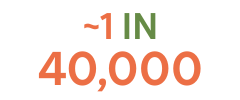
Pan-ethnic, and occurs in ~1 in 40,000 in the general population
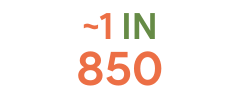
More common in people of Ashkenazi Jewish ancestry

of American Jews are Ashkenazi
Inheritance Pattern of Gaucher Disease
Carriers of Gaucher disease only inherit 1 pathogenic variant in the GBA1 gene and are asymptomatic, but can pass on the disease to their children.2,9 Gaucher disease usually occurs when an individual inherits 2 pathogenic variants within the GBA1 gene, one from each parent.2,9 The disease can be passed down to children in the following ways2,9:
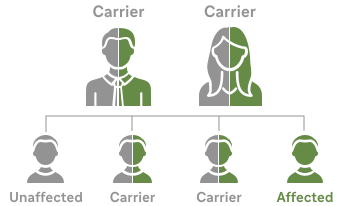
When both parents are carriers, there isa:
- A 50% (1 in 2) chance of a child also being a carrier
- A 25% (1 in 4) chance that a child will have Gaucher disease
- A 25% (1 in 4) chance that a child will be unaffected
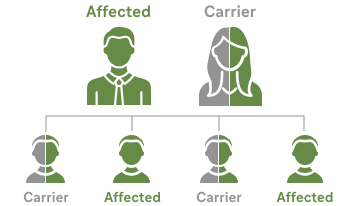
When one parent has Gaucher disease and one is a carrier, there isa:
- A 50% (1 in 2) chance a child will have Gaucher disease
- A 50% (1 in 2) chance of a child being a carrier
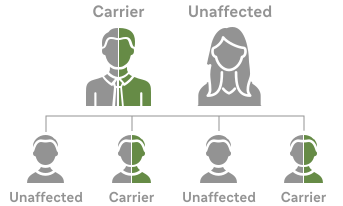
When one parent is a carrier and one is unaffected, there isa:
- A 50% (1 in 2) chance of a child being a carrier
- A 50% (1 in 2) chance of a child being unaffected
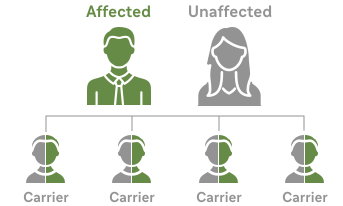
When one parent has Gaucher disease and one is unaffected, there isa:
- A 100% chance of a child being a carrier
aThe probability of having a child with Gaucher disease does not change, no matter how many children the parents have.
GBA1 Gene Variants in Gaucher Disease
The GBA1 gene encodes the acid β-glucosidase (also known as glucocerebrosidase), which plays a vital role in lipid metabolism.1 The enzyme resides mainly in the lysosome, where it breaks down glucosylceramide (also known as GL-1) into glucose and ceramide.10
Pathogenic variants in the GBA1 gene, and consequently a disrupted function of acid β-glucosidase (also known as glucocerebrosidase), cause a buildup of the enzyme's substrate. Glucosylceramide accumulation in cells of the liver, spleen, and bone marrow leads to progressive multiorgan dysfunction and the symptoms of Gaucher disease.10
Over 400 pathogenic variants have been reported to cause Gaucher disease.11,12 Frequently observed variants include N409S (c.1226A < G), 84GG (c.84dupG) and L483P (c.1448T > C ).8 These variants are unequally distributed across different populations.8
Some variants are more frequently associated with certain disease types; for instance, the N409S variant is associated with Gaucher disease type 1, whereas L483P is linked to type 2 and 3.8 Despite these observations, individuals carrying the same variants can show a heterogeneous clinical manifestation of Gaucher disease.8,13 This indicates that other contributing factors influence the clinical presentation of the disease, such as the environment and epigenetic status of the person.13
Help fill the knowledge gaps about Gaucher disease by encouraging your patients to join the Gaucher registry.
Summary Table of Common GBA1 Variants by Population8
| Population | Most prevalent mutations in individuals affected by Gaucher Disease | Disease Association |
| Ashkenazi Jews | N409S (previously known as N370S), 84GG, R496H, IVS2+1 | Mostly type 1 (non-neuronopathic), milder |
| Worldwide | L483P (previously known as L444P), F252I | Types 2 and 3 |
Screening Can Help Get Ahead of Gaucher Disease
Gaucher disease is almost always passed down from birth parents and may affect several members of a family within a single generation.9 Hence, it is important to direct family members to consider testing if their relative has been diagnosed with Gaucher disease. Genetic testing can confirm a diagnosis or that someone is a carrier for Gaucher disease.9
FAQs
What chromosome is affected in Gaucher disease?
The pathogenic variants responsible for Gaucher disease are found on chromosome 1 (1q21), where the gene for acid β-glucosidase (also known as glucocerebrosidase) is located.2
What type of pathogenic variants cause Gaucher disease?
Pathogenic variants in the GBA1 gene lead to Gaucher disease. The condition can be caused by a variety of genetic rearrangements, including missense mutations, nonsense mutations, frameshift mutations, splice-site mutations, insertions, and deletions.12
Is Gaucher disease recessive or dominant?
Gaucher disease is a hereditary autosomal recessive disease.2
Which populations are most affected by Gaucher disease?
Gaucher disease can affect all populations. However, Gaucher disease type 1 has the highest prevalence in individuals of Ashkenazi Jewish heritage, affecting about 1 in 850 Ashkenazi Jewish people.7
References: 1. Stirnemann J, Belmatoug N, Camou F, et al. A review of Gaucher disease pathophysiology, clinical presentation and treatments. Int J Mol Sci. 2017;18(2):441. doi:10.3390/ijms18020441 2. Alaei MR, Tabrizi A, Jafari N, Mozafari H. Gaucher disease: new expanded classification emphasizing neurological features. Iran J Child Neurol. 2019;13(1):7-24. Accessed August 1, 2025. https://pmc.ncbi.nlm.nih.gov/articles/PMC6296697/ 3. Mehta A, Kuter DJ, Salek SS, et al. Presenting signs and patient co-variables in Gaucher disease: outcome of the Gaucher Earlier Diagnosis Consensus (GED-C) Delphi initiative. Intern Med J. 2019;49(5):578-591. doi:10.1111/imj.14156 4. Kishnani PS, Al-Hertani W, Balwani M, et al. Screening, patient identification, evaluation, and treatment in patients with Gaucher disease: Results from a Delphi consensus. Mol Genet Metab. 2022;135(2):154-162. doi:10.1016/j.ymgme.2021.12.009 5. Chaves RG, Coelho JC, Michelin-Tirelli K, et al. Successful screening for Gaucher disease in a high-prevalence population in tabuleiro do Norte (northeastern Brazil): a cross-sectional study. JIMD Rep. 2011;1:73-78. doi:10.1007/8904_2011_19 6. Strom CM, Crossley B, Redman JB, et al. Molecular screening for diseases frequent in Ashkenazi Jews: lessons learned from more than 100,000 tests performed in a commercial laboratory. Genetics in Medicine. 2004;6(3):145-152. doi:10.1097/01.GIM.0000127267.57526.D1 7. Mistry PK, Cappellini MD, Lukina E, et al. A reappraisal of Gaucher disease-diagnosis and disease management algorithms. Am J Hematol. 2011;86(1):110-115. doi:10.1002/ajh.21888 8. Riboldi GM, Di Fonzo AB. GBA, Gaucher disease, and Parkinson’s disease: from genetic to clinic to new therapeutic approaches. Cells. 2019;8(4):364. doi:10.3390/cells8040364 9. Hughes DA, Pastores GM. Gaucher disease. In: GeneReviews®. University of Washington, Seattle; 1993. Accessed July 29, 2025. https://www.ncbi.nlm.nih.gov/books/NBK1269/ 10. Boer DEC, van Smeden J, Bouwstra JA, Aerts JMFG. Glucocerebrosidase: functions in and beyond the lysosome. J Clin Med. 2020;9(3):736. doi:10.3390/jcm9030736 11. Tayebi N, Lichtenberg J, Hertz E, Sidransky E. Is Gauchian genotyping of GBA1 variants reliable? Commun Biol. 2025;8(1):718. doi:10.1038/s42003-025-08059-y 12. Dardis A, Michelakakis H, Rozenfeld P, et al. Patient centered guidelines for the laboratory diagnosis of Gaucher disease type 1. Orphanet J Rare Dis. 2022;17(1):442. doi:10.1186/s13023-022-02573-6 13. Davidson BA, Hassan S, Garcia EJ, Tayebi N, Sidransky E. Exploring genetic modifiers of Gaucher disease: the next horizon. Hum Mutat. 2018;39(12):1739-1751. doi:10.1002/humu.23611
MAT-US-2601792-v1.0-05/2026
