- Artikel
- Bron: Campus Sanofi
- 4 aug 2026
Chronische Rhinosinusitis met Nasale Poliepen (CRSwNP): De verbinding tussen Type 2 Inflammatie en Reukverlies

Verlies van het reukvermogen is een belangrijk symptoom van chronische rhinosinusitis met neuspoliepen en treft tot wel 90% van de patiënten.1,2 Reukverlies, dat leidt tot een aanzienlijke impact op het dagelijks leven en een psychologische ziektelast3, is een belangrijke indicator van type 2-inflammatie4 en kan het eerste teken zijn van een terugkeer van de ziekte.1,2
Type 2 Inflammatie en reukverlies |
- Reukverlies is een van de meest impactvolle symptomen van CRSwNP1,2
- Het heeft een impact op de kwaliteit van leven3 van patiënten en kan zelfs na een operatieaanhouden4
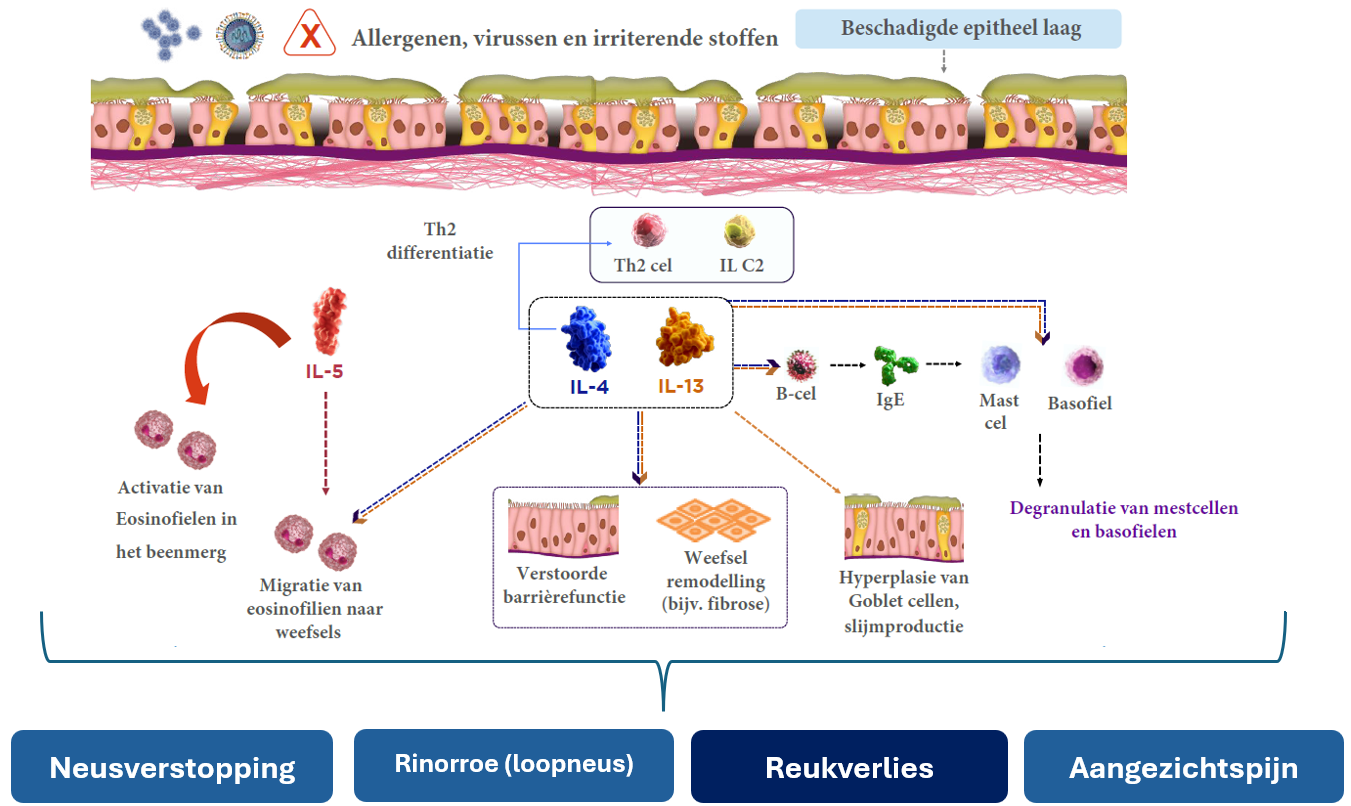
- Type 2 inflammatie kan een rol spelen bij het ontstaan van anosmie of hyposmie5
- Ongeveer 90% van de CRSwNP-patiënten ervaart reukverlies1
- Anosmie of hyposmie kan een teken zijn van een terugkerende ziekte1,2
- De mate van type 2 inflammatie correleert met de ernst van het reukverlies1,2
Reukverlies wordt in verband gebracht met type 2 inflammatie5-9 |
Reukverlies vormt een zware last voor CRSwNP-patiënten1,2 |

Verminderde kwaliteit van leven (HR-QoL)1,10

Dagelijkse activiteiten worden beïnvloed3

Depressie, angst, fobie, vermoeidheid, irritatie, enz.3

Invloed op persoonlijke relaties11

Economische last, verminderde productiviteit12
Reukverbetering als maat voor ziektecontrole |
1 - Internationale richtlijnen
benadrukken het belang van reukverlies als behandeldoel13-14
2 - Evaluatie van het reukvermogen is essentieel
bij de klinische beoordeling van CRS1
3 - Behandeling van reukverlies
Is complex en vereist een multidisciplinaire aanpak19-21
1 - Internationale richtlijnen
benadrukken het belang van reukverlies als behandeldoel13-14
2 - Evaluatie van het reukvermogen is essentieel
bij de klinische beoordeling van CRS1
3 - Behandeling van reukverlies
Is complex en vereist een multidisciplinaire aanpak19-21
Afkortingen
CRS, chronische rhinosinusitis; CRSwNP, chronische rhinosinusitis met nasale poliepen; HR-QoL, gezondheid gerelateerde kwaliteit van leven; QoL, kwaliteit van leven.
Referenties
-
Yan X, et al. Laryngoscope Investig Otolaryngol. 2020;5(6):992-1002;
-
Rouyar A, et al. Allergy. 2019;74(3):549-559;
-
Mullol J, et al. J Allergy Clin Immunol Pract. 2022;10(6):1434-1453.e9;
-
Seys SF, et al. Allergy. 2020;75(11):2867-2878;
-
Dekeyser A, et al. Int J Mol Sci. 2024;25:4460;
-
Bachert C, et al. Front Immunol. 2024;15:1356298;
-
Lee K, et al. Int J Mol Sci. 2021;92:910;
-
Fokkens WJ, et al. Rhinology. 2020;58:1-464;
-
Stevens WW, et al. J Allergy Clin Immunol Pract. 2016;4:565-572;
-
Hopkins C, et al. Otolaryngol Head Neck Surg. 2024;170(4):1173-1182;
-
Patel ZM, et al. Int Forum Allergy Rhinol. 2022;12(4):327-680;
-
Schlosser RJ, et al. Int Forum Allergy Rhinol. 2017;7(1):50-55;
-
Fokkens WJ, et al. Rhinology. 2024;62(3):287-298;
-
Orlandi RR, et al. Int Forum Allergy Rhinol. 2021;11(3):213-739;
-
Rumeau C, et al. Eur Ann Otorhinolaryngol Head Neck Dis. 2016;133(3):203-206;
-
Brumm MC, et al. Neurology. 2023;100(16):e1691-e1701;
-
Mullol J, et al. J Allergy Clin Immunol Pract. 2022;10(4):1086-1095.e5;
-
Doulaptsi M, et al. Clin Transl Allergy. 2018;8:32;
-
Marglani O, et al. J Asthma Allergy. 2023;16:1055-1063;
-
Senna G, et al. Multidiscip Respir Med. 2022;17(1):813;
-
Buchheit KM and Holbrook EH. Chronic rhinosinusitis with nasal polyposis: Management and prognosis. UpToDate. 2023. Available at UpToDate. Last accessed on 28 Aug 2024.
Neem contact op

MAT-NL-2600369 V1.0 - 07/2026