
On this page...
- Alpha-1 antitrypsin deficiency (AATD) imposes an economic and emotional burden3-6
- AATD is associated with increased hospitalizations and healthcare costs compared to chronic obstructive pulmonary disease (COPD) without AATD5,6
- Progression of AATD leads to worsening COPD burden and quality of life7-9
- Emotional burden impacts patients and loved ones who assume the caregiver role3,4
AATD carries a distinct economic burden compared with COPD without AATD5
AATD-related COPD (n=742) carries a greater clinical and economic burden than COPD without AATD (n=7420)5
Pre-Index Pulmonary Events5
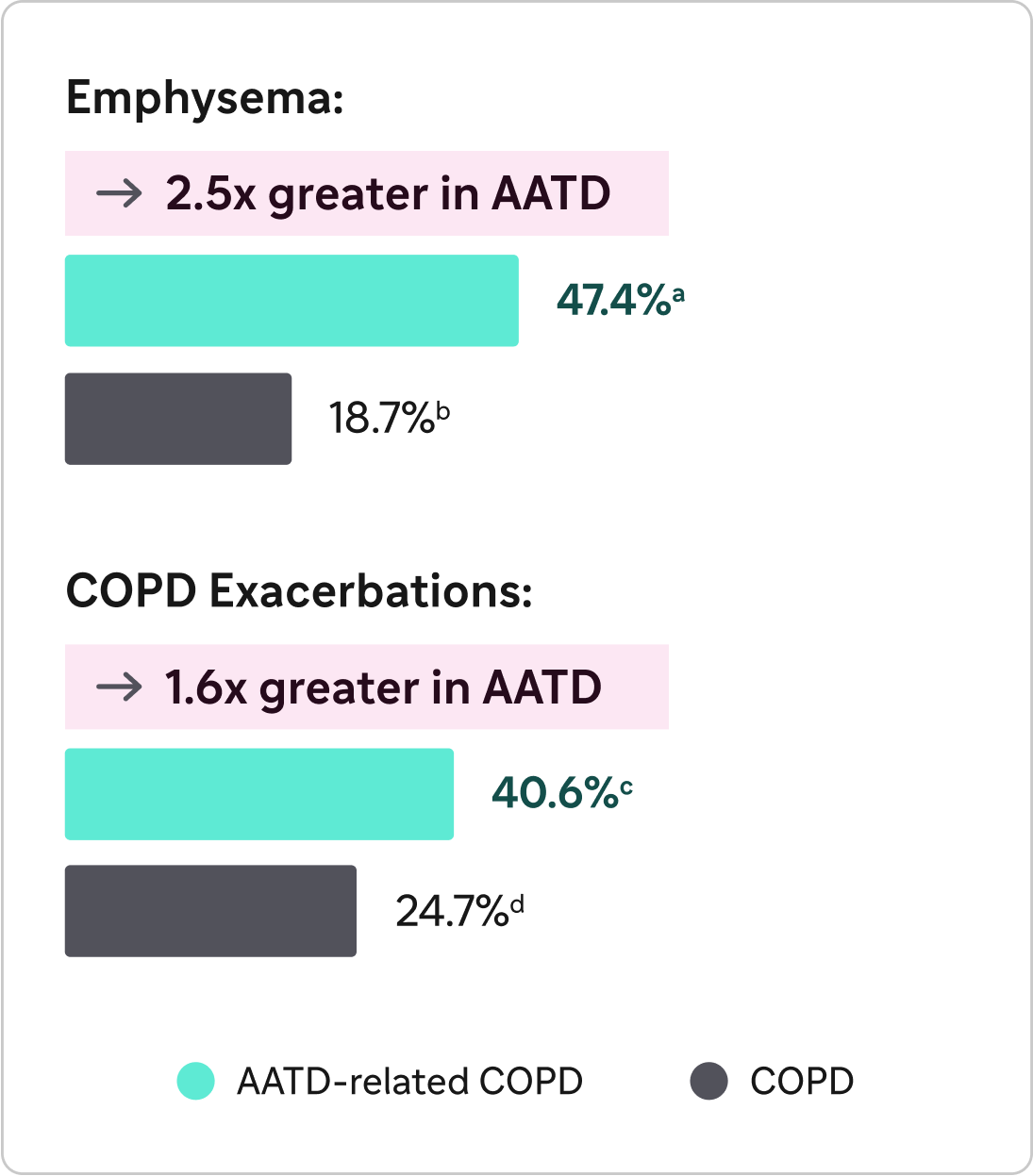
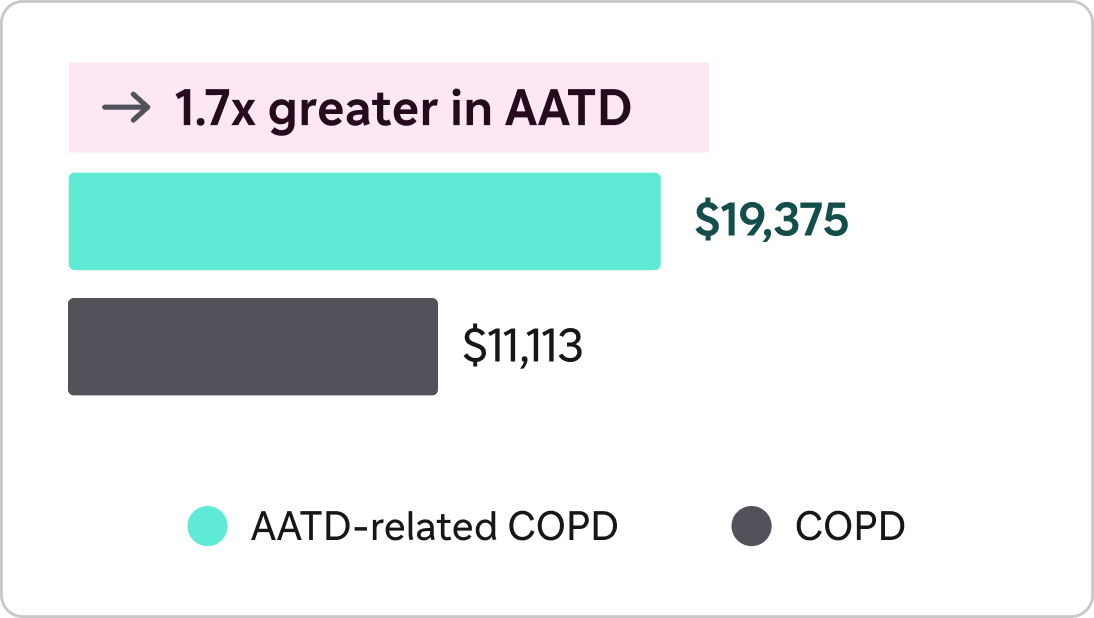
Retrospective observational study using administrative claims data from the Humana Research Database.5
an=352.
bn=1390.
cn=301.
dn=1834.
According to retrospective analyses of claims data5,6:
Higher healthcare utilization and spending underscore the importance of timely identification and management of AATD-related COPD.5,6
Progression of AATD leads to worsening COPD burden and quality of life for patients.7-9
How does AATD impact patients and their family?
The physical and emotional burdens can have a significant impact on quality of life1-4
AATD can negatively impact patients with AATD and their immediate family members1-4




How are caregivers impacted by the burden of AATD?
Caregivers may experience anxiety, stress, and despair as family members struggle with AATD and they may face constraints on their time, which can impact their work and social lives.4

How does the burden of AATD extend to family members?
Family members of patients with AATD may feel guilty that their own genetic makeup may be responsible for passing on the disease, and many report fears for future generations of their family.13
Talk to your patients about how AATD is impacting their daily life to gain a more comprehensive clinical picture.


Frequently asked questions
AATD-related COPD is associated with greater clinical and economic burden than COPD without AATD. This includes higher healthcare utilization, increased exacerbation-related costs, and greater overall resource demand.5,6
Key cost drivers include5,6:
- Higher rates of emphysema-related complications
- Increased frequency and severity of exacerbations
- Greater need for hospitalizations and specialist care
Timely diagnosis allows for5,6:
- Risk factor modification (eg, smoking cessation)
- Implementation of appropriate management strategies
- Potential reduction in exacerbations and hospitalizations
- Mitigation of long-term healthcare costs
Progression of AATD is associated with worsening COPD burden, including increased symptom severity, reduced physical activity, and declining health-related quality of life.1,2,8,9
Definitions: AAT=alpha-1 antitrypsin; AATD=alpha-1 antitrypsin deficiency; COPD=chronic obstructive pulmonary disease.
References: 1. Choate R, Holm KE, Sandhaus RA, et al. Health-related quality of life in alpha-1 antitrypsin deficiency–associated chronic obstructive pulmonary disease. Am J Respir Crit Care Med. 2023;208(10):1132-1134. 2. Choate R, Holm KE, Sandhaus RA, Mannino DM, Strange C. Characteristics associated with SF-36 in alpha-1 antitrypsin deficiency-associated COPD: a cross-sectional analysis. BMC Pulm Med. 2024;24(1):138. doi:10.1186/s12890-024-02953-7 3. American Thoracic Society/European Respiratory Society Statement: Standards for the Diagnosis and Management of Individuals with Alpha-1 Antitrypsin Deficiency. Am J Respir Crit Care Med. 2003;168(7):818-900. 4. U.S. Food and Drug Administration. The Voice of the Patient: Patient-Focused Drug Development for Alpha-1 Antitrypsin Deficiency; Public Meeting September 29, 2015; Report Date September 2016. Silver Spring, MD: U.S. Food and Drug Administration; 2016. 5. Khandelwal N, Hinson J, Nguyen T, et al. Clinical and economic outcomes in patients with alpha-1 antitrypsin deficiency in a US Medicare advantage population. J Health Econ Outcomes Res. 2025;12(1):66-74. 6. Sieluk J, Slejko J, Silverman H, et al. Medical costs of alpha-1 antitrypsin deficiency-associated COPD in the United States. Orphanet J Rare Dis. 2020;15(1):260. 7. Kalfopoulos M, Wetmore K, ElMallah MK. Pathophysiology of alpha-1 antitrypsin lung disease. In: Borel F, Mueller C, eds. Alpha-1 Antitrypsin Deficiency: Methods in Molecular Biology. Humana Press; 2017:9-20. In: Borel F, Mueller C, eds. Humana Press; 2017:9-20. 8. Meseeha M, Sankari A, Attia M. Alpha-1 antitrypsin deficiency. In: StatPearls [Internet]. Accessed March 4, 2026. https://www.ncbi.nlm.nih.gov/books/NBK442030/ 9. Campos MA, Alazemi S, Zhang G, et al. Exacerbations in subjects with alpha-1 antitrypsin deficiency receiving augmentation therapy. Respir Med. 2009:103(10)1532-1539. 10. Stoller JK, Smith P, Yang P, et al. Physical and social impact of alpha-1 antitrypsin deficiency: results of a survey. Cleve Clin J Med. 1994;61(6):461-467. 11. Megenhardt L, Ransdell S, Clark-LoCascio J, et al. Relationship between alpha-1 antitrypsin deficiency and obstructive sleep apnea. Sleep Breath. 2021;25(4):2091-2097. 12. Holm KE, Sandhaus RA, Allison S, et al. Sleep apnea among individuals with alpha-1 antitrypsin deficiency-associated lung disease. Respir Med. 2025;246:108217. 13. Smith DJ, Ellis PR, Turner AM. Exacerbations of lung disease in alpha-1 antitrypsin deficiency. Chronic Obstr Pulm Dis. 2021;8(1):162-176. 14. Mazzuca C, Vitiello L, Travaglini S, et al. Immunological and homeostatic pathways of alpha-1 antitrypsin: a new therapeutic potential. Front Immunol. 2024;15:1443297. doi:10.3389/fimmu.2024.1443297 15. Feitosa PHR, de Oliveira Castellano MVC, da Costa CH, et al. Recommendations for the diagnosis and treatment of alpha-1 antitrypsin deficiency. J Bras Pneumol. 2024;50(5):e20240235. doi:10.36416/1806-3756/e20240235
