
On this page...
- Although genotype is a determinant of risk in alpha-1 antitrypsin deficiency (AATD), behavioral, environmental, and physiological factors also influence this risk1-4
- Smoking and air pollution may accelerate emphysema progression and are associated with increased frequency and duration of COPD (chronic obstructive pulmonary disease) exacerbations1,2,4,5
- Educating patients about risk may support behavior change and improve disease management6,7
What factors beyond genotype and AAT levels can contribute to risk in AATD?
These factors may exacerbate the underlying protease-antiprotease imbalance and contribute to ongoing alveolar injury2,4,8



Smoking can significantly accelerate the rate of lung decline in patients with AATD9
FEV1 % Predicted by Genotype and Smoking Status9,a
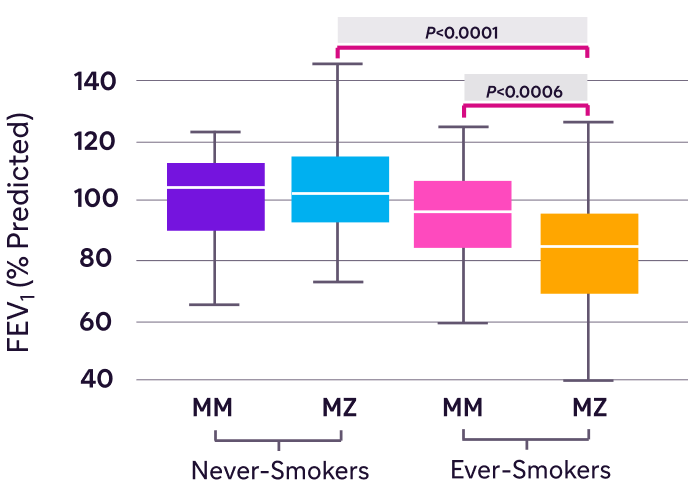
Figure adapted from Molloy K et al. Am J Respir Crit Care Med. 2014;189(4):419-427.
aIncluded 99 individuals with MM genotype and 89 individuals with MZ genotype.
In MZ individuals, FEV1 was significantly lower in ever-smokers compared with never-smokers9
How do smoking and air pollution affect lung decline?
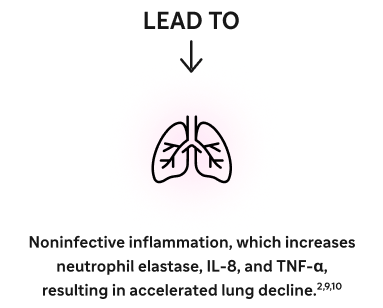
Exposure to smoking and air pollution not only accelerates emphysema but also increases the frequency and duration of COPD exacerbations1,2,4,5


AATD is caused by pathogenic variants of SERPINA1, the gene that encodes the AAT protein. Understanding risk begins with defining the underlying genetics of AATD.4,11,12
Educating patients about their risk of lung decline can drive positive behavioral changes6,7
Talk to your patients about the behavioral and environmental factors that could be contributing to their AATD risks.1,2,4,5


Frequently asked questions
In addition to genetic determinants and circulating AAT levels, behavioral, environmental, and physiological factors contribute to disease risk by exacerbating protease–antiprotease imbalance and promoting ongoing alveolar injury. These include smoking, air pollution, occupational exposures, and respiratory infections.1-3
Clinicians should advise patients to1,2:
- Avoid smoking and secondhand smoke
- Minimize exposure to air pollution and occupational irritants
- Use appropriate protective measures in high-risk environments
Management should include4,5,17:
- Preventive counseling (especially smoking cessation)
- Monitoring for lung function decline and exacerbations
- Consideration of guideline-directed therapies as appropriate
Definitions: AAT=alpha-1 antitrypsin; AATD=alpha-1 antitrypsin deficiency; COPD=chronic obstructive pulmonary disease; FEV1=forced expiratory volume in one second; IL=interleukin; TNF=tumor necrosis factor.
References: 1. Torres-Durán M, Lopez-Campos JL, Barrecheguren M, et al. Alpha-1 antitrypsin deficiency: outstanding questions and future directions. Orphanet J Rare Dis. 2018;13(1):114. doi:10.1186/s13023-018-0856-9 2. Wang T, Shuai P, Wang Q, et al. α‑1 Antitrypsin is a potential target of inflammation and immunomodulation (Review). Mol Med Rep. 2025;31(4):107. doi:10.3892/mmr.2025.13472 3. Kokturk N, Khodayari N, Lascano J, et al. Lung inflammation in alpha‑1‑antitrypsin deficient individuals with normal lung function. Respir Res. 2023;24(1):40. 4. American Thoracic Society/European Respiratory Society Statement: Standards for the Diagnosis and Management of Individuals with Alpha-1 Antitrypsin Deficiency. Am J Respir Crit Care Med. 2003;168(7):818-900. 5. Global Initiative for Chronic Obstructive Lung Disease. GOLD Report. Accessed April 14, 2026. https://goldcopd.org 6. Roche SM, Carroll TP, Fraughen DD, et al. Alpha-1 antitrypsin deficiency and smoking cessation. Chest. 2023;163(4):e197. 7. Franciosi AN, Ralph J, O'Farrell NJ, et al. Alpha-1 antitrypsin deficiency–associated panniculitis. COPD. 2021;18(1):76-82. 8. Barjaktarevic I, Campos M. Management of lung disease in alpha-1 antitrypsin deficiency: what we do and what we do not know. Ther Adv Chron Dis. 2021;12:49-63. 9. Molloy K, Hersh CP, Morris VB, et al. Clarification of the risk of chronic obstructive pulmonary disease in α1-antitrypsin deficiency PiMZ heterozygotes. Am J Respir Crit Care Med. 2014;189(4):419-427. Am J Respir Crit Care Med. 2014;189(4):419-427. 10. Smith RA, Wienke S, Coffman DL. Alpha-1 couples: interpersonal and intrapersonal predictors of spousal communication and stress. J Genet Couns. 2014;23(2):212-220. 11. Cazzola M, Stolz D, Rogliani P, Matera MG. α1-Antitrypsin deficiency and chronic respiratory disorders. Eur Respir Rev. 2020;29(155):190073. doi:10.1183/16000617.0073-2019 12. Feitosa PHR, Castellano MVC, da Costa CH, et al. Recommendations for the diagnosis and treatment of alpha-1 antitrypsin deficiency. J Bras Pneumol. 2024;50(5):e20240235. 13. Vijayasaratha K, Stockley RA. Reported and unreported exacerbations of COPD: analysis by diary cards. Chest. 2008;133(1):34-41. 14. Donaldson GC, Seemungal TA, Patel IS, Lloyd-Owen SJ, Wilkinson TM, Wedzicha JA. Longitudinal changes in the nature, severity and frequency of COPD exacerbations. Eur Respir J. 2003;22(6):931-936. doi:10.1183/09031936.03.00038303 15. Stoller JK, Tomashefski J Jr, Crystal RG, et al. Mortality in individuals with severe deficiency of α1-antitrypsin: findings from the National Heart, Lung, and Blood Institute Registry. Chest. 2005;127(4):1196-1204. 16. Wahlin S, Widman L, Hagström H. Epidemiology and outcomes of alpha-1 antitrypsin deficiency in Sweden 2002-2020: a population-based cohort study of 2286 individuals. J Intern Med. 2025;297(3):300-311. 17. Sandhaus RA, Turino G, Brantly ML, et al. The diagnosis and management of alpha-1 antitrypsin deficiency in the adult. Chron Obstr Pulm Dis. 2016;3(3):668-682.
